Isopods Gone Wild

Benidorm is a seaside city on Spain’s eastern coast, famous for its long sandy beaches, striking skyline of high-rise hotels and lively nightlife. I’ve never been there, but it sounds like a lovely place to vacation.

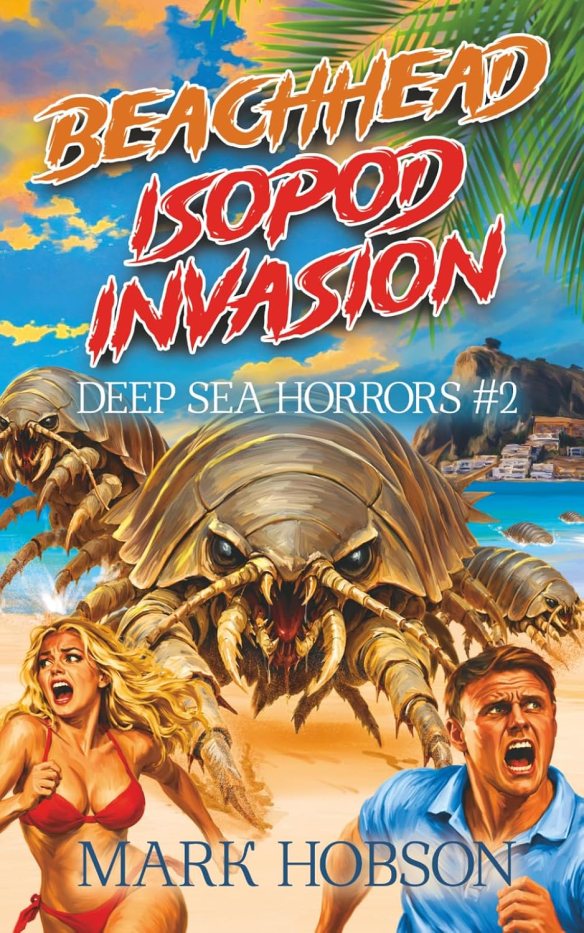
That idyllic picture changed dramatically when giant prehistoric-looking crustaceans were spotted in the Mediterranean Sea. The shallows along the coast appeared alive—no longer a sea, but a moving carpet of armored bodies stretching from one end of the bay to the other. “The scene possessed a strange grandeur,” said author Mark Hobson, “biblical in scale, as if one of the ancient plagues had returned.”

Once on land, the mutant isopods moved methodically and with a peculiar mechanical precision. Up close they looked like something that didn’t belong in any version of the world we lived in.

The ensuing destruction in Benidorm was devastating. It was as if the creatures had emerged with a purpose—to reclaim the city’s shoreline and declare war on humanity.

Mark Ellison, on vacation with his two preteen kids, jumped into action right away. With just a hand axe, he somehow found a way to slice open a seven-foot-long isopod covered in segmented armor plates that overlapped like a medieval cuirass.

Impressed with his martial prowess, the authorities recruited Mark for further crustacean-bashing duties. And that, for better or worse, was how he became the reluctant hero of Beachhead isopod Invasion. He spends the rest of the novel killing isopods, protecting his kids and pining for his hotel’s sexy customer rep.

There’s an assortment of oddball characters caught up in the maelstrom of the Benidorm invasion. In fact, the novel’s opening is similar to a random episode of The White Lotus (or perhaps The Love Boat or Fantasy Island).

Possibly my favorite character of them all is Jodie Vale. When she’s first introduced, she’s portrayed as a silly flibbertigibbet—a cute but vapid TikTok content creator documenting her vacation and trying to attract as many followers and likes as possible.

But later, Jodie discovers a connection between the mutant crustaceans and a local company illegally dumping biohazard muck into the surrounding bay. “This is one of those things governments and large corporations cover up,” she realizes. “Just like Area 51 but … wetter. Deep-sea experiments, toxic waste, monsters—pick your own storyline, honestly.”

At this point Jodie isn’t simply watching the story unfold; she’s become a central player in it. A half-million viewers watch as she puts the pieces together IRL.

Initially, she was just a cipher representing a generation of navel-gazing social media creators. But in the end, she gains my respect by reinventing herself as an unlikely investigative journalist. Her character arc is a pleasant surprise.

[ Beachhead Isopod Invasion / By Mark Hobson / First Printing: October 2026 / ISBN: 9798177921853 ]
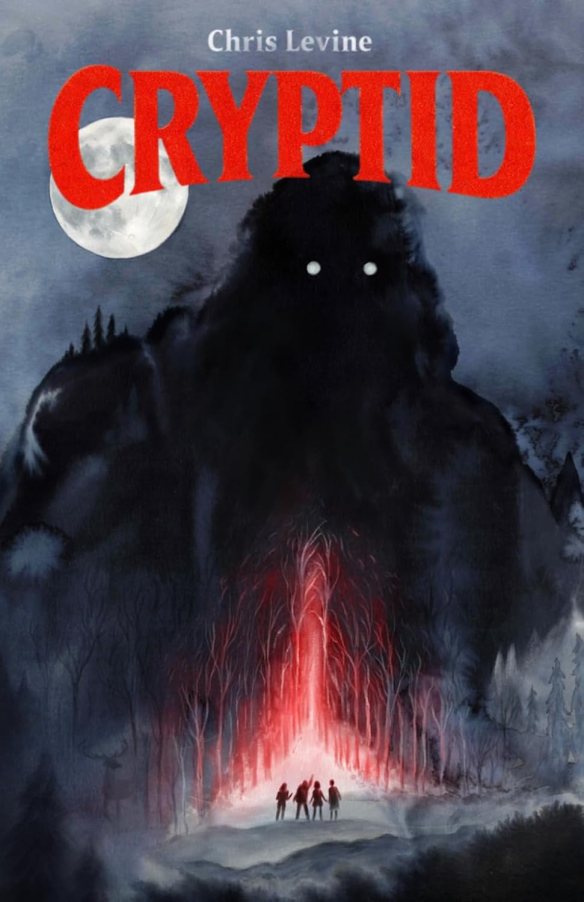
The Abominable Bigfoot

Blake was just a small child when he saw his first bigfoot. Standing in the middle of a deserted highway at night, the beast towered well over eight feet. Its body was bent at an unnatural angle, as if its bones had been torn apart and reassembled incorrectly.

Its face was human, but not exactly. The structure suggested a man’s features, yet everything was slightly distorted and stretched over a skull that didn’t quite fit. Its mouth hung slightly open, revealing teeth that looked more suited for tearing flesh than chewing food.

The beast watched Blake and his family pass, its gaze following their car with an unsettling intensity. Even as a young boy, Blake felt like he was trespassing on territory the creature considered its own.

For the next 20 years, Blake lived with the memory of that profound moment. “I’ve spent my entire life afraid of something no one else believes in,” he told his wife. He swore to himself that he would avoid the nearby woods where bigfoot called home.

But Blake couldn’t escape the contrived narrative of genre fiction forever. He and his wife Jessica (along with their friends Kyle and Norah) make the ill-fated decision to spend a long weekend hiking and camping in a national park lousy with apemen.

Once in the wilderness, the foursome are relentlessly harassed by a handful of cryptid beasts. If you’re reading with your eyes wide open, you’ll be able to predict how Chris Levine’s novel ends pretty easily. The signposting was overt.

That’s okay with me, however; atmosphere was all that mattered here. Tone and color. Vibe over verisimilitude. The ensuing bigfoot violence was just an articulation of nature’s indifference to humanity.

For example, when the apemen finally attacked, the forest gave no sign that it cared one way or another. A nearby river flowed leisurely through the trees; its calmness seemed cruel as wind stirred the branches above, carrying the tang of blood.

Near the end of the novel, Blake’s wife was captured and taken to a mountain cavern. This was the first time she was able to see the creatures clearly. Despite their grotesque semblance to humanity, she saw intelligence and deliberate purpose in their eyes. Standing above her, the monolithic figures inhaled her scent and dissected her with their gaze. She knew immediately that what they wanted from her was worse than death.

[ Cryptid / By Chris Levine / First Printing: October 2026 / ISBN: 9798905040474 ]

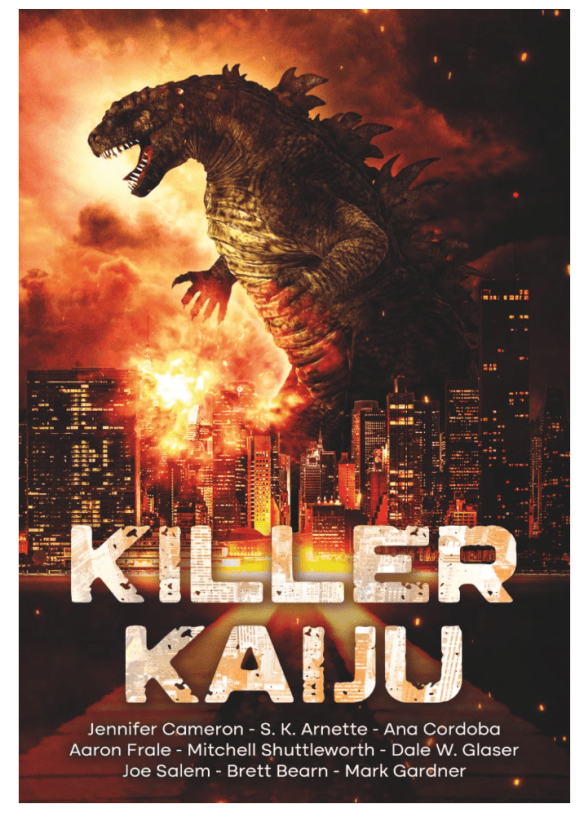
Killer Kaiju Stomp

I wouldn’t blame anyone for abandoning this anthology after reading the first three stories. The editor’s sequencing choices are questionable enough, but the quality of these selections raises even greater concerns. One story, in particular, doesn’t even meet professional publishing standards.

It’s a weak and disappointing start, no doubt about it. But don’t give up. The collection rebounds nicely, giving fans of kaiju fiction a bunch of smart and unique stories to enjoy.

Things get on the right track with a story called “Kaiju Rodeo” by Aaron Frale. It’s not unlike a crazy Dog Man adventure in which Petey the Cat combines aerosol cans of “Living Spray” and “Cannery Grow” to create giant anthropomorphic monsters out of boats, buildings and household appliances. It’s funny and absurd, and I’m sure Dog Man creator Dav Pilkey would get a kick out of it.

“The Story for the Monstrous Age” by Mitchell Shuttleworth follows an ambitious reporter who survives a thunderous “megafauna” battle in Boston. After witnessing the devastating power of colossal monsters, she’s certain that she’ll become some type of guru or cult leader. Fittingly, the story’s No Hope-like ending is her sad reward.

“Where Monsters Make Their Lairs” by Dale W. Glaser features two fictional characters who crave agency beyond the control of their creators. To achieve this, they embark on a “mad monster hunt,” seeking an adventure that will transcend their source material. I’m happy to say that they get exactly what they want.

There are other excellent stories as well, but editor Sarah Arnette saves the anthology’s strongest effort for last. “Harmonic Depth” by Mark Gardner is a first-contact story set at the bottom of the ocean. The author uses elliptical language to describe the conversation between the abyssal artifact and the seafaring adventurers. Depending on your perspective, it’s either artfully subtle or maddeningly confusing. Personally, I liked it very much.

Anyone who listens to ambient or experimental electronic music will appreciate Gardner’s efforts to describe the indescribable. If you’ve read music reviews on bleep.com, igloomag.com, or even disquiet.com, you’ll know exactly what I mean.

Gardner describes the alien’s voice as having “an intricate, fractal-like pattern, too deliberate to be noise.” At some point, the tone shifts. What initially sounds like a single voice becomes a chorus—voices layered on top of one another, overlapping and resonating at frequencies that don’t make sense. The sound persists until the only thing left is an endless wave of noise.

When the artifact eventually reveals itself, its surface pulses in sync with a resounding waveform of sharp peaks and deep valleys forming a network that stretches deeper into the abyss. “It was no longer just an object,” explains Gardner. “It was alive, a force that pulsed with an energy beyond comprehension.”

[ Killer Kaiju / Edited by Sarah Arnette / First Printing: March 2026 / ISBN: 9788253665701 ]

Lightning Claw

Australia was a wild, raw and dangerous place back in the late 19th century. It was a young settler society that lacked urbanization and infrastructure; a land prone to floods and bushfires, and filled with spiders, crocodiles, snakes and dinosaurs. 

These days, most Australians have only seen captive-bred dinosaurs in a circus or a zoo. But back then, Australovenators and other giant lizards roamed the bush alongside sheep, koalas and kangaroos. 

The biggest and most feared dinosaur species of them all was the Lightning Claw. From nose to tail, they were more than 20 feet in length and nearly six feet tall at the hip. Their faces were slender-jawed and flattened like those of a crocodile. Their teeth were long, and their talons were shaped like butcher knives curved into hooks. When they hissed, the sound they made was louder than a steam engine. 

Unprovoked, dinosaurs generally stayed away from people. But when they went rogue due to extraordinary circumstances, they would come out of the bush and terrorize remote settlements and townships. 

Recently, a rogue Lightning Claw had come to the township of Smithy’s Creek. Desperate to get rid of the beast, the local citizenry hired a professional lizard killer. Jim Vandebus’s fee was exorbitant, but he had the reputation of being the best dinosaur hunter in Australia. 

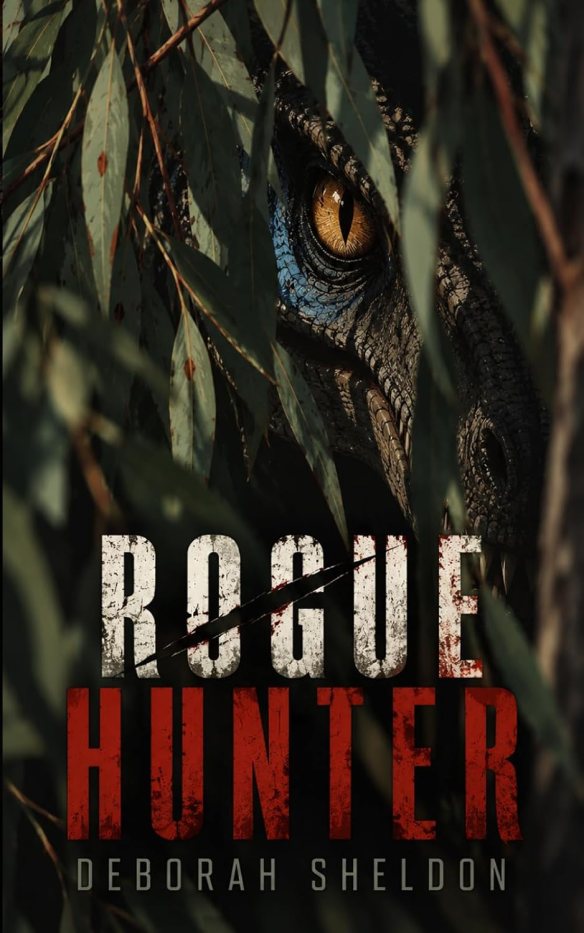
Fourteen-year-old Edwin “Winny” Callaghan witnessed the Lightning Claw kill (and eat!) his mother on Christmas Eve. He was consumed with vengeance and was anxious to join Vandebus and his crew on their upcoming expedition. Rogue Hunter is Edwin’s personal memoir, written 60 years after the fact, of his dinosaur-hunting adventure.

Initially, the quest for the Lightning Claw felt like a leisurely camping holiday to Edwin. He was captivated night after night by the beauty of nature and the congenial company of Vandebus. During these quiet times, he imagined a future in which he became Vandebus’s faithful partner and followed him into dangerous corners of the world. 

That wistfulness disappeared quickly when Edwin came face to face with the giant lizard for the first time. The vision of the beast was so fantastical and otherworldly that he thought to himself, How could a young boy with a .22 rifle kill such a monster?

What happened next completely altered the boy’s perception of man-eating dinosaurs forever. He and the rest of Vandebus’s entourage witnessed something amazing, something that no one—at least, no one alive—had ever seen before. It was so profound that Edwin would dedicate the rest of his life to the memory of the Lightning Claw.

Author Deborah Sheldon (with help from Edwin Callaghan) has written a nice little coming-of-age story about a big monster, a big-hearted monster hunter and one boy’s baptism into manhood. Good job. 

[ Rogue Hunter / By Deborah Sheldon / First Printing: September 2026 / ISBN: 9781923663558 ]

The Ultimate Unknown

Monsters from space are awesome because they embody the ultimate unknown. Here on Earth, we Earthicans have a pretty good idea of what lurks in the shadows. But in outer space, the possibilities are practically endless. 

A cosmic creature could have evolved from an environment with completely different biological origins. Who knows what’s out there? Translucent monsters, biomechanical nightmares, enormous tentacled things, crystalline organisms, insectoid predators—there could literally be a gazillion variants in the omniverse. 

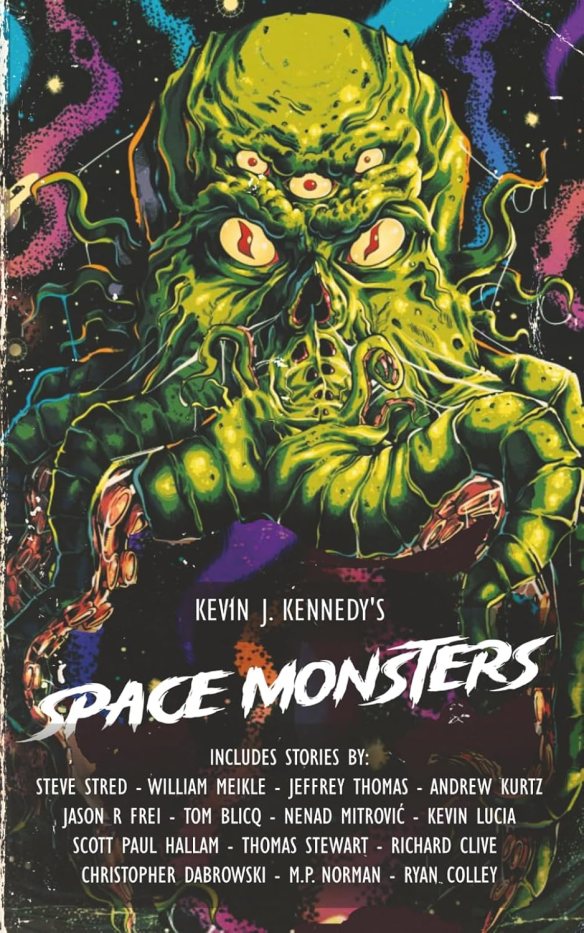
And that, more or less, is the premise of Space Monsters, the new short story compilation from editors Kevin J. Kennedy and Ann Keeran. There are monsters In outer space, the coeditors assert, and they’re all utterly incomprehensible. 

The two most enigmatic creatures come from authors Jeffrey Thomas and Ryan Colley. “Monsters,” the book’s first story, is about a hotshot surgeon who performs reconstructive surgery on a “the most hideous sentient life form he’s ever set eyes upon.”

Things spin out of control quickly when the creature’s parents object to the results of the surgery. To complicate matters further, there seems to be some sort of attraction between the surgeon and his patient. During the procedure the doctor experiences the stirring prelude to his own sexual arousal. He can’t help but wonder what it would be like to press his body against her ardently.

In Colley’s story, “The Grave Between the Stars,” a spaceship from Earth becomes one of many dead vessels in a floating, celestial graveyard. The crew eventually discovers a group of hexapedal survivors aboard a nearby ship. 

Despite the litany of science fiction stories extolling the profound experience of first contact, this one offers no transcendental moments to speak of. I might even describe it as mundane. Humanity’s first meeting with another intelligent life form takes place in a junkyard of broken spaceships. The two species fail to exchange any meaningful information and learn almost nothing about each other. “They just did what was necessary to survive,” says the author. 

Other monsters include JOURA, the space baby; alien parasites that squeal like fangirls at Comic-Con; serpentine cave dwellers; Borg-like mechano-slime cephalopods; a giant disembodied head from Mohawk tradition; alien insects who insist on conducting cruel psychological experiments on humans; a supreme force of nature called the Gluttonous Star; the manifestation of eternity; and space monsters who strike a deal with politicians, bankers and greedy corporate owners to rule the world.

And finally, there are two stories in this book about quivering globs of extraterrestrial protoplasm. If you know anything about me, you know that I unequivocally love all blobs. In fact, I wish more authors would sit down and write more stories about these undulating, shapeshifting, pulsating things. If you do, I promise that I’ll read your novel and give it a great review.

[ Space Monsters / Edited by Kevin J. Kennedy & Ann Keeran / First Printing: September 2026 / ISBN: 97881772558283 ]

The Wood Apes of Wildcat Thicket

Lagoe, Texas, was classified as a disappearing community; a ghost town in the making. Main Street was lined with buildings that had been empty for 40+ years. Like a lot of rural towns in the U.S., it was destroyed during an economic apocalypse in the 80s and sputtered along on life support ever since.

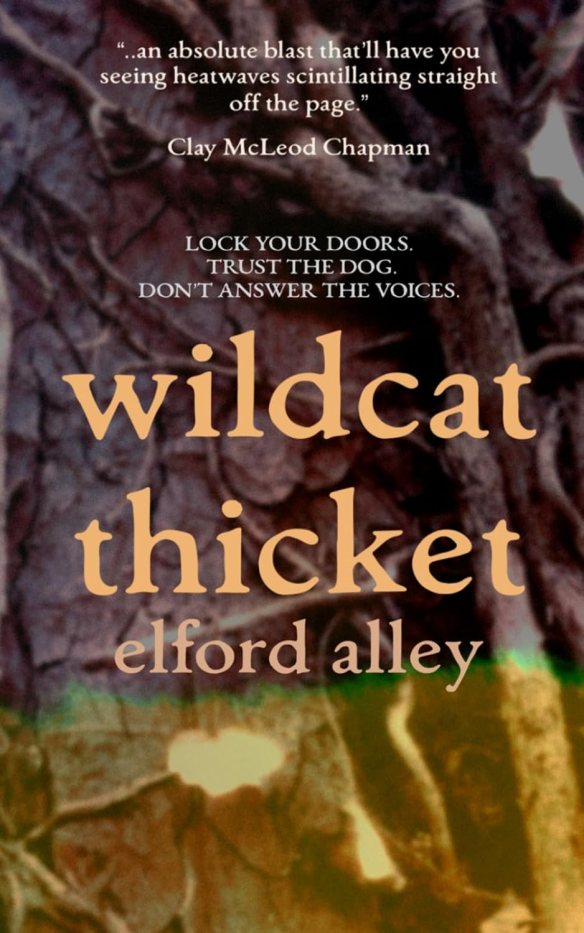
The most interesting thing about Lagoe was the dense flora surrounding the small rural townlet. Known locally as Wildcat Thicket, it was a mecca for weirdness—a place where outlaws could lose themselves and monsters could hide. Said a local reporter: “No one hunts there. No trails. Hell, no one is even willing to set up a meth lab there.”

Citizens knew something profound was hidden in the bramble—things that couldn’t stay hidden such as giant angry birds, Bigfoot and lions from the Stone Age. “The wild places were shrinking and there were fewer shadows for monsters to hide.”

In these early pages, author Elford Alley does a nice job of describing the quirks of the thicket and its continuing influence on the people living in Lagoe. The briar was so entangled in community culture, for example, that a prehistoric lion (specifically a Panthera atrox) was the school’s proud mascot. Only later does Wildcat Thicket explode into absolute chaos.

One man who lived in the middle of the thicket kept a journal of what he saw. The “wood apes” interested him the most. “They all ranged from six to seven feet in height,” he wrote. “They made sounds, whoops and screams. One of them even mimicked human laughter that sounded like a well-worn tape recording.” They were apes, he concluded. Animals. Nothing supernatural about them. Just wood apes.

But he was wrong—they were more than just apes. They had a primitive intelligence that went beyond human comprehension. Ryder and Erin, two people living in a travel trailer close to the thicket, suspected that these elusive ape-men were up to something sneaky. One way or another, they were determined to find out what it was. 

Ryder entered the thicket and quickly came face to face with a lone ape-man. It didn’t go well. “The creatures had the face of an ape,” he thought, “but there was human intelligence and cruelty in it’s eyes.” Meanwhile, Erin had her own problems to worry about. She was in the thicket doing her best to evade the giant prehistoric lion that was stalking her. 

Ryder and Erin survived their adventure and eventually discovered the mystery of the wood apes. There’s an improbable twist at the end of the novel that’s both tragic and romantic at the same time. I guarantee that you’ll go back and reread the prologue once you finish the book. I did, and it was well worth it.  

[ Wildcat Thicket / By Elford Alley / First Printing: April 2026 / ISBN: 9798296505651 ]

Disease X

I can totally understand why Aron Beauregard chose a horsefly to be the monster in his latest creature feature book. Not only are they big and ugly and gross, but the bite of a female horsefly really, really hurts—they’ll slice you open for a bloody meal. “I lived on a farm growing up and became a bit of a bug nerd,” said one character. “Bugs were my friends. Well, not the horseflies. They sucked.”

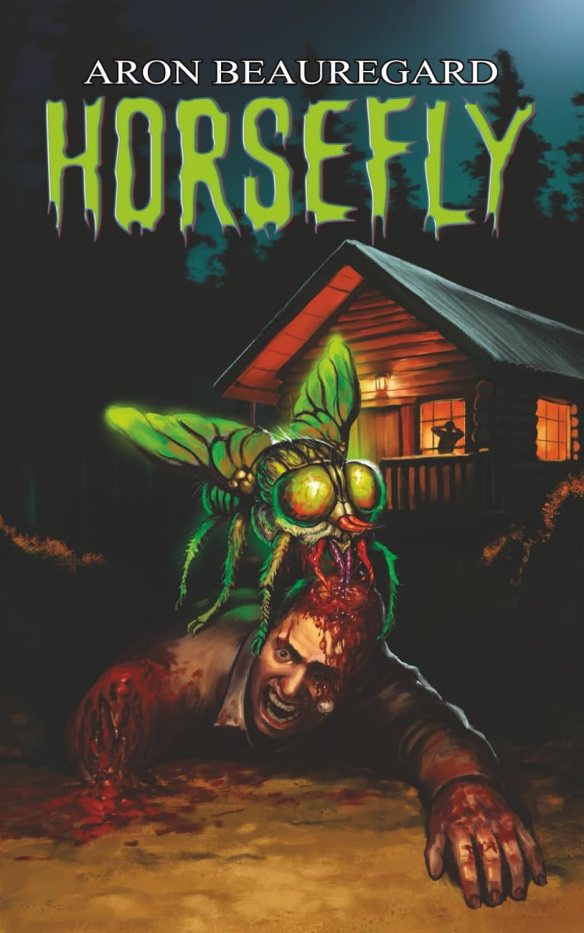
Now imagine a genetically modified horsefly the size of a pit bull. Its mandibles—like a pair of serrated mouth-swords, vibrating with the fury of jackhammers and capable of cutting a human in half “like a poop-knife through diarrhea.”

The giant horsefly was created in a laboratory and infected with Disease X. With a secret proprietary vaccine already in the bag, the pharmaceutical company wanted to start a pandemic that only they could cure. Too bad the bug went rogue and escaped into Connecticut’s Mount Archer Woods. 

Disease X gave the mutant horsefly a twisted kind of sentience. No longer was it simply concerned with survival and nourishment. It wanted to inflict pain on every other species it encountered. 

But more than that, it began to ponder the mysteries of its existence. God, it believed, had chosen it to bring about a new way of life—to be a soldier and advance its genus into the next phase of existence. As you’d expect, the horsefly carried forth the word of God in the most violent way imaginable. Nothing could stop it’s bloody crusade, according to the author. 

In short order, the monster attacked a family taking a vacation in the woods. Later, it descended upon a neighboring horse farm. Things got exponentially more complicated when the horsefly started harassing a cabin full of frisky swingers.

All these freewheelin’ libertines wanted to do was chill, get drunk and hook up. They never thought they’d be caught on the front lines of a horsefly invasion. 

One by one, the giant fly attacked the group. The ones it didn’t kill became infected apostles of God’s will. Without a doubt, the most fervent convert was Ruben Alto.

Even though he was a charismatic and good-looking fellow, Ruben had done lots of horrible things in his life. But now, after being infected with Disease X, he suddenly hungered to be worse than he’d ever been before. “He sensed the thirst for carnage rumbling in his heart,” said the author, “and he felt manic like a windup doll that had been fully cranked.”

Ruben’s behavior manifested itself in surprisingly psychosexual ways. Not only was he on a violent rampage, but he was horny as hell. For example, when he spotted the desecrated corpse of his cabin mate on the kitchen table, his red eyes glowed with lust and rage. What came next was both gooey and absurd. 

The scene ends when a park ranger stumbles upon Ruben’s rancid lovemaking. “Sick fuck,” he sputtered. “You didn’t even have the decency to use a rubber.”

[ Horsefly / By Aron Beauregard / First Printing May 2026 / ISBN: 9781961758957 ]

The Aboriginal Devil

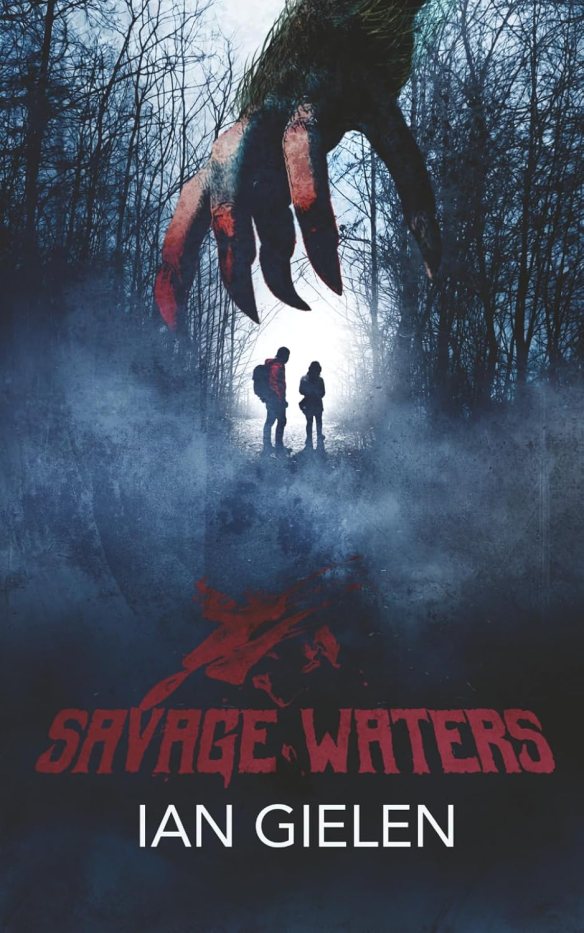
Author Ian Gielen dedicates his latest novel Savage Waters to “all those who desperately want cryptids to be real,” and then proceeds to unleash a cryptid so ferocious that it makes you grateful these creatures exist only in myth.

Whether Gielen is being sincere or a smartass, I don’t know. But the fact remains that the Aboriginal beast in this novel is a terrifyingly aggressive brute. “Ten feet tall,” says Gielen. “A wall of fur and muscle built for death.”

It all starts when random hikers start disappearing while exploring Kakadu National Park in Australia’s Northern Territory. The military gets involved when they discover a photo of a bear-ape-like creature in the area. 

A team of mercenaries with extensive military experience is ultimately hired and dispatched to the park. Their mission is clear: They will deploy to Kakadu, locate the source of these incidents, identify the threat and neutralize it if necessary.

Deep within the Northern Territory’s wetlands, the members of Apex Defense Services were on high alert. They could hear a deep, heavy growl dripping with primal menace coming from the nearby trees. It was a sound that no crocodile, wild pig or water buffalo could ever make. 

It was a bunyip, of course. A creature from Aboriginal folklore whose name basically means “devil.” As a semi-aquatic animal, the bunyip usually lives close to waterholes, rivers, swamps and billabongs. But now, as Australia’s rainy seasons get shorter, its habitat was getting hotter and hotter. The bunyip was looking for a new place to hunt and call home. 

By the end of Part One, the bunyip kills the presumptive hero and efficiently annihilates most of the remaining government mercenaries. 

But hold on—the story doesn’t end there. In Part Two of Savage Waters, a couple of cryptozoologists from New York travel to Kakadu Park to investigate the bunyip’s recent activities. Ray and Kate figure that if they can get a video of the creature, fame and fortune will come their way. 

As luck would have it, the plucky pair of cryptid investigators come face to face with the bunyip after just a few short days in the wetlands. The beast is freakin’ enormous, says the author. Towering above them, Its body is compact and powerful, resembling a monstrous pit bull that had been sculpted from someone’s worst nightmare. Four huge fangs protruded from its cavernous mouth, and its four powerful limbs ending in paws ripped with wicked, razor-sharp claws. Curved, pointed bones ran up and down its spine and whip-like tail.

Before the novel ends, Ray and Kate (along with the surviving members of Apex Defense Services) share a terrifying moment in the bunyip’s bone-filled cave. How does it turn out? No spoilers from me, but I will say this: Author Gielen is already planning to write an upcoming sequel. 

[ Savage Waters / By Ian Gielen / First Printing: August 2026 / ISBN: 9781764012645 ]

Draw the Line

Unlike Harold and his famous purple crayon, 15-year-old Baylor Jenkins needed help from a magical spellbook to bring her scribbles to life. 

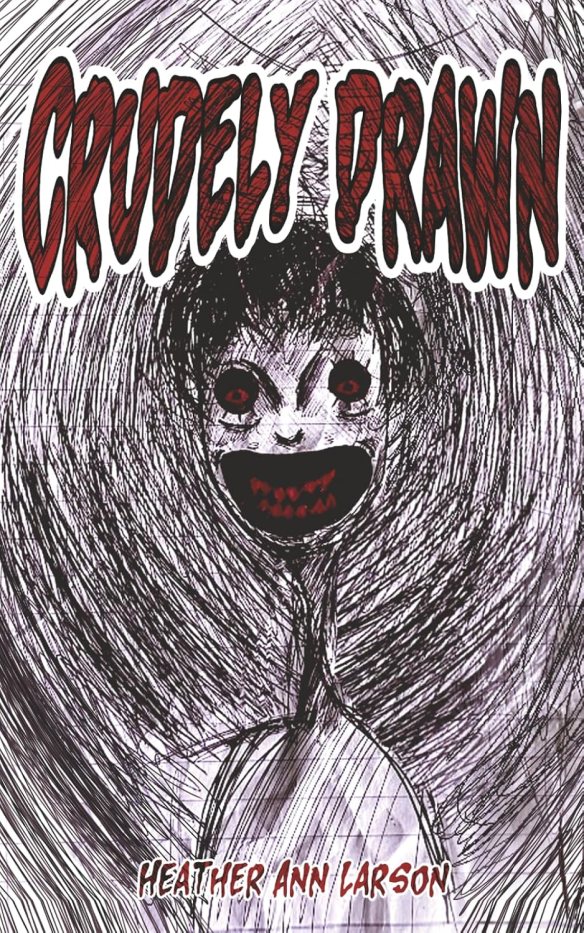
Being a morose kid, Baylor wasn’t drawing flowers, rainbows, kittens or anime girls in cute outfits. Instead, she uncapped her black Sharpie and drew the kind of things you’d expect to find scrawled in the margins of a metalhead’s high school math textbook—mostly monsters with gaping mouths, sharp teeth and rippling gray eyes.

Baylor used her grimoire to help her write a hex that would bring her doodle monsters to life. “Rules be damned,” she wrote, “give these creatures life. Let this curse take hold and cure my strife.” Admittedly, the spell was kind of dumb, but give credit to author Heather Ann Larson for capturing the awkwardness of bad teenage poetry. 

Surprisingly, Baylor’s malefice was successful, and the monsters in her sketchbook sprang to life. Before the night was over, one of her parents was eaten (!!) and her little sister Ruby slipped into a catatonic state that would last for the next 15 years. 

Now the crudely drawn things were back. In fact, they never really went away. Even Baylor’s coworkers could tell something was haunting her. “There was something in the air,” thought Bill, her best friend and colleague, “a wavy aura surrounding her that was dark, foreboding and gave off the stench of a rotting corpse.” Peripherally, he caught a glimpse of movement in Baylor’s office. It almost looked like a kid had taken a Sharpie to her wall.

Pretty soon, Baylor was having explicit nightmares. The abominations even dragged Ruby (now 20 years old) into their sketchpad domain. It was all too much for her to handle. How the hell could she defeat a drawing, she wondered. Baylor knew she couldn’t do it alone. 

Thankfully, her coworker and a concerned police detective rushed to her rescue. Unbeknownst to her, they both had preternatural superpowers. Bill had synesthesia, an acute perceptual intuition, and, like a dowsing rod, Detective Elliot Wolfe had the ability to find hidden things. 

Which leads me to the one major criticism I have of Crudely Drawn. According to the author, Baylor had a “small amount of power.” In addition, her coworker had superpowers, the police detective also had superpowers and her sister was a telepath. Sheesh! It’s just too much. I’m sure I’ve got powers. And I bet you do too. Everybody’s got superpowers!

But I quibble. Despite some missteps, Larson has written an entertaining and creepy little story. It’s obvious to me that the author is at the beginning of her writerly journey. Give her some time. I predict good things from her in the future. 

[ Crudely Drawn / By Heather Ann Larson / First Printing / August 2026 / ISBN: 9798187276158 ]

Everlasting and Eternal

Here’s a personal request for all writers walking the thin line between pulp fiction and comic books: At the very beginning of the process, when rendering the main characters of the story, please give some consideration to creating a villain who is simply a disembodied brain floating in a jar of formalin. 

Talking brains are the best, amirite? Still to this day, I remember watching the movie Donovan’s Brain and being shocked by the image of a “talking” cerebrum suspended in a laboratory container. Various episodes of The Simpsons and Futurama have also used this iconic image to great effect. 

There’s a fun story in Monster Aristocracy, a new compilation from editors Dan Brereton, Allison Pang and James A. Moore (RIP), that unabashedly uses the disembodied brain trope with gusto—and I’m all for it. 

Author Thomas E. Sniegoski revisits his character Grim Death (with the help of Jeannine S. Acheson) in a story called “Earthbounders’ Lament.” If you picked up Grim Death’s first adventure back in 2017 (Grim Death and Bill the Electrocuted Criminal), you already know the origin story of how a recluse named Bentley Hawthorne donned a skull mask and became an agent of supernatural retribution. 

In this new adventure, Hawthorne is trying to provide eternal rest for the dead. “I was visited by the life energies of those trapped between the worlds of the living and the dead,” he explains. These Earthbounders (as they were called), were recently exhumed by grave robbers and used to create reanimated monsters. 

The mad villain behind the caper was Dr. Fredrick Clive, the talking brain—a.k.a. the Floating Muscle of Thought. He was a renowned expert on radical surgical transplant techniques and automata. His goal was to drag humanity into the future by building an army of Frankenstein-like patchwork soldiers. And, if he had time afterward, he wanted to find a suitable skull for his brain to reside.

Beyond Dr. Clive’s big brain, Monster Aristocracy is filled with all sorts of horrible (good) monsters, including vampires, mummies, werewolves, evil magicians, murderous mythical creatures, wild flora and abominable snow queens. My favorite monster of the bunch can be found in a story called “A Procession of Brides.”

Here’s the truth, writes Carina Bissett: Dr. Frankenstein didn’t create a wife for his original monster. He wanted a bride for himself. “She was nothing more than a vessel,” says Bissett, “an empty receptacle for him to fill.”

Ultimately rejecting her creator, Frankenstein’s bride walked the earth becoming a willing repository for all the girls and women abused and abandoned in back alleys and under bridges, chained to stones and strung from wires. “You know the ones,” she says. “The drowned girls. The burning girls. Brown girls, black girls, the disappearing girls and the runaways.” She became a multitude of souls swirling through one core union.

Bissett ends her story like this: “We are no longer following the script Frankenstein wrote. We are the women raped on the altar. The forced brides. The final girls. And we are coming for you. We are the New Eve. Everlasting. Eternal.”

[ Monster Aristocracy / Edited by Dan Brereton, Allison Pang & James A. Moore / First Printing: July 2026 / ISBN: 9798184340388 ]