Wolverine Blues

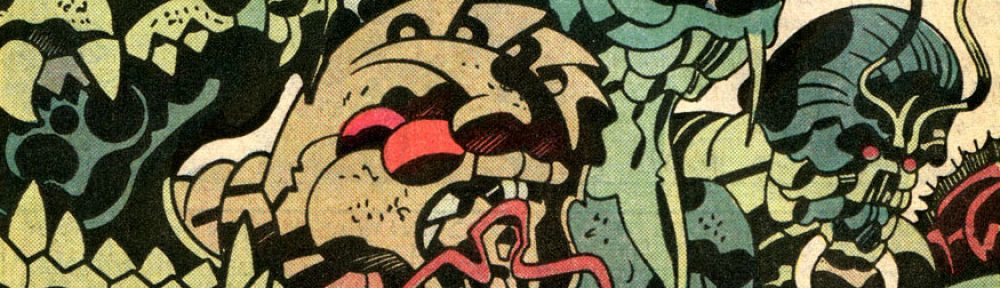
RoadofBomesThere’s no question about it. Wolverine is a tough nut to crack. In this book alone, for example, he’s pumped full of lead, burned alive, fed to sharks, attacked by ninja and blown to pieces. Later, he jumps out of an airplane without a parachute. Twice. “It will only slow me down,” he says.

Okay, I get it. Wolverine’s a first-class stud. He’s been alive for over a century and he’s practically indestructible. He’s a living weapon who prowls the shadowy space between human and animal. Thank goodness he’s one of the good guys.

His latest assignment starts in Japan and takes him to Brazil, Austria, Russia, Nigeria, Turkey and South Africa. But this isn’t a picaresque novel by any means. Wolverine is on a mission to save the world from a drug called panacea. This miracle drug can cure anything, “cancer, tuberculosis and the common cold—it can cure them all. Viral, bacterial, congenital, it doesn’t matter.”

Unfortunately it has one deadly flaw. Once a patient takes panacea, he will die unless he continues taking it every day for the rest of his life. In other words, it’s sort of like food or water or Starbucks coffee. And, of course, Wolverine is 100 percent against that sort of thing. When he learns about plans to use panacea to enslave an African nation in order to exploit its bountiful supply of crude oil, he vows to cut the drug cartel down to size with his adamantium claws.

That’s when the shooting, burning, exploding and shark feeding begins. Wolverine and his sexy Chinese mutant sidekick are up against a powerful consortium of yakuza and super ninja. These gangsters didn’t play around. Their only motive is “power for its own sake.” And panacea gives them all the power they need.

Naturally, Wolverine stops the distribution of the drug. But no one throws him a ticker tape parade or gives him a pat on the back when his mission is complete. In fact, some people are rather upset by his hubris. “Who are you to chose our fate?” asks an African woman slowly dying of illness and starvation. Panacea would have made her a slave. But so what? She’s already a slave to political upheaval, warlords, meddling foreigners, hunger, dehydration and disease. She’s just looking for options. Wolverine’s a tough guy, all right. But when it comes to solving the problems of the world, sometimes he’s just as powerless as the rest of us.

[Wolverine: Road of Bones / By David Alan Mack / First Printing: October 2006 / ISBN: 9781416510697]
The Big O

OscawanaThere are many things I hate (Starburst candy for one, cow’s milk for another). But specific to this site, I especially hate authors who write monster novels and don’t fully commit to the genre.
How many times have you read a novel where the monster lurks in the shadows until the final chapter? How many times has an author used vague and unsatisfying descriptive language? In other words: How many times has a monster novel not been a monster novel at all?

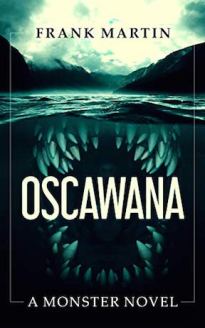
I’m happy to report that Oscawana by Frank Martin wholeheartedly embraces the monster novel playbook. The creature (affectionately dubbed “Oscar”) is big enough to blot out the sun when he arises from the titular lake, and there’s plenty of explosive kaiju carnage during his relentless slog from Upstate New York to Manhattan.

When Oscar first shows up, he’s unquestionably a bizarre sight. But he’s far from intimidating. He’s short and fat (about the size of a pit bull) and his face looks somewhat like a Picasso painting. Despite his fierce grotesqueness, says the author, April Hawkins finds the creature to be innocently sweet.

April is a 16-year-old city girl who’s spending the summer lakeside with her mother’s brother. With his dorky grin and nerdy beachwear, Uncle Henry looks like he’s a Monkey D. Luffy wannabe. During April’s first night by the shore of Lake Oscawana, Uncle Creepy sneaks into her bedroom looking for a little One Piece.

And there it is. Author Martin introduces the most enduring genre trope: Man, not beast, is the biggest monster of all. I think we can all agree that pedophilia trumps giant sea blob mayhem every day of the week.

But there was always a chance that Oscar wasn’t real. Maybe April’s imagination was stuck in overdrive. I mean, what made more sense? That she discovered a freaky lake monster, or that her mind was fractured and broken after being abused by her uncle?

The answer comes in one explosive moment. Oscar is real, and April is unintentionally controlling him to do her bidding. She’s using the beast as a murder weapon to wreck vengeance on a couple of horny boys, a grumpy neighbor and a child molester. She even sends him to Manhattan to smash her parents. “Her mission had consumed Oscar and become the only force driving him forward,” writes Martin. “Nothing else mattered or registered in his mind.”

The kaiju action that follows is dramatic and totally satisfying. The author may have been making a point about mankind being the ultimate super monster, but that didn’t stop him from unleashing Oscar upon New York. Let monsters be monsters, that’s what I say.

[Oscawana / By Frank Martin / First Printing: January 2020 / ISBN: 9781922323224]

World War B

ZombieBigfootRuss Cloud was a wildlife expert and the star of a reality program called Survivor Guy. But over the years a lot of copycats had chipped away at his show’s popularity—shows like Man vs. Nature, The Naked Survivalist and The Mormon Family Robinson.

According to network bean counters, Cloud needed a big ratings boost to keep Survivor Guy ahead of the pack. “Your show is beautiful, but you’re hemorrhaging market share,” warned his agent. “Ya gotta shake things up. You run around in the woods, but think about it. What else runs around the woods? Ghosts, aliens, monsters … Bigfoot!”

Cloud thought monster-hunting shows were stupid, but he reluctantly agreed to participate in a bigfoot-themed edition of Survivor Guy anyway. Maybe that would put him back on top of the ratings again. Fingers crossed.

Along with an ace crew of trackers, hunters and academics (and one eccentric billionaire), Cloud sets up camp in the Idaho woodlands. Within a day or two, his team stumbles upon a troop of sasquatch. What luck!

But hold on. Something was obviously wrong. Even though Native American tribes referred to their cryptid neighbors as “wild men of the woods,” most experts believed bigfoot were not “wild” at all. History suggested that they were reclusive and non-aggressive “as long as humans didn’t carry a boom-stick,” said author Nick Sullivan.

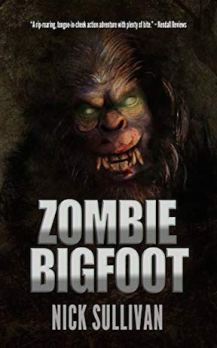
The creatures that Cloud and his team discovered were the exact opposite of “reclusive” and “non-aggressive.” Their eyes glowed with madness, demonic features stretched into a perverse rictus grin, sounds of feral rage gurgled from their massive vocal cords—“a wild-eyed, slavering monstrosity that would have been home in a nightmare,” underscored the author.

What could possibly be going on? Were the sasquatch psychotic? Did they have rabies? Were they under an evil spell from Baron Mordo? Or was some form of environmental (or otherworldly) toxin disrupting their brain chemistry?

Spoiler alert: the title of the novel gives it all away. The bigfoot troop had somehow become a ravenous horde of zombies. And that was bad news for reality TV stars and anyone else hiking, camping, engaged in paintball military simulations or micro-dosing in the Idaho woods.

There were two sides to Sullivan’s novel. As you’d expect, there was a horror and shock element to the story. Someone gets their head sliced open by a low-flying drone, for example. But there’s also a warm-and-fuzzy Hallmark Channel vibe too. In other words, there’s a pinch of humanity in the brutal inhumanity.

In addition, the cast was mostly sweet and goofy. Cloud was a bit of a prankster, Brick Broadway was a musical lovin’ ex-wrestler and Dr. Sarah Bishop was on a quest to exonerate her disgraced father. Even a few of the bigfoot youngsters scored high on the eccentric scale.

Throughout the novel, my two favorite characters were billionaire Cameron Carson and his devoted assistant Bill Singleton. I’m positive that the author created them as knockoffs of Waylon Smithers and Montgomery Burns. Even when events turned fatal, the pair’s relationship continued unabated. “Call my personal chef,” cried the hungry walking dead billionaire. “I’m craving several Wagyu rib-eye steaks.” “Of course, sir,” said Singleton with undying servitude.

[Zombie Bigfoot / By Nick Sullivan / First Printing: August 2016 / ISBN: 9780997813203]