Mahtog Mindwarp

Terence O’Corcoran was halfway through his deep space exploratory mission when he crash-landed on Mahtog, a previously uncharted planet. O’Corcoran was either 28 or 22 years old (depending on how you calculated stasis-time), but in truth he was only 900 heartbeats older than when he left Earth.

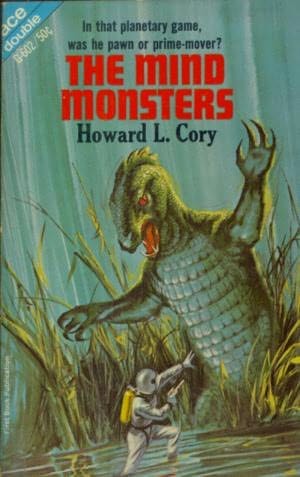
One thing was certain, O’Corcoran’s ship had taken him to the outer limits of outer space. Exploring the alien landscape, the shipwrecked astronaut was immediately attacked by a sundry of terrifying creatures—among them a dinosaur-sized amphibian, a large ant, a green-skinned pigmy and a purple hawk with a wingspan of more than 12 feet. The entire scene was bizarre and reminded O’Corcoran of the garish covers on science fiction adventure magazines of a century ago. “All that was missing,” wrote authors Jack and Julie Jardine, “was the scantily clad maiden—and, of course, the bug-eyed monster.”

Near the end of the novel, O’Corcoran battled more familiar and specific earthly monsters. Said the authors: “His academy training had prepared him for encounters with every sort of life-form imaginable, with the notable exception of werewolves and vampires. Mahtog turned out to be far madder than anything Lewis Carroll had imagined down the rabbit hole.”

O’Corcoran also bumped into an alluring local gal named Naira. She was a pretty little thing. Tiny and lushly curved, she would have looked good on the cover of Miss Galaxy magazine. The first time he spotted her she was wearing loose-fitting and transparent clothing along with embroidered curly toed slippers. “Her wardrobe was barbaric and somewhat reminiscent of an Earth-style harem costume.” Needless to say, it was love at first sight for the lonely spaceman.

Naira (and her peek-a-boo outfit) persuaded O’Corcoran to enlist in the ongoing and escalating Mahtog civil war. When he said yes to her proposal, he unknowingly signed up for a golden age Edgar Rice Burroughs-like adventure.

But back to the monsters: As you might have deduced from the book’s title, all the monsters in this creaky space opera were imaginary—illusions created to spook the Earthman. “Nothing was real,” explained a chatty leprechaun named Seamus O’Flynn (don’t ask why there’s a leprechaun in this story, it’s stupid). “We picked them out of your subconscious—memories of things you’d read about or imagined, like the little green man and the 30-foot purple lady.”  

As it turned out, spaceman Terence O’Corcoran wasn’t the hero of this book at all. He was merely a pawn in the local Mahtog conflict—just a tool who was duped by his banal golden age imagination.

[The Mind Monsters / By Jack and Julie Jardine writing as Howard L. Cory / First printing: January 1966]
War Is Hell

“War is Hell” is a figurative and well-worn term that describes the most ghastly human experience possible. The expression, first coined over 150 years ago, has been used for great effect by everyone from Gen. William Sherman to Sgt. Franklin Rock.

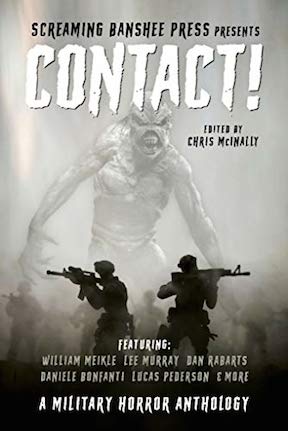
Contact!, a new nine-story military horror anthology, uses the phrase “War is Hell” in a non-metaphorical sense. Devils, gods, aliens (and a few large crickets) literally turn Earth into a burning Neo-Testament inferno.

“Black Ice” by R.F. Blackstone is probably the best example of this. The story even adds a meta element to the narrative. A group of mercenaries enlist in a mysterious search-and-rescue mission. Following a path of black ice to their target, the “Filthy Animals” find themselves on the highway to Hell.

But is it Hell? Or is it another theological black pit of doom? Blackstone pauses twice or thrice to allow his characters to muse about the topic.

“This is the perfect location for the realm of Helheim,” says one of the mercs. “It’s nothing but ice and darkness, with only the souls of the dishonored dead to give any light.”

Naw, says his comrade. “This is clearly Hell from Christianity—specifically the lowest level Cocytus the frozen lake that keeps traitors and fraudsters trapped forever. In the center at Judecca you’ll find the Devil. Not some bitch from a Marvel movie, but the real deal. Satan, who isn’t some buxom wench, but is, in fact, a three-headed monster that is also trapped and buried waist-high.”

Hel, Satan, Luzifer, Der Teufel, whatever god they feared, the Filthy Animals knew they were fallen angels on the road to ruin.

With “Man of His Word,” author Alister Hodge sends 80 centurions into the desert to search for a charismatic holy man. Whether they’re looking for Jesus is unclear. Instead they get ambushed by a powerful seer named Bārû who communicates with gods and demands their presence.

“I am here to rid the world of Rome’s pestilence!” the seer screams—his body exploding in a ball of mucous, shit and blood signaling the arrival of a holy warrior with a really big sword. The demon is ferocious and righteous, but can’t complete its mission on Earth. The Roman Empire lives to see another day.

This is the second anthology I’ve read from editor Chris McInally and they are both very good. Like its predecessor Aberrations (see my review here), Contact! fully delivers its intended objective with vigor. I’ll admit some of the contributions are disappointing. For example, I have no patience for stories with surprise endings that aren’t surprising at all. But otherwise, efforts by Daniele Bonfanti, Lucas Pederson, Justin Coates and others are all worthy monster-military smashups.

[Contact! / Edited by Chris McInally / First Printing: February 2021 / ISBN: 9798713943677]

Awesome Possum

Back in the day, author, firebrand and dragonslayer Gore Vidal made a memorable (but dismissive) comment about contemporary fiction and the people who read it.

“Readers like books with a lot of dialogue,” he said at the time, “because they can skim pages quickly and finish books faster. It makes people feel good about themselves. It gives them a sense of accomplishment.”

That quote was rattling around inside my head immediately after reading Playing Possum by Stephanie Rabig. I swear I sat down with her book one Saturday afternoon and 10 minutes later I was done with it.

I confess, time flows differently in my house, but the point remains: Rabig’s dialogue-heavy novel can be finished in one sitting without a bathroom break and with just a single cup of coffee.

Did it make me feel good about myself? Did it give me, as Gore Vidal opined years ago, a sense of accomplishment? Yes, I suppose so, maybe, I dunno. One thing is certain; I wouldn’t have plowed through Playing Possum if it didn’t compel me to keep turning pages.

Rabig’s novel is a creature feature “nature runs amok” comedy about small town family feuds, nasty hoodoo and hissing were-possums. There’s even a sweet romance too. I admit, the book probably could have benefited from a more equitable mix of dialogue, narration and action, but otherwise it’s totally awesome. It’s probably the most popular possum horror novel in the Okefenokee Swamp library.

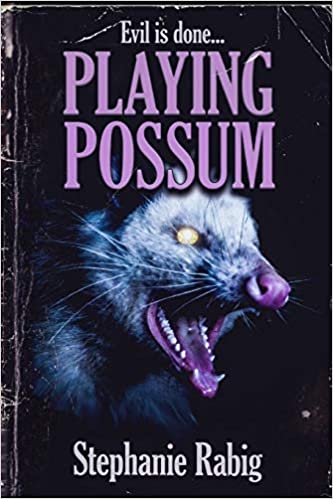
Actually, the author gives readers two possum abominations: zombie-possums and were-possums. The “possum-people” had black eyes, white and gray fur and “wickedly pointed teeth.” They reminded me a lot of Kristen Wiig in her Cheetah outfit from the latest Wonder Woman movie.

The zombie-possums weren’t as glamorous as Kristen Wiig, unfortunately. They were just rabid opossums blindly obeying a hoodoo spell. The locals quickly knew something wasn’t right. “Possums were supposed to play dead or something, not attack,” cried the book’s first victim. “And they sure as hell didn’t hunt in packs!”

My favorite scene occurs when an army of possessed possums attack the Sunny Side Up Diner à la Night of the Living Dead. As you can imagine, a skirmish in a restaurant is ripe for slapstick and Rabig knows it. Her waitstaff use anything handy to protect their customers and themselves: iron skillets, forks, spatulas, serving trays, toasters, bar stools and fire extinguishers. Frontline workers, we salute you.

[Playing Possum / By Stephanie Rabig / First Printing: April 2020 / ISBN: 978634951782]