The Call To Adventure Time

Read enough genre fiction and you’ll notice a pattern to every story. It’s a commonly used template known to comparative mythology students as the hero’s journey.

This monomyth has been around a long time and appears in every culture—from Gilgamesh to Star Wars, Moses to Captain Marvel and Buddha to The Lion King. It’s the foundation of every Disney and Marvel movie you’ll ever see.

There’s a bunch of well-defined steps in the hero’s journey (for specifics, check out The Hero With a Thousand Faces by Joseph Campbell), but the journey starts with the call to adventure and ends back at home with some sort of accomplishment and enlightenment.

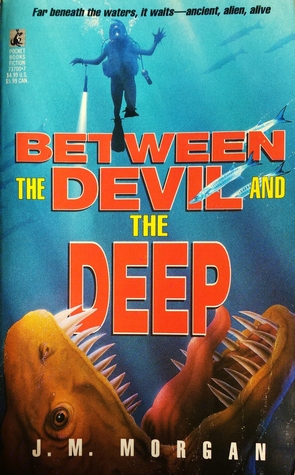
You can tell author Jill Morgan is familiar with the hero’s journey because her 1992 underwater actioner is a transparent swipe of Campbell’s monomyth.

Being versed in protomythology isn’t a crime. If it were, every college professor teaching screenwriting would be behind bars right now. It’s only a problem when an author sticks to the template in a facile way. And that, unfortunately, is the problem with Between the Devil and the Deep.

During a search and rescue mission in an underground river 80 miles below Death Valley, Kelsey Chase discovers a prehistoric nest with 10 large petrified eggs. For a chilling moment, the cave diver feels the ghost-like presence of a mother dinosaur guarding her nest of young. The experience changes his outlook on life irrevocably.

Later, when Chase is offered an opportunity to travel to Scotland and hunt the Loch Ness monster, he hears his call to adventure. Coming face to face with Nessie (and a nasty 600-foot eel), Chase is humbled by the majesty of 65 million years of earthly creation. As a result of his encounter, he decides not to kill the creature, but to protect it.

During his time in the Scottish Highlands, there’s a lot of chitchat about Chase’s journey. Everybody in his orbit understands that he’s on some sort of ineffable quest. Says one: “Each man must follow the path of his journey to where the circle ends.”

After a mad jumble of monomyth exposition, the novel concludes with Chase back at home with his girlfriend. “He embraced her in the place where his journey had begun; and he knew the peace that comes with reaching the journey’s end.”

[Between the Devil and the Deep / By J.M. Morgan / First Printing: June 1992 / ISBN: 9780671737009]
Web of Spider-Man

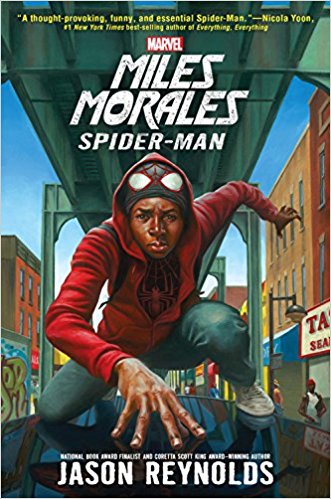
Sixteen-year-old Miles Morales always thought he came from bad blood. Both his father and his uncle were hoodlums when they were his age, and now his younger cousin was locked up in prison. Miles was worried that he would inevitably follow in their footsteps. Like Bigger Thomas, was his destiny written in stone by forces beyond his control?

That was a question he asked himself every single day. Despite being a nascent superhero with the powers of a genetically engineered spider, Miles couldn’t shake the feeling that he was the monster Dr. Frankenstein was chasing.

But one day while perusing his school’s library, Miles discovered a little tidbit about spiders that would help him navigate his family’s messy history. “It used to be said that spiders could connect the past with the future,” explained a chatty librarian. “I think it has something to do with the symbolism of the web.”

Suddenly Miles knew what he had to do. Just as a spider weaved a web, Miles had to weave his own path in life. The same fearlessness that led his father, uncle and cousin to a life of crime would now propel him toward excellence. “I believe it’s not just about where you’re from,” he said, “but also about where you’re going.”

Whoever convinced author Jason Reynolds to write this amazing book deserves a gold star. Reynolds (As Brave As You, Look Both Ways and Stuntboy, in the Meantime) has a passion for telling stories about kids (like Miles Morales) who overcome challenges and triumph over their circumstances. He’s a lively writer who’s tapped into the intellectual and moral climate of our times.

As such, his Spider-Man novel is a nuanced look at an Afro-Hispanic teenager (with superpowers) who’s grappling with family issues, personal identity, school and romance. Naturally there’s villainy afoot, but there isn’t a Vulture, Goblin or Octopus anywhere in sight. Instead of superhero bang-ups, Reynolds informs his story with the pulse of music, language, literature and poetry. I guarantee that you’ll never read another superhero novel containing so much poetry—specifically Korean poetry.

Miles successfully defeats his family’s lingering bad reputation, and by doing so he finds a way to overcome the past and move confidently into the future. In other words: By creating a new and stronger web, he’s able to smash the old webs to smithereens. Spider-Man superpowers not required.

[Miles Morales: Spider-Man / By Jason Reynolds / First Printing: August 2017 / ISBN: 9781484787489]

Rare Bits

“The wooden cabin stood in the middle of nowhere,” wrote Aurelio Rico Lopez III. “It was the ideal place to escape the hustle and bustle of city life, and also, if one were psychopathically inclined, the perfect place to commit murder.”

It was also a perfect place to kick-start a classic horror story. After all, many authors had previously used the cabin-in-the-woods trope to great success. I agree with author Jasper Bark. In his intro to Rare he writes: “Lopez is not trying to reinvent the [horror] genre or transcend it, he simply wants to celebrate it in all its pulpy, gory glory.”

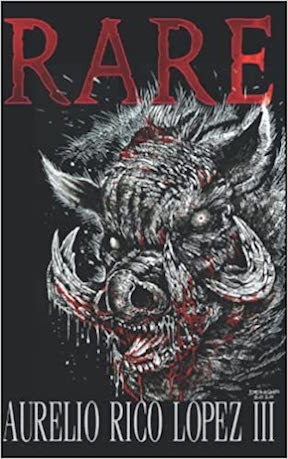
There’s also a gigantic 500-pound killer pig in Lopez’s latest book. And you know what that means, right? The word “pig” starts with “P” and that rhymes with “T” and that stands for “trouble.”

The boar was as big as an automobile and possessed two sharp tusks that could easily impale and disembowel any woodland rival. In addition, the beast’s hearing and tactical senses were acute, honed by centuries of evolution. Its genetic arsenal, along with its sheer size, made the pig a formidable predator. “Creatures, large and small, fell victim to the beast’s hunger.” wrote Lopez, “And it was always hungry.”

Four friends on holiday make the unfortunate mistake of using the abandoned cabin for their glamping pleasure. (What were they doing?? Had they never read a Richard Laymon book?)

With one whiff of the newcomers, the monster’s appetite was aroused. It suddenly knew where its next meal was coming from. Unlike other predators, it was not deterred by skanky human odor. Meat was meat, after all.

Nothing good ever happened in isolated cabins in the woods—Lopez knew it and his readers knew it too. Add a hungry, LeBaron-sized wild pig and you’ve got yourself an 80s-style nature-runs-amok treat.

One comment: Despite the setup, nothing monstrous (or evil) actually happened in Rare. The pig hunted its prey because it was hungry, and the campers defended themselves because they didn’t want to die. According to Rudyard Kipling (and Guns N’Roses), it’s simply the law of the jungle. The giant beast was a monster but it was blameless

[Rare / By Aurelio Rico Lopez III / First Printing: October 2021 / ISBN: 9798456639530]