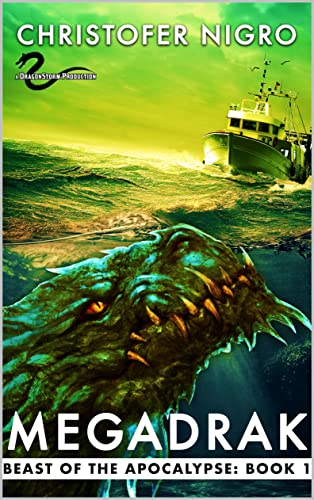
It all started in 1954 on a small man-made island located in Tokyo Bay. That’s when humanity came face-to-face with the wrath of nature’s vengeance in a manner few besides Biblical literalists could ever have imagined.
I’m talking about the appearance of Megadrak of course, the first daikaiju the world had ever seen. Fifty-five meters tall, covered in bluish-gray bony armor and adorned with tiger-like stripes, the Brobdingnagian über-beast rose from the Philippine Sea and quickly asserted its alpha status over mankind.
In chapter two, author Christopher Nigro spends five chunky paragraphs describing the fearsome reptilian monster. All you really need to know, however, is that Megadrak is a proxy for Godzilla.
The author freely admits that this novel (and its sequel) represent a dark retelling of the early mid-century Gojira films. It’s all part of his inclusive DragonStorm Universe of giant monsters and tokusatsu superheroes. After reading Megadrak: Beast of the Apocalypse, Book 1, I look forward to future volumes in an ever-expanding DSU.
Before Megadrak makes his big screen debut though, a clew of giant mutant bloodworms invade the island of Odaiba. The hideous annelid were 12-meters long with proboscides filed with copper-metallic fangs. In many ways, the worm onslaught reminded me of a creepy Jinji Ito manga.
It became clear right away that Japanese response teams and U.S. naval support weren’t ready for Megadrak. They were dealing with a beast considerably larger and more deadly than anything outside of the darkest and most frightening passages of world mythology—larger than Tiamat, Jörmungandr or Fin Fang Foom.
The story is told through the eyes of a marine biologist, an amateur naturalist and a local fisherman. All three knew firsthand how destructive and unrivaled Megadrak was. They also understood how the leviathan could be a serious threat to dethrone mankind from its position at the top of Earth’s food chain.
I must confess that I never fell into a comfortable rhythm with Nigro’s (somewhat) awkward writing style. Even though it’s not a translated manuscript, to me his text read like a literal translation in need of a rewrite. For example, he calls a fisherman a “procurer of aquatic food.” But I know literal translations have become popular these days because of manga pirate sites—sometimes more popular than officially approved translations. So who knows? Maybe Nigro is doing it on purpose. Maybe I’m the one who’s not in sync with current reading preferences.
On the other hand, all G-fans will undoubtedly enjoy the occasional nods to the original Gojira source material. It’s a lot of fun and personally I’m always open to new interpretations of the classic Toho films.
There’s also a funny callback to the original King Kong movie from 1933. In one memorable scene, a pretty police secretary named Kei is grabbed by the towering colossal reptile. Like Kong, Megadrak is curious about attractive human females and wants to get a closer look. Unlike Kong and Ann Darrow, Megadrak doesn’t remove Kei’s clothing in a fumbling, naive manner. The monster simply gives her the stink eye and stuffs the struggling woman into its cavernous mouth.
[ Megadrak: Beast of the Apocalypse, Book 1 / By Christofer Nigro / First Raven Tale Edition: June 2023 / ISBN: 9798396850156 ]
 Monster Book Club
Pingback: New Gods, Part 2 | Monster Book Club