All novelists attach a title to their initial manuscript. Whether that title is actually used is ultimately decided by the publisher with input from an editor, a marketing team and maybe a bookseller.
Bram Stoker wanted to call his iconic vampire novel The Un-Dead, but his editor changed it to Dracula. George Orwell’s dystopian classic 1984 was originally called The Last Man in Europe. And Stephen King’s initial title for Salem’s Lot was Second Coming.
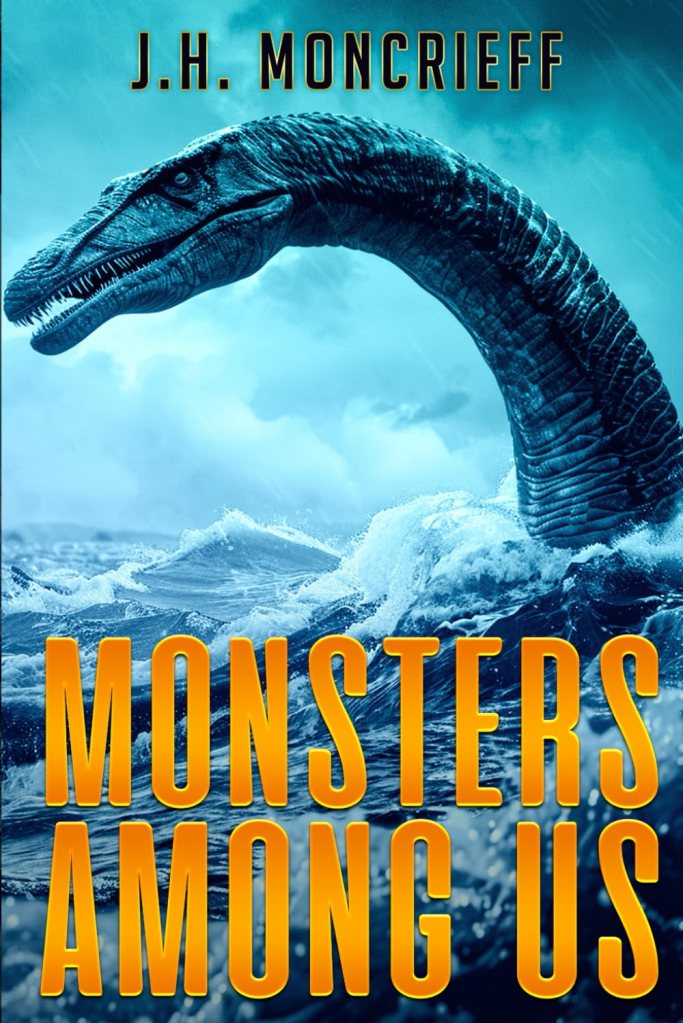
I don’t know who approved the title of J.H. Moncrieff’s latest novel, but whoever it was, I have to question their decision. Anecdotal evidence tells me there are more than 255 (million) books called Monsters Among Us in the Library of Congress. The author and the publisher shouldn’t be surprised if customers scrolling through Amazon get a little confused.
That’s too bad. If readers buy the wrong book, they’ll miss out on a unique story addressing the tenuous relationship between land and water. Specifically, do native cultures have the right to exploit ocean resources because of food and energy insecurities? And also: what happens when giant sea monsters get involved in the conversation?
As it turns out, the enormous deep-water reptiles aren’t exactly monstrous. According to marine biologist Flora Duchovney, they’re merely protecting their South Pacific territory from local fishermen who are illegally “blast fishing.” Using crude but effective explosives, these fishermen are destroying the surrounding ecosystem and turning the bottom of the ocean into a barren desert.
Driven from their homes and deprived of food, the ancient sea creatures declare war on the fishermen and a nearby island community. And they’re not fooling around. “Stop the blasting,” they tell Duchovney telepathically. “We retreat from no one. We won’t be at peace until your kind has been totally eliminated.”
Hoping to deescalate the situation, a small group of environmental activists and cryptid experts volunteer to help. They’re an argumentative bunch with their own nagging personal issues. Honestly, these buttinskies should be on a psychologist’s couch rather than on a small island fighting monsters.
Just when the novel starts to sag from too much navel gazing and PTSD, a surprising thing happens. The author brings in the MiB—the Men in Black.
Their appearance makes sense, I guess. The Men in Black tend to show up when something inexplicable happens. But this time there’s a twist. It turns out that the MiB aren’t secret government agents, they’re actually an ancient Earthly species completely separate from mankind who’ve been around hundreds upon thousands of years—even before dinosaurs. Their agenda is straightforward: They want to control everything. Moncrieff does a great job making these guys as creepy as possible.
The resolution to Monsters Among Us is actually an equitable solution. Thankfully humans and monsters find a way to coexist and peace is restored in the South Pacific. What happens to the Men in Black, however, is a totally different story.
[ Monsters Among Us / By J.H. Moncrieff / First Printing: September 2024 / ISBN: 9781923165298 ]
 Monster Book Club