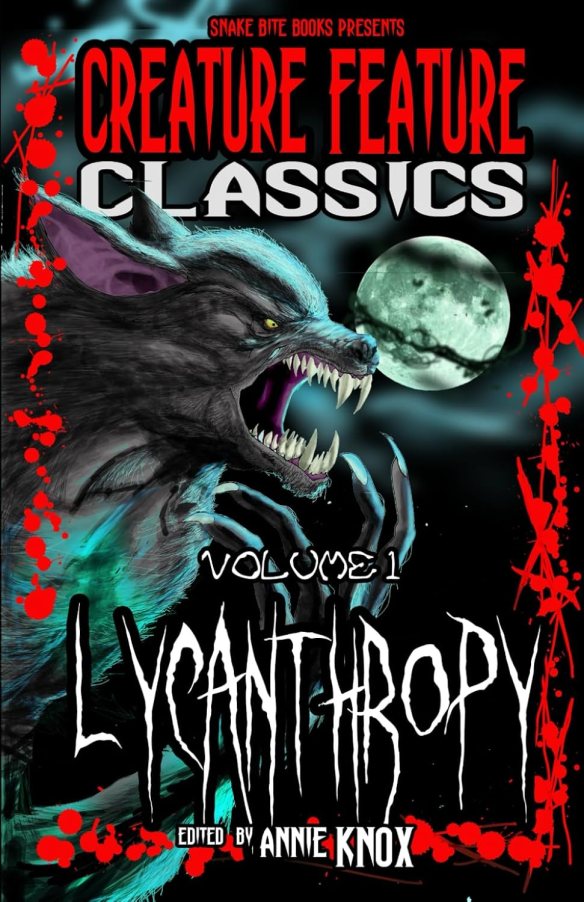
In her introduction to this new lycan-lovin’ anthology, editor Annie Knox recalls her youthful affection for monsters. “I was convinced that they must be real,” she writes. “The idea of monsters lurking in the world around us, unseen but felt, both thrilled and frightened me.”
Given her life-long proclivity, it makes sense that Knox would someday curate a terrific short story collection that takes werewolves seriously. They are, she says, symbolic of a thousand things. For example, they’re an allegory for puberty and a metaphor for transformation and change. They also represent mental health disorders and the uncontrollable animalistic side of humanity.
Werewolves can also draw inspiration, and exist side-by-side, with classic literature. Contributions from Simon John Parkin and Nora Studholme (in particular) borrow cultural cachet from William Shakespeare and Margaret Atwood. “One Last Kill” is about the tragedy shared by brothers and “A Dark Place to Hide” explores the loss of female agency and other Gilead-like themes. Both stories are very good.
Some authors are empowered to forgo the familiar horror tropes associated with lycanthropy. Or, I should say, they willfully subjugate the hysterics inherent in the genre. I have to admit that these are my least favorite stories in the collection. But that’s my problem. Others may disagree. In general, I greatly enjoy the gnashing, the shapeshifting and the howling.
Personally, my favorite thing in the first volume of Creature Feature Classics is “Wolves Only Come Out at Night.” Not only is it well written (props to author Davey Cobb), but it balances a whole bunch of disparate points of view in a mere 23 pages.
The story begins with a prologue of sorts. Seeing the moon in the sky was a bad omen, writes Cobb. “When it was present so too was evil, the sickness that plagued humanity under night’s blanket. Vagabonds, murderers, harlots, thieves. The moon was their beacon, confirming that the hour was for malice.”
To eradicate vagrancy and dangerous fauna, the town of Butterwood hires a mercenary to cull wolves, bears and foxes—anything and everything that threatens the townsfolk is butchered to extinction or driven out.
Butterwood’s artificial tranquility is shattered by the arrival of a werewolf. Cobb handles the ensuing chaos like a champ. The manner in which the werewolf, the werewolf hunter and the werewolf hunter’s daughter disrupt the town’s citizenry and municipality is unexpected to say the least. The resolution is totally crazy. No spoilers from me, but I’ll just say this: in Butterwood there is no truth in justice.
[ Creature Feature Classics, Vol. 1: Lycanthropy / Edited by Annie Knox / First Printing: February 2025 / ISBN: 9798310686472 ]
 Monster Book Club