
The fish processing plant was the economic heart of Saltwick Bay. Its massive concrete bulk dominated the harbor like an industrial cathedral dedicated to the harvest of the sea.
The factory had been dumping waste into the estuary for decades, and the results hadn’t gone unnoticed. “We’re witnessing rapid evolutionary adaptation in response to extreme environmental pressure,” explained Professor Nigel Ashworth.
The locals knew how bad the bay had become. The crabs, in particular, were displaying coordinated behavior, problem-solving abilities and tactical thinking. “They’re not acting like crustaceans anymore,” said one distraught commercial fisherman. “They’re acting like predators.”
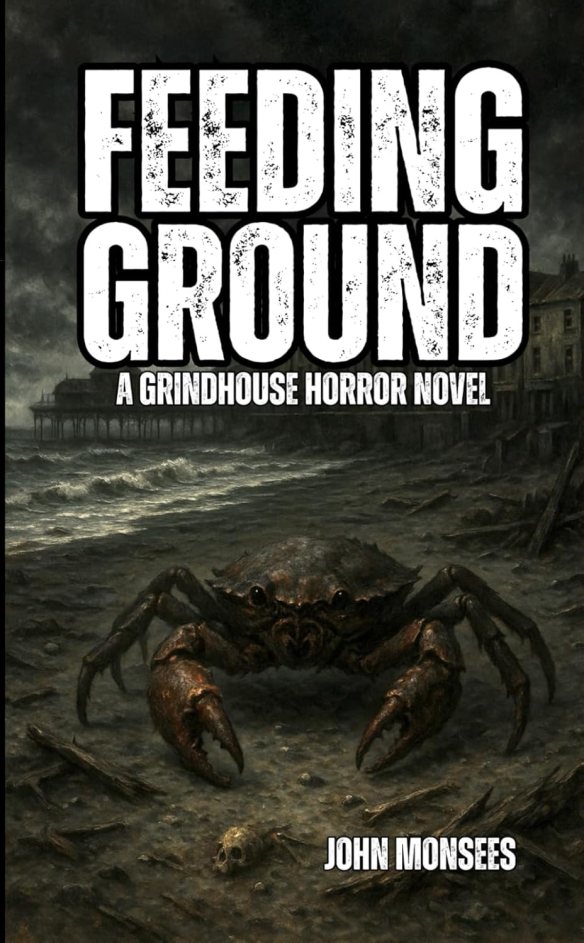
The mutated crabs, some of them the size of cars, chose to invade Saltwick on the day of the annual summer festival. Strategically, they took over the village and killed most of the people living there. It wasn’t pretty. “One crab cracked open its victim like a ripe melon,” said author John Monsees. “Another one folded a man in half like a broken deck chair. Yet another creature peeled the skin off a woman like she was a sardine tin.”
Following the crabs back to the processing plant, four brave souls embarked on a suicide mission to destroy the crab nest and the Queen Mother. This group included a marine biologist from London, a local fisherman, the owner of Saltwick’s pub and an assembly line worker at the facility.
Right from the get-go, Feeding Ground was a pretty good tribute to Guy N. Smith and his eight seminal killer crab novels. Monsees acknowledged this at the very beginning of the novel. “I owe a deep and gory debt to the great scribbler himself,” he wrote of Smith. “His Crabs books taught me that horror could be wild, weird and gloriously unrestrained.”
Unfortunately, the novel loses steam once the action shifts from Saltwick Bay to the nearby fish processing facility. I hate to say it, but I suspect Monsees simply used ChatGPT to help him finish his manuscript. Maybe he was feeling the weight of a deadline crunch. I don’t know. But the difference between the first 116 pages and the last 116 pages is striking.
I don’t want to presume anything untoward by the author, but honestly I’ve read prose written by AI chatbots in the past and I have a strong suspicion that something is amiss here.
Even while the narrative sputtered with repetitive and awkward computer-enhanced jibber-jabber, the ongoing descriptions of giant crabs were uniformly excellent—especially the novel-ending descriptions of the crab queen. She was a lovely creature that transcended every category of natural biology, said Monsees. “Decades of chemical exposure had transformed her into something that was barely recognizable as terrestrial life—a fusion of organic evolution and industrial contamination that represented nature’s response to humanity’s worst environmental crimes.”
[ Feeding Ground / By John Monsees / First Printing: August 2025 / ISBN: 9798290574134 ]
 Monster Book Club