Monster Book Club: Best of 2025

Years ago, as an editor for a leading manga publisher in the U.S., I pushed to acquire the four out-of-print Godzilla novels by Marc Cerasini. The books probably didn’t sell well back in the 90s, but publishing is a funny business. Maybe a publisher with a substantial Japanese pedigree could reach an audience that a homegrown publisher couldn’t? After all, Godzilla is an iconic Japanese export in the same way that Pokémon, Dragon Ball, Naruto and Sailor Moon are. It made sense to me that Godzilla would be a valuable license to acquire.

If I were still living in San Francisco and working as a manga editor, I’d try one more time to acquire those Godzilla books. That’s because I sense an uptick of interest in daikaiju fiction. The genre is definitely gaining momentum, and that momentum is reflected in my annual genre recap. Below is my list of the best books of 2025. 

1) Attack of the Kaiju, Vol. 3: Giants on the Rampage and Reign of the Titans, Vol. 1: Ragnarok … Now! edited by Christofer Nigro. Honestly, in any other year, I probably wouldn’t put these two anthologies at the top of my year-end list. But in 2025, they clearly represent a tipping point. Interest in daikaiju fiction is growing. If you’re curious about the genre, start here. 

2) Flesh-Eating Turtles! by Nora B. Peevy. An outrageous and funny critique of scientific hubris with a nod toward Japan’s “Guardian of the Universe”—Gamera, the kaiju-kame. Without question, my favorite novel of 2025. 

3) Combat Monsters edited by Henry Herz. I’ve said it before and I’ll say it again: War and monsters go together like love and marriage. You can’t have one without the other. As proof, check out this excellent monster-in-arms collection. 

4) Modern Mummies: A Horror Anthology edited by A.C. Bauer. All good mummy stories, like the ones in this volume, present a window into humanity, both ancient and modern. But that’s no surprise. The dead have always told us the truth about the living. 

5) Janitors vs. the Living Dead by Melissa Lason and Michelle Garza. Authors Lason and Garza call their shambling zombies “walking shit bags, shitter-monsters and unstoppable shit machines.” Their description is apt—Janitors vs. the Living Dead is good shit.

What follows is an ongoing list of novels that are on my radar for 2026. I’ll update the list throughout the year as books become available.

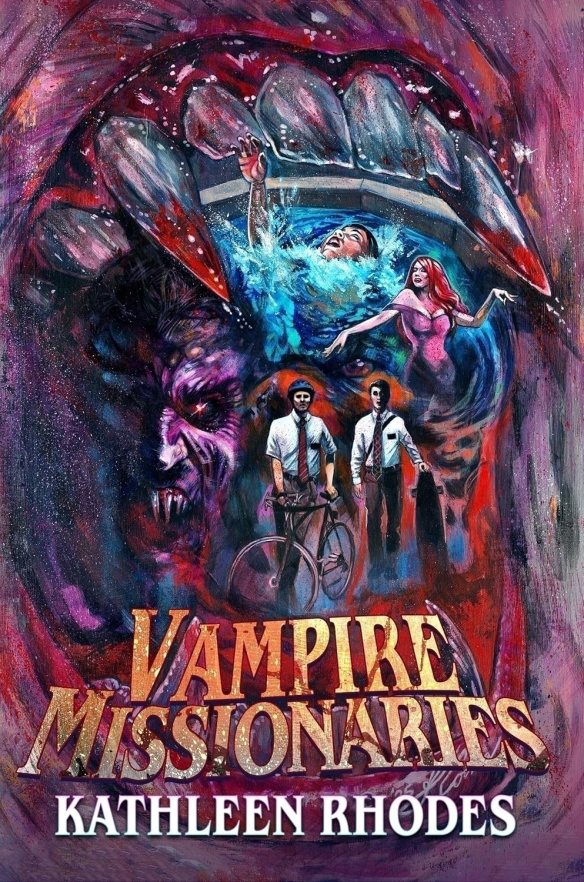
Blood Sick by Adam Cesare. Boy, with Accidental Dinosaur by Ian McDonald. Brokeula by Michael J. Seidlinger. Cryptid by Annah Browning. Escape from Skull Island by Simon Furman. Fabulous Bodies by Chuck Tingle. Giant Killer Kaiju published by Raconteur Press. He’s the Devil by Tobi Coventry. Maria the Wanted by V. Castro. Meat Bees by Dane Erbach. Nest of Tongues by Randy Ribay. Pet Monsters edited by David Badurina. Pinupocalypse by Andrew Tarusov. Plasma Pulp: Lost Worlds published by Raconteur Press. Reliquary by Hannah F. Whitten. Return of the Ancients edited by Katy Soar. Scorpion Deep by C.G. Drews. Serial Chillers: The Monster in the Mines by Jennifer Killick. Shadows Over Innsmouth edited by Stephen Jones. Shampe by Anthony Kincaid. The Big Bad Book of Kaiju edited by Jonathan Maberry and Henry Herz. The Book of Blood & Roses by Annie Summerlee. The Fate of Finnegan Quick by Larry Hayes. The Haunted House that Swallowed the Universe/Mummies and Sorcerers in South Boston by Christoph Paul. The Jellyfish Problem by Tessa Yang. Them by W.H. Chizmar. Tooth and Claw by Michael Cole. Under a Carnivore Sky by Brianna Jett. Vampire Missionaries by Kathleen Rhodes. We Call Them Witches by India-Rose Bower. Wretch by Jeremy Wagner. Zombie Joe and the Multiverse Lizards by Robert Charles. 

Gojira -1.0

Two years ago, the movie Godzilla Minus One received an Academy Award for Best Visual Effects. Although I still enjoy watching Godzilla stomp miniature model sets, I admit the FX on Minus One were very, very good. Overall, they were immersive and organic in a way that’s rarely seen in Hollywood Godzilla films these days.  

The movie wasn’t just another CGI blowout, however. When it was first released, many critics praised the movie’s emphasis on character-driven drama, especially the ongoing storyline surrounding Koichi Shikishima, the disgraced kamikaze pilot. 

But in my opinion Godzilla movies have always had compelling human characters. The original Dr. Daisuke Serizawa, for example, and mecha pilot Akane Yashiro. My personal favorite has always been Mr. Tako (no first name). While other kids my age admired Bruce Lee, Muhammad Ali or Fonzie, I found a kinship with the comedic idiot from King Kong vs. Godzilla

Here in the movie novelization of Godzilla Minus One (written by director Takashi Yamazaki), the plight of Koichi Shikishima is emphasized even more than it was in the movie. 

“To be cursed for having returned alive from a losing battle was about the harshest reception a soldier could endure,” writes Yamazaki. “Abandoning his mission as a kamikaze bomber was a felony offense in Japan. He was a man whose only value to his country was in death.” 

Koichi’s personal life takes a turn for the better when he meets Noriko Oishi, a young homeless woman who survived the bombings of Tokyo during WWII. Koichi allows Noriko and an infant in her care to share the warmth of his hovel. Along with a grumpy next-door neighbor, Koichi slowly builds a support system for his postwar redemption.

One negative comment here: When Noriko is first introduced, she’s a scrappy street urchin. Her seamless transformation into a docile homemaker is an easy narrative convenience. But Iet’s not be too critical. This is a monster novel, after all—not something from Charles Dickens. 

While Koichi and Noriko are slowly falling in love, Godzilla causes problems wherever he goes. After surviving U.S. nuclear blasts at Bikini Atoll, he transforms into the kaiju icon he is today. 

Here’s how the author describes the transformation: “Any ordinary life-form would have perished instantly but Godzilla’s extraordinary regenerative capabilities allowed him to weather the blast. And as his body regenerated, a rage began to form within him—an immense hatred toward whoever or whatever had inflicted this pain upon him. 

“But even with his great power of regeneration, Godzilla’s body would not return to its original shape. The radiation from the blast had penetrated so deeply into his epidermis that his cells grew distorted and irregular, turning his hide rugged and rocklike as the replacement tissues hardened. The dorsal fins along his spine grew longer and sharper, branching out in fractals like Hell’s own snowflakes. This process repeated, the body building layer upon layer of new armor over itself until it took on the appearance of an impenetrable, battle-hardened oyster shell that had lived for eons at the bottom of the sea. 

“Yet still, Godzilla’s body grew larger and larger, as if his biological systems had broken and no longer knew when to stop, until eventually he became so gargantuan and so mutated that he hardly even resembled the being he had been before.” It was at this moment, says Yamazaki, that Godzilla became the king of all monsters. 

[ Godzilla Minus One / By Takashi Yamazaki / Translated by Evan Ward / First U.S. Printing: September 2025 / ISBN: 9798895617588 ]

Monsters and Superheroes

Creature Feature, a chilling new anthology from Raconteur Press, is filled with all sorts of monsters— werewolves, warlocks, dinosaurs, psychic dinosaurs, bog-bred things, cosmic gods, kaiju, Venusians, mummies and a sundry of other supplemental hobgoblins. 

It’s interesting, then, that one of the highlights of the volume is a story by T.R. Tuttle with a title that asks the question: “What Is a Human?” 

Amelie Wheeler, the appointed Senior Representative of Humanity, is tasked with an impossible job. She must describe all the vagaries of human behavior to a council of aliens from outer space. To complicate matters further, she finds herself trapped in a Groundhog Day-like time loop. With each new iteration, Amelie must answer the same question over and over again with further nuance—what is a human?  

Every day that Amelie returns to the spacecraft, the aliens change their appearance in surprising ways. During her final visit, for example, they look like something from an Area 51 gift shop. She wonders, “Are they trying to be funny, or are they mocking me?”

In the end, Amelie cannot adequately describe her own species in a simple, straightforward manner. How can she? And who are these aliens to ask? They can’t even decide what they look like from one moment to the next. 

Everything else in the collection is a straight up monster story—there’s even a story about classic mid-century Aurora hobby kits that come to life. If you’re a certain age, you undoubtedly have fond memories of these iconic plastic models. Certainly author Gregory Nicoll does. “Everything You Need to Make Your Monsters Come Alive” is written with love and affection for the monster kits of Aurora.

In editor Spearman Burke’s story, “The Rescue Shelter for Ravenous Things,” a shelter for monsters is in danger of being shut down. The U.S. Inhumane Society doesn’t think federal money should be spent providing safe harbor for cryptids and abominations. Things take a life-changing twist when the society’s peevish inspector is accidentally bitten by a werewolf. 

There are a handful of great stories in Creature Feature. “Ole Maw” by Gina Sakalarios-Rogers is perhaps one of the best. It’s about a swamp crone and generational secrets screaming for redress. “Soldier of Fortune” by Dean Stone is a tangled tale of military obligations and misfortune. “The Sky Falls Up” by Paul Ryan O’Connor is about the simmering war between psychic dinosaurs at the Earth’s Core. And finally there’s Geoff Holder’s shitty (not shitty) story called “What the Kaiju Leaves Behind.” 

Without a doubt, however, my favorite thing in this anthology is “Spats Tut” by Lee Allred. A 4,000-year-old crime-fighting mummy comes to Chicago in this neo-pulp adventure that predates comic book superhero archetypes. It’s a story that perfectly captures this website’s love of monsters and superheroes. 

[ Creature Feature / Edited by Spearman Burke / First Printing: October 2025 / ISBN: 9798270059286 ]

Monsters on Parade

’Tis the season for another volume of Halloween Horrors, the perfect yuletide balm for fruit cake, tangled Christmas lights, airport delays and Mariah Carey. 

Both Halloween and Christmas share a disreputable past. Did you know, for example, that English Puritans thought Christmas was a time of carnal and sensual delights? Massachusetts even outlawed the holiday for a short period of time. 

Halloween, however, continues to be the top banana of disreputable holidays. Its celebration of pre-Christian traditions still irks many people to this day. Seeing kids roaming the neighborhood in Art the Clown costumes doesn’t help matters either. 

But some people think Halloween has gotten too soft—Jennie Quinn, for one. She’s tired of all the candy corn, Hallmark gewgaws and Great Pumpkin ornaments. She wants to bring back the ancient Celtic ways filled with fairies, spirits, magic and divination. 

“I’m a girl on a mission,” she states. “I want the Old Ways to return, and I’m gonna be the queen bitch to do it.” 

She continues: “The world will once again be filled with magic and wonder and enchantment and terror and all that shit. It’ll be the exact opposite of this stupid pathetic world we live in now. These days, it’s all boring as fuck.”

In Halloween Horrors, Vol. 1, Jennie almost accomplished her mission. Unfortunately, she found herself on the wrong side of Lord Samhain. Her considerable Celtic magic was no match for the mighty Dark Lord of All Hallows—sometimes referred to as the demonic pumpkin patch kid, squash-head and bulb-headed cunt. 

This year, Jennie is in Rutland, Vermont, for the town’s annual Halloween parade. She’s got insider information that Lord Samhain will be the celebration’s guest of honor, and like all disgruntled 22-year-olds, she’s looking for some revenge. 

Little did she know that Samhain was waiting for her in Vermont with a cadre of monsters at his side—a cyclopean centaur, a minotaur, a white buffalo, a gargoyle and a huge crab called Crancer. Also making an appearance would be Black Annis, the blood-drinking hag; Lingus, the Killer Klown; Genzel, the fearsome sasquatch; and Kire, the demon of music. 

Complicating matters even further, a legendary monster-hunting organization called the Boogey Knights (monsters themselves) was also on duty. In my opinion, Halloween Horrors, Vol. 2, represents the greatest confluence of monsters ever assembled in one place. 

Beyond all the monsters and supernatural shenanigans, the story “Boogey Knights: A Halloween Horror in Rutland,” features a surprising (or maybe shocking?) development between two major characters. Congratulations to writer (and editor) Christofer Nigro for finding ways to twist his multiverse into tighter and tighter knots. 

[ Halloween Horrors, Vol. 2 / Edited by Christofer Nigro / First Printing: October 2025 / ISBN: 9798993398006 ]

It Came from the Deep Fryer

The name of the titular monster in V.S. Lawrence’s latest novel is obviously a cute portmanteau that immediately evokes images of puffy tacos and bloodsucking cryptids. 

The novel’s title also makes me think of other wacky monster combinations, such as a warty Burritoad, a colossal Nachozilla, a spooky Tacomancer and (my favorite) a Green Enchiloblin. BTW: I freely give the author permission to use any of these puns when she sits down to write her sequel to Chalupacabra Y2K.

The title may be artfully contrived, but it effectively tells readers what they’re getting. However, the question remains: How does a tasty menu item from a Mexican fast food joint become a grotesque monster that sucks the blood out of people and then goes on a hot sauce bender? 

The whole situation is a nightmare, thought Janet. She was one of the two restaurant employees who inadvertently created the Chalupacabra. “Who’s ever heard of a chalupa—or any food, for that matter—coming to life and slaughtering fast food workers?” It didn’t make sense to her. 

One-hundred and eighty-two years ago, Dr. Frankenstein stitched together dead body parts to create life. And now, just a few short months into Y2K, Janet and her coworker have successfully created a sentient monster from a vat of fried food. 

Laugh if you want, but the Chalupacabra wasn’t a joke, especially when it became an eight-foot-tall chalupa deluxe. It was a weirdly rendered creature that skittered on alligator-like legs. In addition, it had a forked tongue, a mouth full of shark teeth and eyes that were literally made of diced red tomatoes. 

The author admits in her afterword that Chalupacabra Y2K was inspired by numerous midnight runs to Taco Bell. I can definitely relate to that. During college, I ate at Taco Bell every single day. And believe me, I can totally see how their food could easily turn into a sentient monster. 

The novel ends when Janet and her friends Trina and Landon confront the Chalupacabra at a weekend chili festival. Together, they have a vague and improbable plan to stop the creature. If they fail, they know that it will be the end of their small town, and very possibly, the entire world. 

Like all high-concept novels, Chalupacabra Y2K includes a strong hook and is written with a clear premise. Characters are generally de-emphasized in favor of high-stakes drama (although I did kinda fall in love with Trina, the MegaBarbie). If the author were to pitch her book to a movie studio, she could probably do it in one simple sentence. Who knows, this could be the start of a long-running deep-fried franchise. 

[ Chalupacabra Y2K / By  V.S. Lawrence / First Printing: September 2025 / ISBN: 9798230647225 ]

Truckenstein Must Die

In Frank Herbert’s 1966 novel The Green Brain, an alliance of insects unites and begins behaving in a frightening human-like manner. It’s what entomologists might call “swarm intelligence.” 

There’s a story in Dillon Wylder’s first short story collection, that touches on a similar collective consciousness idea—albeit in a more facile way. 

The unnamed narrator of “Hidden Potential” discovers that his dead father was actually a human simulacrum comprised entirely of cockroaches. Now that their human host is dead, the infestation is looking for a new body to inhabit. “They need a new hole,” says Wylder chillingly. 

Comment: Finding out that your father is a human-shaped cockroach is pretty gruesome, but the yuckiest part of the story is when the narrator accidentally discovers his takeout dinner is actually Kung Pao Kockroach. He’s disgusted, of course, but the joke’s on him. We’ll all be eating bugs for sustenance in the near future. Get used to it. 

Continuing with another creepy-crawly story, “Bug Legs” is about the sadistic thrill a young boy gets from pulling the legs off insects. Like Thom Yorke, the boy is “a weirdo and a grade-A creep.” 

Things take a twist when the kid encounters a giant insect-like creature in the woods. Although his comeuppance doesn’t come as a surprise, it’s still an absurd way to end the story of Charlie, the wriggling torso. 

There are a lot of male characters in this anthology who receive brutal comeuppance. For example,“Who Do Voodoo” is about a man who wants to kill his wife using a voodoo doll. There’s only one problem—even with a cursory Google search he can’t figure out how to go about it. Frustrated, he asks his wife (!!) to make the doll for him. She makes the doll and kills him the next morning. Let this be a lesson to all the men out there: always clear your search history before going to bed.  

There’s also a couple of fun stories featuring young women luring feeble-minded men to their doom. Most notably the lacertomorph in “Gone Fishin’” and the flirty amphibian girl in “God of the Gnar.” 

But without a doubt the volume’s centerpiece is “Truckenstein Must Die” a 2000 AD-like story about a man-made monster built from the body parts of the deceased. “Truckenstein likes to destroy electric vehicles and suck the juice from their batteries,” explains the author. “He doesn’t mind killing their owners, either.” 

He’s a massive brick wall of a man, a seven-foot-tall monster with an ugly green mug. He looks like your average run-of-the-mill Frankenstein but with a lug wrench jammed into his skull. 

Not only does he resemble Mary Shelley’s iconic creation, but he also suffers from the same existential sadness. He even quotes from the source material: “All men hate the wretched,” he moans. “How then, must I be hated, who am miserable beyond all living things?” Truckenstein’s not exactly a sympathetic creature, but readers will recognize his isolation and the hatred he inspires.

[ Ghoul! / By Dillon Wylder / First Printing: September 2025 / ISBN: 9798223498810 ]

New Genesis

After three novels, 999 pages, 328,601 words and countless setbacks, Russian expatriate Dr. Vladislav Volkov is still trying to save the world with his God-like scientific experiments. 

During WWII, Dr. Volkov developed an army of werevolks in an effort to defeat the Nazis. Later, during the swingin’ 60s, he tried to turn people into compliant sheep. And now, in the 80s, he’s back in the game with a dozen scrappy Sharkenstein hybrids. 

A quick comment about these Sharkenstein fellows: Each of them is burdened with a personality quirk that mirrors specific trends from 40 years ago. They represent a fever dream of 1980s pop culture fused with maritime apex predators. Among others, there’s an acid-wash jeans shark, a Karate Kid shark, a mall rat shark, an aerobics shark and one guy who’s simply known as Sharkamania. I’m surprised there isn’t a compact disc shark, a Swatch shark or a Cabbage Patch Kids shark.

Along with his fearsome shark enforcers, Dr. V has developed a nanite autophagic subversion technology system that manipulates the brain. This N.A.S.T.Y. pill is the ultimate cure for the disease of free will. “Control the mind, and you can control the world,” he says. “Where religion has failed repeatedly, science will prevail!”

This time, however, there’s a competing mad scientist working secretly in a subterranean laboratory in Sedona, Arizona. Not only does Elena McCone want to end all wars and strife, but she’s got an apocalyptic plan to bring new genesis to Earth. Inexplicably, she’s created hundreds of faceless mummy assassins to help her achieve her goal. 

Anybody who’s read the first two books in this series (Trapped! and Trapped! Again!) knows that author Richard D. Bailey is a funny guy. He consistently packs his manuscripts with witty wordplay, absurd James Bond-like gimmicks and bombastic monsters. 

Trapped! Finale! is funny as well, but this time the author takes a pause to give readers a somewhat serious plot twist. It all begins in Chapter Eight when Dr. McCone discovers a way to exploit quantum technology to mutate the human race and create a “second genesis.” Cryptically, she calls it Subject 51: Project Elena.

Angel Elena is a clone of Dr. McCone who has transcended the limitations of mere flesh. She is the triumphant conclusion of human evolutionary perfection. “I’m the harbinger of extinction,” she says in her novel-ending soliloquy. “The human experiment has run its catastrophic course—no more endless wars, overpopulation, environmental collapse or mass extinctions of innocent creatures.”

She continues her tirade with a seraphim-like flourish: “You had millennia to evolve beyond your primitive, destructive impulses, countless opportunities to choose wisdom over greed, yet instead, you’ve created weapons capable of sterilizing continents—weapons that can turn your beautiful planet into a dead husk. Extinction is not my judgment, but the logical conclusion of your choices.”

Always ready with a quippy retort, Dr. Volkov is unimpressed with Angel Elena’s incoherent jibber-jabber. “Stand down, child,” he says. “This is what happens when female angst is fueled by hormonal hysteria. You are living proof that God was just an amateur.”

[ Trapped! Finale! / By Richard D. Bailey / First Printing: October 2025 / ISBN: 9798268718119 ]

The Golden Age of Daikaiju Fiction

Hot on the heels of the latest volume of Attack of the Kaiju (see my review here) comes Reign of the Titans, Vol. 1: Ragnarok … Now!, another terrific collection of giant monster stories. It makes me wonder: are we currently living in the golden age of daikaiju fiction?

Let’s hope so. This year alone we’ve seen a handful of memorable anthologies, plus excellent longer efforts from Dustin Dreyling (Primordial Soup: The Second Batch), Nora B. Peevy (Flesh-Eating Turtles!), Sam M. Phillips (Kaiju Chrysalis) and Neil Riebe (Kaiju Bites). Like they say: small steps build momentum, and momentum leads to success. 

As the anthology’s title suggests, the stories in Ragnarok … Now! are grim. They envision an apocalyptic future delivered by colossal creatures. Yet, contrary to the Norse legends, many of these monsters face no comeuppance from the cyclical nature of Ragnarok. According to a story by Kevin Heim, the kaiju-tachi are spawned completely outside the bounds of any myth cycles, so there are no gods to punish them.

That, of course, is bad news. With no tether to restrict them, the modern-day kaiju are nigh invincible. All we can do, says author Dustin Dreyling in a story called “Run,” is try to find a nanosecond of pleasure before collateral damage claims us. 

Still, the volume’s collected authors cannot resist tinkering with Norse mythology—and who could blame them? The first two stories even feature the Thunderer himself, Thor Odinson. 

“The Serpent and the Hammer” by Christofer Nigro and “The Thunder and the Lightning” by Matthew Dennion are dandy Thor adventures. But more interesting to me is how well the Marvel Comics version of Thor has seamlessly merged with the original Northern myths. I can’t think of another example where mythology and pop culture have integrated so smoothly. Both Nigro and Dennion seem inspired equally by Stan Lee and the Poetic Edda.

Even though all the stories in this collection foretell an inevitable future where giant monsters dominate humanity, one story stands out with great humor and unexpected élan. 

“Assault of the Powersaurs” by Cody Bratsch is sure to tickle the funny bone of anyone who watched the original Mighty Morphin’ Power Rangers TV show from the 90s. 

In Bratsch’s imagined future, Earth is ravaged by war. The planet has become a barren space rock, but people are still fighting for territory. To that end, dinosaurs are resurrected and given bionic enhancements. “They contained the animalistic brutality of prehistoric monsters with futuristic combat technology.”

The Powersaurs form an awesome group of futuristic thunder lizards. They are Blastersaurus Rex, along with Nitroceratops, Protonsaurus and Terrordactyl. They’re dinosaurs to the core—stronger than before. Go, go Powersaurs!

[ Reign of the Titans, Vol. 1: Ragnarok … Now! / Edited by Christofer Nigro / First Printing: October 2025 / ISBN: 9798993398075 ]

Titanic Terrors

As a casual onlooker, you might be surprised to discover that there are numerous authors currently dedicated to writing kaiju prose fiction. Matthew Dennion, Neil Riebe, Dustin Dreyling, Jeremy Robinson, Steve Alten and Eric S. Brown (among others) are doing their best to grow readership and push the genre forward. 

The biggest obstacle they face is the lack of outlets for their work. Short stories are compiled in fanzines with limited print runs, and novels are usually indie or self-published endeavors that get lost in the Amazon algorithms. Based in Australia, Severed Press is arguably the tippy-top publisher of kaiju fiction. 

That’s why I’m happy to see Wild Hunt Press step up and take ownership of the Attack of the Kaiju anthology series. By continuing the series, they’re providing yet another platform for aspiring authors to tell their giant monster tales. 

Volume 3: Giants on the Rampage begins with a Matthew Dennion story about the end of mankind. Experts tell us that computers will likely match (or exceed) human intelligence in the next 20 years. Depending on who you listen to, this singularity event will either be a boon or a death knell for everyone living on the planet.  

In “The Island of the Ape,” the singularity has occurred and is systematically wiping humanity off the face of the Earth. An atoll west of Sumatra has become the last outpost for mankind. 

The sentient computer is baffled when it discovers a 300-foot-tall giant ape living on the island. It cannot comprehend the existence of such a creature. The ape is a god (or maybe a king?), says an islander addressing the computer. “It is beyond the understanding of a lifeless thing such as yourself.”

“Titanic Terror” by Zach Cole is a fun Elseworlds-like adventure involving the RMS Titanic. Instead of colliding with an iceberg, the luxury ocean liner is sunk by a sea serpent more than twice its size. “It could have been only one of two things,” reasons one terrified passenger: “a prehistoric beast that missed extinction by dwelling deep within the ocean, or something not of this world.” 

Other fun stories include “Moving On” by Joshua Brafman that features a jaw-dropping final sentence, and “The God Complex” by Kevin Heim about a mysterious warehouse in France containing bits of Gorgo, Konga, Fin Fang Foom and perhaps King Kong. I also enjoyed the fanfic and mecha contributions from Skip Peel and Nathan Marchand.  

My favorite story, however, comes from publisher Christofer Nigro himself. “A Bug in the System” is the third installment in his ongoing serial featuring a daikaiju-fightin’ superhero called the Blue King. Fans of Ultraman will get a kick out of Nigro reinterpreting the greatest kyodai hero of all time.

[ Attack of the Kaiju, Vol. 3: Giants on the Rampage / Edited by Christofer Nigro / First Printing: September 2025 / ISBN: 9798990366176 ]

The Thing That Creeps on Many Feet

At night, a lawless posse of U.S. immigration agents aggressively patrolled the Arizona border. The lucky migrants they captured were sent back to Mexico naked and raped. The unlucky ones were left to rot in the desert beneath the unforgiving gaze of buzzards and coyotes. 

These border agents weren’t out in the desert all by themselves, however. They were accompanied by a cluster of prehistoric centipedes. The creatures—originally from the Carboniferous Period—were eight feet long and covered in impenetrable armor. The native people in the area called them the “Thing That Creeps on Many Feet.” 

Using recombinant DNA, gene splicing and other advanced techniques, a group of renegade scientists had resurrected the long-extinct Arthropleura to provide inexpensive border defense. Quick question: was this really an inexpensive option??

The experimental program was financed by a shadow organization with the blessing of the president himself. According to author J. Rocky Colavito, the plan was to release the creatures into the environment where they would hunt anyone attempting to enter the country through its southern border. Researchers claimed that the creatures could be programmed to attack only certain racial groups. Once the Arthropleura passed their trial test in the desert, they would then patrol all sides of the continent, protecting “legitimate” Americans from invasion.

But, of course, the crazy plan went sideways fairly quickly. The prehistoric arthropods became resistant to the scientists’ controls, and pretty soon they were attacking everything in sight, including a herd of 50 longhorn bulls worth half a million dollars. That ain’t nothin’. 

Stopping the monster invasion turned into a full-on intervention featuring a crush of unlikely characters, most prominently a veterinarian named Brutus Gowdry, a transgender helicopter pilot named Callie “Chopper” Culver, a lab technician with a Steve Ditko-like name called Mr. Blank, a forensic pathologist named Connie Santiago, and a decidedly non-evil character named El Malignu. They were a scrappy bunch, that’s for sure. 

As the novel progresses, we discover that the Arthropleura weren’t the only monsters birthed in the laboratory. The scientists also created an unbelievable batch of complementary chimeras—“the stuff of nightmares,” said one character with a shiver. One such monster was a raptor-pterodactyle hybrid called the quetzoraptor. It had claws that could slice open a reinforced steel door and a beak that could penetrate concrete. 

During the final battle, the group breaks into the underground laboratory where all the mutant beasts were created. It was a bad place, they all agreed. Even the original scientists referred to the subterranean research facility as the “The Seventh Circle.” The novel’s endgame unfolds in this underground hellhole. 

Arthropleura Attack! starts strong with a promising mix of xenophobia and xenozoia. While it never quite reaches its implied potential, it features a handful of demented and profane moments that readers have come to expect (and enjoy) from a novel by Colavito. Next up: Engorgeasaurus Sex

[ Arthropleura Attack! / By J. Rocky Colavito / First Printing: August 2025 / ISBN: 9798296048844 ]