The Epic of Gilgamo

It’s a popular misperception that pollution and nuclear testing created the giant monsters known as kaiju. But did you know that exposure to pollution and radiation accounts for only 38 percent of the creatures on the United Nations deadly kaiju roster? Mother Nature can be blamed for the rest.

Gilgamo was one of the rare 38 percenters. The mutant megalosaurus was the product of illegal radioactive experimentation back in 1958. As a hatchling, he grew at an alarming rate finally reaching a weight of 40,000 tons and 220 meters in length. In short order he became the world’s undisputed apex predator. 

But in Neil Riebe’s latest (and best) monster novel, Gilgamo is struck with a blast from a shrink ray. Within seconds, the purple-scaled behemoth is downsized to five feet tall (in his theropod stance). For the rest of the book, he mostly exists as an itsy-bitsy mini-saurus. 

Being small is a big problem for Gilgamo. Not only is he being hunted by Japanese security personnel plus a secret Chinese consortium, but he can no longer compete with rivals such as Tiamatodon and Cynog. In his present state, the only way he can kick over cars and trucks is when he wanders into a playground. 

Consequently, he takes shelter inside a small cottage near Tokyo. What he doesn’t know is that an American expatriate and the 1,500-year-old ghost of a shaman priestess are already living in the house. 

This absurd arrangement is arguably the most entertaining thing in the book. It’s not exactly a kaiju version of Three’s Company, but it’s kooky nonetheless. The monster, the ghost and the emigrant all coexist in an improbable bubble of domestic bliss. As impossible as it seems, Gilgamo behaves himself and is as cute and innocent as an overgrown puppy.

Meanwhile, on the other side of the world, a super-sized Allosaurus is crushing the United States. Twenty-thousand dead in San Francisco, 23,000 dead in Sacramento and 18,000 dead in Vegas. The U.S. military is nothing but useless. “My God,” says an official with the Pentagon. “We dropped 150 tons of explosives on him. If he can take that kind of pounding, he can take anything.” 

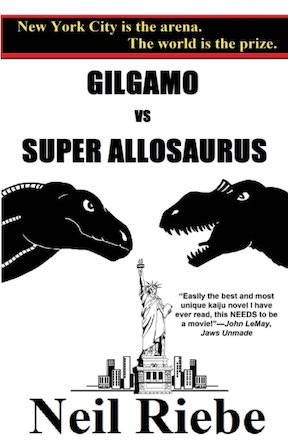
As he did with his first two novels (I Shall Not Mate and Vistakill), author Neil Riebe has created a fun and unique kaiju adventure combining both Japanese history and global alt-history. As promised by the book’s title and cover, Gilgamo and Super Allosaurus have a novel-ending knock-out battle which destroys downtown Manhattan. The fight is great, but the journey to New York is pretty exciting too.  

[Gilgamo Vs. Super Allosaurus / By Neil Riebe / First Printing: May 2022 / ISBN: 9798809392013]
Unidentified Killing Object

Doris Piserchia’s monstrous science fiction novel from 1980 is enjoyable overall, but it’s not without its problems. For one thing, the SFnal details are ridiculously banal—at one point, for example, she writes about visiting a microfiche library. Here and elsewhere, Piserchia’s script is as visionary as an average episode of Little Einsteins

And secondly, there are only two female characters with dialogue in the novel. Both of these ladies are ugly and ill tempered, but mostly they’re wholly gratuitous. I can’t help but think of a quote from Haruki Murakami: “Without women,” he once said, “nothing good happens.” 

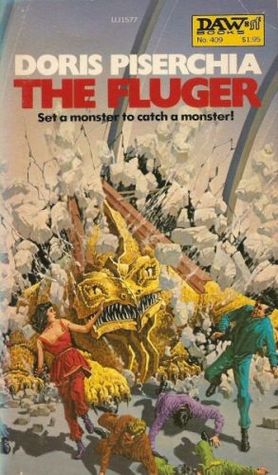
The monster, on the other hand, is terrific. Corradado (the titular Fluger) is big—four hundred kilos, five meters long, four thick legs, lithe yellow body, blunt head, numerous teeth, eyes tawny and full of guile. 

He comes to Earth as a stowaway, an illegal refugee from the planet Fluga. Once ensconced in Olympus, the heavenly sky-high metropolis hanging over the Manhattan ghetto, Corradado releases his wrath on the utopian community like a fraggin’ atom bomb. “Hatred was his inspiration and his motive for living,” says Piserchia. Venting his rage upon the enemy, he grows to hate them even more. At times he wonders, “What would it be like to destroy a world?”

The Fluger’s rancor is countered by the hegemonic idiocy of Olympus. Everybody on the city’s governing council is a vainglorious ineffective boob. Happily they all get a dose of messy karma in the end. 

It’s up to a handful of minor characters to stop Corradado’s endless rampage—a “wetback” from Manhattan, a blind security guard, a 72-year-old drug dealer and a hired mercenary from outer space. 

Kam Shar is introduced as a soldier of fortune and a galactic detective who “knows his onions” (that means he’s smart btw). But in reality, he’s just a fiddle-footed professional hit man with questionable motives.  

Initially, Kam Shar is seen as a fiend just like Corradado. “He’s an alien,” explains one character, “what we humans consider a dangerous animal.” But the assassin’s offworld experience and wiliness ultimately prevails—Olympus, the city of heaven, is saved from a monster by a monster. 

[The Fluger / By Doris Piserchia / First Printing: November 1980 / ISBN: 9780879975777]

Them!

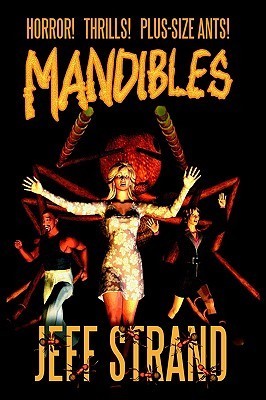
Mandibles by Jeff Strand isn’t exactly a parody of the killer mutant bug genre—it stands on its own merits (mostly), but there’s a moment early in the novel that is undeniably meta. 

Outside during a smoking break, a bored accounting assistant named Trevor sees a fire ant the size of his pinky. That’s a pretty big ant, he admits. By the time he’s done with his cigarette, he spots hundreds of similar-sized ants chittering on the patio. Time to get back inside and back to work, he tells himself.

Returning to his cubicle, the young clerk starts thinking about the upcoming weekend. “Maybe I’ll stop by the video store on the way home tonight and rent a copy of Them!,” he says referring to the (now) classic big bug movie from 1954. Also on his wish list: Phase IV, Empire of the Ants and It Happened at Lakewood Manor—and if he’s lucky, he’ll grab Antz and A Bug’s Life too. 

An ant kills Trevor pretty quickly so he never gets to enjoy his weekend movie marathon. But before he’s stung, he instinctively realizes that he’s a character in a novel about a giant ant invasion of Tampa, Florida. In a collision of fiction and reality, he falls victim to the metaverse. 

The remaining characters don’t know nothin’ about metafiction. Monette, Jack, Zachary and Roberta are simply trying to navigate their way to safety. Says Roberta: “Let’s just get out of Tampa. Maybe head east. I’m sure Disney World has a state-of-the-art ant defense system.” 

Unfortunately, an escalating tide of fire ants keeps the survivors running around in circles—and each ant wave is bigger than the one before it. At first the ants are two-inches long. Then they’re as big as a large rat. Soon they’re the size of a wolf or a living room couch. Eventually the crew bump into an ant that’s as big as a refrigerator. 

Mandibles is filled to the brim with characters that flit in and out of the narrative. My favorites are Dr. Tyler Enzian the sociopathic entomologist, Winston Cameraman the incompetent boss and (of course) Hack and Slash, the villainous Laurel and Hardy of the ant apocalypse. 

The author does a good job of stitching together a patchwork narrative giving readers a realtime peek into the situation. Chapter 13, in particular, is packed with various short vignettes that gradually build into a coherent account of the chaos. 

And of course, like everything Jeff Strand has ever written, there’s plenty of unsuspecting laughs throughout the novel. One thing that’s not funny, however, is the ongoing carnage. Like robocalls and Covid, the ants are relentless. They keep coming and coming.   

[Mandibles / By Jeff Strand / First Printing: June 2003 / ISBN: 9781594260063]

The Bogus Man

At best, Nikie Gordon was a C-level actress in a string of B-level films. With her career in the crapper, no one in the industry was surprised when she disappeared in 1974 and became a Hollywood dropout. 

Twenty-three months later, she was back like a Bi-Centennial rockets’ red glare. Full-page ads in Variety and The Hollywood Reporter announced her triumphant return to the spotlight. She was a star reborn. 

The mystery of Nikie’s disappearance and her surprising return ran parallel with a monster that emerged mysteriously from La Brea Tar Pits. In a way, the titular Bog Beast became her benefactor and co-star. 

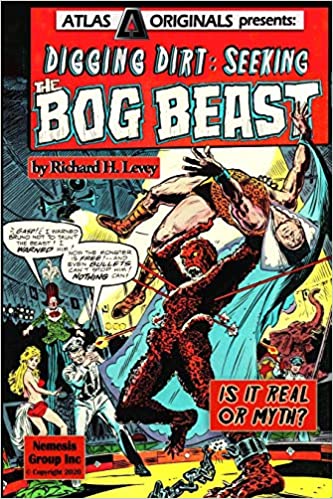
The creature was seven-feet tall, bipedal, skeletal and thickly covered with black viscous tar. Its silhouette was vaguely human if you ignored its crust of twigs, roots, clumps of fertilizer and vegetation. The Bog Beast didn’t come from the swamp, but it certainly was a sludgy cousin of the Heap, Man-Thing, Swamp Thing (and probably Theodore Sturgeon’s It).

Unlike its predecessors, however, the Bog Beast lacked any sort of compelling origin story. Nothing was known about the creature except that it had crawled out of a Los Angeles tar pit. Later, the author would give readers a small crumb to chew on: “It knew nature,” he wrote cryptically. “It was part of nature and had elemental understanding of earth and water.”

The lives of Nikie Gordon and the Bog Beast intersect during the filming of a movie called Tomb of Frankenstein. The sound stage was destroyed by a disgruntled former crew member, and the actor portraying Frankenstein’s Monster was killed. Luckily, the Bog Beast rescued Nikie when she accidentally fell down a rickety FX contraption. The film production was consequently shut down and the actress spent two years convalescing from her injuries. 

During that time, a Hollywood fixer approached Nikie with a proposal. Faced with major insurance lawsuits, union reprisals and insurmountable bad publicity, Worldly Pictures gave her an offer she couldn’t refuse. All she had to do was blame the whole thing on the Bog Beast and she’d get a second chance at Hollywood stardom. And that’s what happened.

I can’t blame the author for his contrived plotting and tidy resolution. Richard H. Levey’s prose is actually quite entertaining throughout the novel. I would even call it perky. 

Unfortunately, Levey is constrained by the poor quality of his source material. If you didn’t know, the adventures of the Bog Beast first appeared in a long-forgotten 50-year-old comic book. Believe me, the comic wasn’t very good, and neither is this novelization. Digging Dirt: Seeking the Bog Beast is a fine example of “garbage in, garbage out.”

[Digging Dirt: Seeking the Bog Beast / By Richard H. Levey / First Printing: July 2020 / ISBN: 9798666859476]

Beware the Leshy

Tree spirits are ancient demigods that symbolize immortality and/or fertility. They protect the forest (and the animals within the forest) and are ubiquitous in every culture around the world. 

Usually benevolent, tree spirits can embody malevolent characteristics as well. The Enchanted Elder, for example, has earned a sinister reputation over the years. Today it’s become an emblem of death and sorrow. 

Like everything old and inexplicable, tree spirits have been anthropomorphized again and again in folk tales and fairy tales—usually they take the shape of a nymph, a goddess or a Totoro-like beast. Whatever form they take, however, their message seems to be the same: heed the forest or else!

Lord of the Forest, the latest effort from author Chris McInally, takes place a millennium after the birth of Christ. That’s a long time ago, but even back then, tree spirits were called “Old Ones.” Men respected and feared them in equal degree. 

Things get hot when a small band of dispirited soldiers from Kievan Rus (a medieval Slavic confederacy) seek refuge in an inhospitable forest. One by one the squad is picked off in a gruesome and organic manner. They instinctively know they’re being stalked by a guardian of the forest—a leshy.

To stay alive, Danil (the leader of the pack) is compelled to to confront three separate adversaries: a surprisingly fierce match against a brother-in-arms, a climatic bash against the leshy and the post-climatic confrontation with the leshy’s wife. Each of these fights is terrific. The author’s writing is strong and clear and enfolds in an easy-to-follow sequential narrative. 

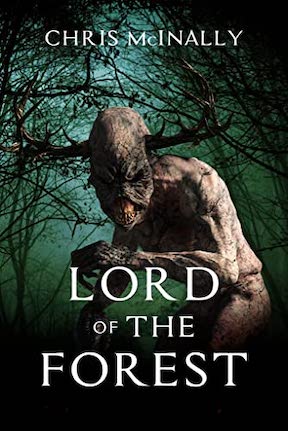
And finally, the author doesn’t withhold any details about his monster. By the end of the book, the reader knows exactly what the mighty leshy looks like. It stood taller than any man, writes McInally, “at least eight feet tall.” Its long, muscular arms hung at either side of a sculpted, humanoid torso. It had a pale face with a pair of blazing green eyes like liquid jade. A thin set of lips twitched and quivered before opening impossibly wide to reveal a nest of glistening, needle-like teeth. Rising from the monster’s forehead were a pair of antlers, strange, twisted, horned extensions that branched off in multiple directions. 

A master of declarative writing, McInally adds one last important detail about the leshy. Its skin was pale and waxy like a cross between flesh and wood, he says. “It was an ugly fucker.”

[Lord of the Forest / By Chris McInally / First Printing: June 2022 / ISBN: 9798836837419]

The Final Chapter

Size matters in kaiju fiction. Just ask Steve Alten, an author who’s penned eight novels featuring an awesome prehistoric shark. “What is cooler than stories of giant creatures?” he asks rhetorically at the beginning of this monster tome. “When it comes to stalking (or being stalked) size obviously matters. Alligator on the loose? No big deal. Wait … he’s a 30-footer? Well, hell, that IS a big deal.”

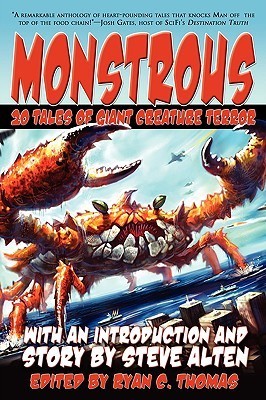
Here in Monstrous, a kaiju-fueled anthology from 2009, the creatures are indeed big. But as we all know, size is a relative thing. Giant head lice, for example, aren’t really that big (“The Enemy of My Enemy” by Patrick Rutigliano). Either are bull ants from Australia (“Six-Legged Shadows” by David Conyers and Brian M. Sammons). 

Thankfully, king-sized colossi dominate most of these stories: Bears (“Extinction” by Evan Dicken), black beetles (“A Plague From the Mud” by Aaron A. Polson), a 60-foot radioactive vampire (“The Big Bite” by Jeff Strand), a cancerous brain the size of your house (“Whatever Became of Randy” by James A. Moore) and a cast of man-eating crustaceans from crabmaster Guy N. Smith. 

There’s even a story about a colossal porn star with an 80-foot boner. “The erection felt great,” says Miles Long while stomping across Los Angeles, “a real classic like in the old days.” But “The Attack of the 500-Foot Porn Star” by Steven Shrewsbury isn’t strictly a 50s radiation monster retread. The ending, in particular, is aimed squarely at our PornTube generation. 

Appropriately, the book ends in Japan, the ancestral homeland for all modern-day kaiju. “The Island of Dr. Otaku” by Cody Goodfellow literally turns the city of Tokyo into a “strange beast.” Tired of rebuilding after an endless barrage of daikaiju attacks, Tokyo’s metamorphosis is the only sensible response—it literally becomes a Toei-inspired monster itself.

Other cities follow. San Francisco, Seattle, Los Angeles and Mexico City—they all begin to collect the world’s fears and misinformation and coalesce into a power source infected with hot air and bullshit. It’s the ultimate chapter in this collection of gigantic monstrous tales.

[Monstrous: 20 Tales of Giant Creature Terror / Edited by Ryan C. Thomas / First Printing: January 2009 / ISBN: 9781934861127]

Life On the D-List

It’s no secret. Everybody knows who’s on top of the superhero A-list. There’s Superman, Batman and Captain America, and all the Avengers and everyone on the Justice League roster. When Darkseid and Thanos come to town, these are the heroes who dutifully show up for work.

The B-list includes all the trusty sidekicks who assist the superheroes—people like Lois Lane, Robin and Bucky Barnes. And since B-listers need a little help too, there’s a C-list as well. Lois Lane always has Jimmy Olsen in her clutch after all. 

At the bottom of the heap are the lowly D-listers. These backup superheroes handle the muggings, heists and regular criminal activity the police can’t respond to in time. They are the faceless heroes who do all the grunt work without getting any of the credit. 

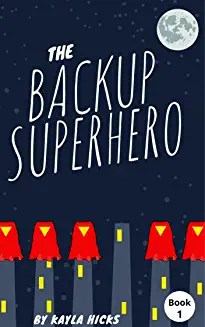
Author Kayla Hicks introduces two of these D-listers in the debut of her Backup Superhero series. Dwighter is an A-list wannabe with a drinking problem. Questions arise when he unexpectedly graduates to the upper ranks of the cliquey Superhero League. It’s up to his friend Tanser Girl to solve the escalating mystery.  

With a little bit of help, Tanser Girl uncovers a messy plot involving international espionage, the FBI, the vaunted Superhero League and a giant shark (for fun). To complicate matters further, the mystery also includes a duplicitous A-lister. 

Goffman is arguably the most popular superhero in the entire League. He holds the record for the most criminal apprehensions and is a PR charmer. He’s proof that absolute power corrupts absolutely. In a way, he’s like a pint-sized Homelander (The Boys) and Ozymandias (Watchmen). 

The Backup Superhero is a rather short effort (only 66 pages), but it contains enough subterfuge and superhero angst to warrant a handful of sequels. It seems reasonable to expect more knotty entanglements and shady alliances in future volumes.   

The key to solving the mystery, of course, is Tanser Girl, a character who freely admits that she’s just a superhero footnote. Like Kathy Griffin, she’s been trying to get on the A-list her whole career. But now, if she can expose systemic fraud within the Superhero League, she might gain the respect she deserves. It’s time for her to get off the D-list.

[The Backup Superhero / By Kayla Hicks / First Printing: March 2021 / ISBN: 9798711535157]

Every Dog Has Its Day

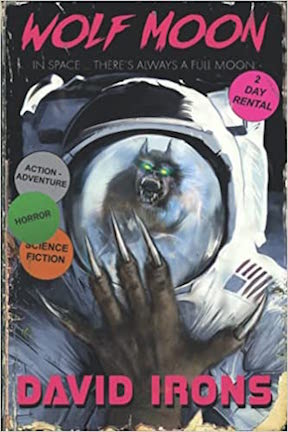
In his introduction to Wolf Moon, author David Irons freely admits his werewolf-in-space novel began as a screenplay. The movie was never produced (unfortunately), but it inspired a great tagline: “In space … there’s always a full moon.”

Irons uses the catchy phrase on his book’s cover and a few times throughout the story, but he isn’t married to it. Wolf Moon actually ends in a flurry of memorable catchphrases. The list goes on and on, but two of my favorites include: “Earth needs a wake-up call … with a bite” and “It’s a dog-eat-dog world and you always have to make sure you have the biggest teeth.” Probably the most provocative of the lot is “Never trust anything that bleeds once a month and never dies.” It’s either the perfect title for an Alice Cooper album, or the perfect tagline for an unmade “90s-style straight-to-video sci-fi/horror movie.”

The novel/screenplay begins with a ubiquitous roll call of disreputable mercenaries: the cocky man-whore, a pair of roidoids, the emotionally vulnerable rocket ship pilot and the pop culture nerd. They’re on a sketchy five-day mission to the dark side of the moon.

Once in space, an unexpected distress call lures the crew to a nearby asteroid. Within minutes of landing, they see a zombie-like human lurching toward them through a “catacomb filled with junked morbidity.” 

BTW: The man’s name is Niles Talbot. Which, I presume, makes him a distant relative to Larry Talbot. And you know what that means, right? The author is setting the stage for some hairy wolf-man action in outer space (soundtrack by Claude Debussy and the rest of his Impressionist pals).

Like I said earlier, Wolf Moon was originally a screenplay, which means you can arguably call this effort a novelization. There’s nothing wrong with that, of course. I’ve been reading movie novelizations and tie-ins my whole life and I quite enjoy them. 

Scripts are lean and mean by necessity, but novels encourage writers to expand their narrative with visual details, subplots and characterization. A good writer takes advantage of the opportunities given to him. 

I have to admit, Wolf Moon doesn’t completely make the transition from screenplay to novel. There’s some excellent word play, humor and description here, but it’s a straightforward rewrite nonetheless. 

[Wolf Moon / By David Irons / First Printing: July 2020 / ISBN: 9798664439939]

Plasmagoria

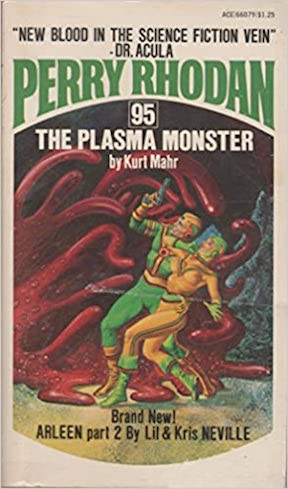
Perry Rhodan, First Administrator of the Solar Imperium and Peacelord of the Universe, is having a bad day. A trader ship under his purview has been hit with a mysterious epidemic, his radar systems have spotted an unwelcome alien spacecraft nearby and a newspaper reporter is stoking dissent against his peacekeeping administration. Worst of all, a plasma monster is rapidly devouring everything in sight. 

Anyone who’s remotely familiar with the ongoing Perry Rhodan serial knows that the titular hero is a proactive man of action. He’s not the type to sit around and wait for trouble to escalate. 

He immediately assembles his trusty crew including Reginald Bell (his best friend) and Lt. Puck (the irrepressible mousebeaver with superpowers). On impulse, Rhodan also conscripts Walt Ballin, the rabble-rousing reporter. 

At this point in the novel, you’re probably thinking all four concurrent crises have solutions dependent on each other—and that’s correct. Even though they seem totally unrelated, the plague, the alien ship, the plasma creature and the reporter all hold keys to a happy ending. 

In particular, the amorphous gelatinous monster is the most menacing threat of them all. Whether Mal-Se is sentient or not is never fully revealed by the author (or the translator). The plasma thingie is referred to as “he,” but there’s no proof that it’s anything but a mindless ambulatory piece of goop.  

In tandem with a giant robot brain (I love giant robot brains, don’t you?), scientists eventually provide some useful analysis. Mal-Se is a formless yet endlessly forming colloidal mixture of complicated endosperms and inorganic materials. By utilizing highly evolved tracing sensors, it moves with uncanny swiftness to consume alien albuminous and other organic compounds.

“There is not the slightest prospect of being able to contain it,” cries one expert in a panic, “because the plasma increases itself at a rate of billions of times per second it will take only 16 months until Earth will be covered in a thick layer of muck.” In the end, every creature on the planet will become a goopy monster. “All of us will become what our attacking agent already is.”

After a moment (or two) of panic, Rhodan and his buddies figure everything out. Whew! In just 120 pages, the plague is cured, the aliens are thwarted and the plasma monster is contained. 

Even the muckraking reporter changes his tune and becomes a fan of the Solar Imperium—although he has one final question for his new pal Perry Rhodan. “Do the monsters out there outnumber us?” he asks. “I mean, is the universe one big bag of horrors or is it a galaxy of wonders?”

“So long as humans fear, that in itself is the monster,” replies the philosophical First Administrator. “Once their fear has been conquered they will perceive the wonders of creation. It’s a long road yet but at the end of it is humankind, to whom the universe belongs.”

[Perry Rhodan #95: The Plasma Monster / By Kurt Mahr / First Printing: May 1976 / ISBN: 9781041660798]

Endgame

What’s your favorite act in a three-act play? The set-up? The conflict? The resolution? If you’re a fan of big Hollywood blockbusters, you probably enjoy the endgame’s explosive resolution—the moments when Godzilla crushes King Ghidorah and Captain America thwarts the Red Skull. 

For readers who enjoy the final act the best (you know who you are), I suggest picking up a copy of Primal Riptide. AuthorJulian Michael Carver dispenses with the first and second acts and goes straight to the climax. His latest novelette is all endgame and nothing but endgame. 

The story picks up immediately after the U.S. Coast Guard destroys a drug cartel’s headquarters on an abandoned oil rig in the Pacific Ocean. Readers miss “the most explosive Naval confrontation since the Cuban Missile Crisis” and join a shootout in progress between Coast Guardsmen and the last four surviving members of the Salerno Cartel, including drug queen Nikki Salerno, Xavier, the tattooed enforcer, mercenary Cassidy Davis and Leon Saville, a Navy turncoat.

Tensions are running high among the cartel castaways. After all, their entire base of operations has been destroyed and they’re trying to outrun a fleet of Navy point-class cutters. Bickering escalates quickly and the fugitives are having a hard time keeping their shit together. 

But what they don’t know (yet) is that the real danger lurks below the water’s surface. All the action on top of the ocean has attracted the attention of something big—something like “an overgrown great white shark or a big orca.” 

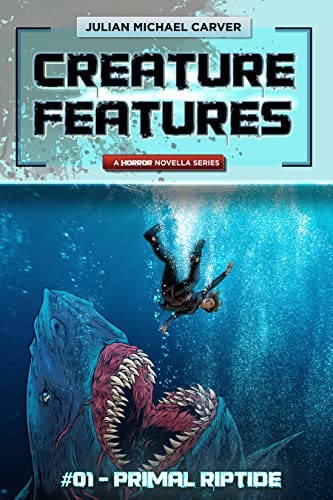
The cartel and the Coast Guard quickly discover that they’re both being pursued by a sea creature that shouldn’t even be alive, namely a 66-foot-long megalodon. When Cassidy first sees the prehistoric shark coming her way, she knows that she and her comrades are doomed: “It’s a killing machine, the largest ocean predator ever known to scientists. We don’t stand a chance!”

Up close, the meg resembled “a large bloated great white shark,” writes Carver. “Its belly hung down as if it had just feasted on an entire blue whale and it’s icy eyes pierced the watery refraction like two great snow-globes. From its mouth jutted an array of razor-sharp teeth that reminded [Cassidy] of a hungry underwater tyrannosaur.” 

In conclusion, I’d say the non-stop action of Primal Riptide is fleetingly enjoyable, but unsatisfactory as a standalone piece of fiction. The author wanted to write a book that could be read in one sitting. Mission accomplished. But there’s a reason stories are written in three-act arcs. It’s the building blocks of all good linear narrative. 

[Creature Features #1: Primal Riptide / By Julian Michael Carver / First Printing: March 2022 / ISBN: 9781922551368]