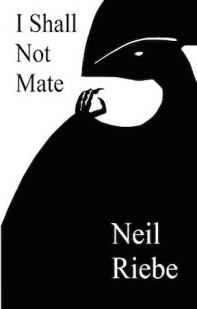
 Shindo Yamaguchi from Japan’s Ministry of Defense knew trouble was brewing. It wasn’t because COVID-19 was spreading or because the 2020 Olympics had been postponed or because manga piracy was on the rise. Yamaguchi knew there was a new kaiju threat on the horizon.
It wasn’t like Japan hadn’t seen a giant monster or two. Tiamatodon, a two-headed mutant theropod, and a Mesozoic-era marine lizard known as Tylogon, had been terrorizing the South Pacific for years.
At the moment, Yamaguchi wasn’t particularly worried about a two-headed Megalosaurus or a prehistoric whale. The new kaiju threat was linked to a nearby flock of pterosaurs. Yamaguchi was alarmed by first-hand accounts of a new flock member covered in body armor. The Japanese agent knew that a bulletproof hatchling would grow up to be a tank-proof adult. Evolution had suddenly become a race war.
“Nature equipped mankind with an advanced intellect and tool-making abilities, and these abilities allowed us to become the dominant animal on the planet,” explained Yuzo Abe, college professor and kaiju expert. “But Mother Nature has not forsaken her other children. We are in an arms race against the flock. If the armored juvenile lives long enough to sire offspring, his descendants could produce even more dramatic adaptations.”
Along with husky body armor that made him look like a medieval warrior, the pterosaur also sported opposable thumbs. And later, when the flock attacked a couple of island military outposts, the youngster (now called “Brown Scale”) was seen to possess a keen strategic intelligence. “Those monsters don’t fight like monsters,” said a sea pirate who witnessed the flock in action. “They fight like soldiers.”
As the danger escalated, the Japanese Maritime Self-Defense Force went on the attack. Its mission was clear: destroy the mutant pterosaur as quickly as possible.
The Japanese weren’t the only ones that wanted Brown Scale dead, however. The flock didn’t want his seed contaminating future generations. Brown Scale was an aberration. “He was deformed,” said the flock’s matriarchy, “and deformity breeds more deformity.”
Everything led to a novel-ending kaiju clash pitting Brown Scale against the Japanese, the flock matriarchs and Tiamatodon, the two-headed freak. Each of them wanted Brown Scale dead—or at least permanently clipped.
But as things unfolded, all the blood and thunder turned out to be nothing but sound and fury. Nobody wanted Brown Scale to sire an X-flock of mutant pterosaurs. In truth, Brown Scale didn’t want to surround himself with a harem of breeders anyway; he only wanted a monastic, sexless existence (although he probably wouldn’t mind spending a little bit of time with his sister Razor Beak occasionally). “He yearned to be alone with the same intensity another person would long for company. The idea of becoming physically intimate with his own kind filled him with revulsion.” Props to author Neil Riebe for writing a unique kaiju story and giving readers a surprisingly reflective novel-ending resolution.
[I Shall Not Mate / By Neil Riebe / First Printing: February 2019 / ISBN: 9781794482463]
 Readers don’t have to wait long for the killer kangaroo to show up in Alan Baxter’s latest novelette. The Australian buck begins its blitzkrieg hop right away on page two: “The roo’s mouth closed over its victim’s neck,” writes Baxter. “The flesh peeled up and away with a wet tear.”
 There’s no question about it. Wolverine is a tough nut to crack. In this book alone, for example, he’s pumped full of lead, burned alive, fed to sharks, attacked by ninja and blown to pieces. Later, he jumps out of an airplane without a parachute. Twice. “It will only slow me down,” he says.
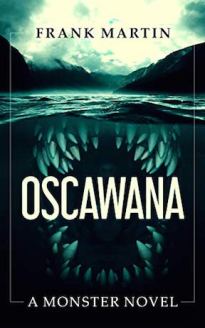 There are many things I hate (Starburst candy for one, cow’s milk for another). But specific to this site, I especially hate authors who write monster novels and don’t fully commit to the genre.
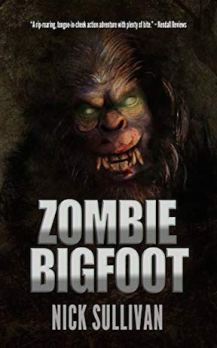 Russ Cloud was a wildlife expert and the star of a reality program called Survivor Guy. But over the years a lot of copycats had chipped away at his show’s popularity—shows like Man vs. Nature, The Naked Survivalist and The Mormon Family Robinson.
 According to editor Christofer Nigro’s introduction, the inspiration for this 2019 short story collection goes all the way back to 1965. That was the year Creepy #7 appeared on newsstands.
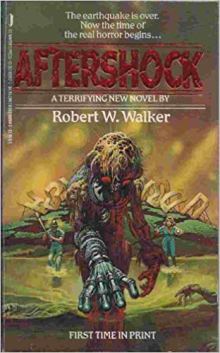 Aftershock starts on the day Los Angeles is smacked by the biggest earthquake in recorded history. The initial tremor began “like a deeply released, contented sigh from a lover in warm slumber,” and quickly escalates to a 9.4 on the Richter magnitude scale.
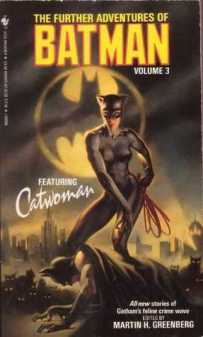 At night, Gotham City belongs to Batman. But it doesn’t belong to him alone. Somewhere in the shadows lurks a stray cat yowling in fury and endless desire.
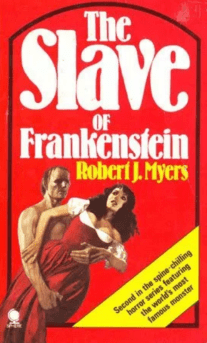 The Slave of Frankenstein takes place two years before the start of the U.S. Civil War. It’s 1859 and the focus of the entire nation is concentrated on Harpers Ferry and the forthcoming hanging of abolitionist John Brown. “Our universe is suspended somewhere between Heaven and Hell,” says a concerned patriot.
 Back in 1961, President John F. Kennedy pulled the plug on a proposal to invade Cuba with a cast of giant crabs. It was Eisenhower’s crazy idea and JFK hated it. The newly elected president didn’t want anything to do with his predecessor’s cockamamie science fiction plan.
 Monster Book Club