Underground nuclear testing, giant bats and unintentional collateral damage—that’s all you need for classic monster misadventure, right? Clearly author Jack Morse thinks so. Mostly, I agree, although a curveball or a subplot might have been nice too.
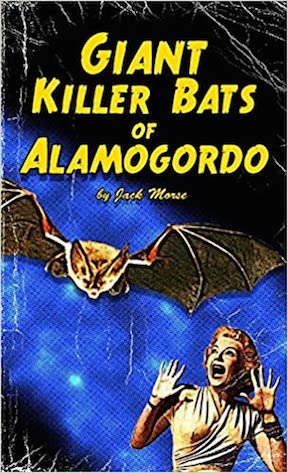
One look at the cover of Giant Killer Bats of Alamogordo and you know exactly what Morse is up to. He’s trying to recreate the “Age of Atomic Monsters” in prose format. He’s not necessarily concerned with details, however. The killer bats could easily be any kind of nuclear mutant like tarantulas, ants, Gila monsters, locusts, scorpions, praying matids, anything—even an amazing colossal man. It doesn’t really matter; the subtext is always the same in these sorts of stories.
The novel begins 75 feet below the New Mexico desert during the summer of 1957. Unbeknownst to anyone in the area, the U.S. Government is actively upgrading its nuclear arsenal. “Hiroshima was nothing compared to the power at my disposal,” cackles an ambitious Army attendant. The ensuing subterranean blast infiltrates a cavern of bats and “the radioactive cloud changes their very essence forever.”
The atomic bats are now bull-sized demons with wingspans over 10 feet. With a newfound intelligence lurking behind their cold dark eyes, they start terrorizing a small nearby town.
“I dunno what we are doing to our world,” says Ray Riggs when he spots the colony of bats for the first time, “but it seems to be striking back at us with a vengeance.” Carrying torches and pitchforks, the townsfolk quickly assemble to combat the scourge. Good luck!
Giant Killer Bats of Alamogordo is a slim novel told in a simple declarative fashion. Actually, the more I think about it, it’s very similar to a Japanese light novel but without any interior illustrations. There’s not much room for nuance or subtlety here (or even a messy subplot). It’s not for everybody, I admit, but I enjoyed the story’s retro vibe and breezy pace.
Another thing I really enjoyed was the author’s semi-regular and random interjections throughout the book. Some were funny and some were odd (in a good way).
My favorite of these exclamations comes early in the story when a character is desperately trying to locate his wife at a shopping mall. Writes Morse with a wink: “For the thousandth time, Ray wishes there were an easy way to communicate with other people. Perhaps he could invent a portable phone that worked without wires. He shakes his head and dismisses the idea; there wouldn’t be much call for that type of thing, he reckons.”
[Giant Killer Bats of Alamogordo / By Jack Morse / First Printing: June 2019 / ISBN: 9781950903030]


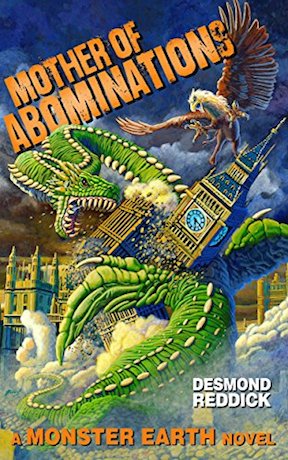 Bree Kenny was a 10-year-old little girl when she saw her parents crushed by “the great griffon.” Since then, her life had become one huge allegory for using violence to solve her problems.
