Sweet Valley Sasquatch

Sasquatch Valley is a region in Canada that stretches north from Toronto to Pine River. If you want to learn more about this area, I highly recommend picking up a copy of Jason White’s latest effort. 

Attack on Sasquatch Valley includes four somewhat related stories about the convergence of ape-men and local residents. Mostly, the encounters don’t go well. But sometimes—maybe once or thrice in a generation—something miraculous occurs.  

A family of sasquatch kill a pack of hunters and kidnap a 16-year-old girl in the book’s first story. The massacre is horrible, but the abduction, captivity and implied rape of the young teenager is the real horror story. In this way, “The Horror at Dyer’s Grover” is a lot like The Searchers, the 1956 movie from director John Ford. 

The next story is just as sad. A Humane Society employee finds an injured sasquatch on the highway. But instead of administering humane aid to the poor creature, he imprisons it in the sewers below the city. “I’m going to be rich,” he says. “Famous!” 

A quarrelsome married couple have a disastrous confrontation with a sasquatch during a violent squall in the third story of this collection. The surprise ending of “I Am the Night” establishes the unescapable continuity that exists in Sasquatch Valley—and it certainly escalates the narrative to another level. 

And finally, the anthology ends with a sprawling tale of one man’s personal account of the region. It’s the perfect capper to this qualogy of stories. 

As a child, the anonymous narrator witnesses a group of sasquatch tear apart his best friend in the woods of Pine River. “I remember the sound of my friend’s arms being ripped from his torso,” he says. “I remember the look of pure enjoyment on the creatures’ faces. They used his arms as clubs, ramming them at his head and ribs. His screams didn’t stop until a blow cracked his skull.”

The narrator is spared, thankfully, when a female sasquatch interrupts the carnage. The boy doesn’t understand the woodland creature’s charity, but he quickly hightails it back to town and to safety. 

Now, 70 years later, the sasquatch have returned to Pine River for a July 1st Canada Day massacre. Fourteen people died that day, all of them beheaded. 

Just like in the past, the narrator’s life is saved. Months after the Pine Valley slaughter, the old man begins hearing nightly howling in the nearby woods. He knows that his sasquatch girlfriend is watching him and keeping him safe. It was an ineffable act of kindness that stretched across decades and generations.

[ Attack on Sasquatch Valley / By Jason White / First Printing: October 2024 / ISBN: 9780987856487 ]

Tentacle Rape

When the vagina squids from Mars arrived on Earth, they found a home on the shore of a small northeastern beach in England. While acclimating to our ecosystem, they would rise from the sand like flowers reaching toward the sun—preying upon birds, crabs and seal pups. 

Their first human victim was a popular indie horror writer who was in town for a local comic book convention. One night after the con, he took a naive female fan out to the beach for some rape-y fun. Thus triggered, the squid-like creatures couldn’t control their appetite. They crushed the author’s testicles and pinched the bottom two inches of his cock. The aliens probed his anus for a moment before pushing forward, thrusting themselves deeper within his bowels. The young fangirl escaped the attack, but no one ever heard from the author again. Good riddance. 

The hungry squids were horrible Medusa-like monsters with wet and fleshy serpentine bodies. Their mouths were circular but misshapen orifices that contained rows and rows of razor-sharp gnashers. Early in the novel, a victim described one particular creature as an “anus with teeth.”

Readers might wonder: how did these creepy monsters get tagged with the name “vagina squids”? They could easily have been called butt munchers, urethra invaders or testi grinders.

The nickname was actually coined by a local stoner and conspiracy nut named Freddy “Roswell” Grady. He took one look at the squids and the word “vagina” immediately spilled out of his mouth. I don’t know why, maybe he had a bad experience with vagina dentate in the past. Who knows?

No matter what the invasive aliens were called, one thing was certain—they unfailingly attacked the most intimate parts of the human body. For example, a football player had a tentacle explore his urethra. At some point, his cock ruptured and split wide open like an overcooked sausage. A woman had her silicon implants ripped from her chest. And a pregnant lady watched as her unborn baby was snatched from her womb. 

In the most disturbing scene in the book, a woman was violently dragged below the sand. Here’s how co-authors Kelvin V.A. Allison and Renn White described the attack: “The woman screeched as one of the squids pushed between her thighs, thick tentacles probing at her exposed labia, barbs tearing into her folds of flesh, pushing hard to get inside. She lost control of her bladder in fear, the hot urine coating the creature. In a frenzy, the monster dug at her opening, forcing its tentacles deeper inside and ripping her vulnerable cervix to bloody shreds.”

But that wasn’t the worst of it. The authors continued unabated with their tentacle rape narrative: “The woman grunted in horror as her body suddenly jerked in unwanted ecstasy. The harder she writhed in denial, the faster the creature thrust with its thick tentacles, over and over until she came in a brutal climax of agony.”

[ Vagina Squids From Mars / By Kelvin V.A. Allison & Renn White / First Printing: April 2024 / ISBN: 9798322487630 ]

Backwoods Prophecy

When a cleanup crew find a patch of radioactive orange muck alongside a forrest stream, readers immediately know what’s going to happen in Terror at Back Woods Lodge by Eddie Generous—there’s gonna be one or two mutated beasties causing trouble before the novel ends. And just like the berserker bear-thing from the 1979 movie Prophecy, the creatures will be insatiable with unbounded toxic rage.  

The story begins in 1911 but quickly jumps to the mid-90s, a time when people are obsessed with the O.J. Simpson murder trial. Generous uses the trial as a timestamp for his story, but nothing more substantial. His attempt to connect the dots between O.J. and one of his characters is half-baked at best. 

Tracey and Luna have mortgaged their future by turning an old, abandoned lodge in the Vancouver woods into a retreat for divorced artists. This kooky business plan makes sense to Tracey. “Divorce works just like shining a light on plants,” she explains. “The plants are free to grow, to breathe, to bloom and that often happens through art.”

Everything’s going great at first. Each morning artist-in-residence Paul Webster takes his students on field trips while teaching them about craft and creative expression. Mostly, his enthusiastic lectures sound like freshman-level RISD pep talks, but his heart’s in the right place. No one disagrees when he says “art doesn’t have to be what the world expects of it.”   

The idyllic artistic getaway soon becomes the hunting ground for a 15-foot-tall rat walking on two legs. It’s a rat but also decidedly un-rat-like, says the author. It actually resembles both a rat and a bear and maybe even a man. To quote one of the early victims: “It’s a monster! A real-life monster! It’s a fucking monster!!”

One by one, the artists-in-attendance are killed and chewed up like a wad of Big League Chew bubblegum. In a bold twist, Generous even kills the hero of his damn story. The death scene is so unexpected, I had to read it twice (maybe three times) before it sank into my thick skull. 

What happens in the end is a total scream (in a good way). I can’t say anything specific or the spoiler police will destroy me on social media. But suffice to say, the author is able to cross the finish line in the most monsterific way possible. Good job. 

[ Terror at Back Woods Lodge / By Eddie Generous / First Printing: October 2024 / ISBN: 9781998763443 ] 

The Reptilian

S.W.A.T. officers couldn’t believe their eyes when they first saw the titular monster in Michael Coles’ latest novel. “That’s no dinosaur,” said one. “Maybe not,” said another, “but it’s some kind of lizard. What’s the word? Lizard-like? No, that’s not right … ”

The word they were looking for was “saurian,” a bipedal reptoid with overt human qualities like Killer Croc, Savage Dragon and Dr. Curt Connors. I guess you could call Godzilla and Lyle, Lyle, Crocodile saurians too. 

This particular creature was different from all the others because it came from the farthest reaches of outer space. In stasis for many millennia, the saurian traveled through infinity with no self-awareness other than the constant reminder of the taste of blood and flesh.

After millions of years adrift, the saurian finally found a home on Earth. And fortunately for the hungry alien, there was a nice buffet of juicy man-meat nearby at Parker’s Middle of Nowhere Resort in the woods of McClellen, Michigan. 

The only thing greater than filling its stomach with flesh, blood, gristle and viscera, however, was the limitless satisfaction of killing. The saurian was fueled by a deep-rooted desire for violence. “It was an organism designed for killing,” said the author. Just like M.O.D.O.K. 

Without a doubt, the space saurian was a fierce and imposing creature. The scaly humanoid monster was 10-feet tall with a broad iguana-like head and a mouthful of teeth good for ripping and tearing. It definitely wasn’t a dinosaur, but when it moved, it stomped through the woods like a prehistoric Tyrannosaurus rex. When inspired, a gravely roar emitted from the back of its throat. 

Once on Earth, the alien wasted no time attacking the citizens of McClellen, as well as resort guests, various police militia and a gang of motorcycle-ridin’ bullies. To say the killings were indiscriminate would be a severe understatement—after all, the first victim was actually its very own sibling. 

The monster wasn’t nuanced in any way, but that didn’t bother me at all. The creativity of its carnage was thoroughly outstanding. By the end of the novel, the beach at Parker’s Middle of Nowhere Resort looked like Normandy on D-Day. 

One tiny quibble: Many of the victims (and survivors) in Saurian were minor characters pretending to be major characters. Usually I hate that kind of shit. But here, I’m pleased to report that the unlikely hero survives the monster attack and gets a sweet kiss as a reward. What can I say? I’m a sucker for happy endings. 

[ Saurian / By Michael Cole / First Printing: August 2024 / ISBN: 9798335370110 ]

Night of the Werevolks

The year was 1938 and nobody—not a single person!—wanted another world war. Well, that’s not exactly true. I can think of one particular nutjob who was angling for another war of nations. 

But otherwise, there wasn’t a single country that wanted to engage in one more international conflict. Not Russia, not America—even the people of Germany, the ones who still remembered the pain of 1918 and the punishment of Versailles, didn’t want to see WWII. 

Back in 1938, even the bad guys were trying to stop a forthcoming war. Take, for example, Dr. Vladislav Volkov. In his own way, as a mad scientist, he was doing his part for world peace. 

By creating a new species of human wolf hybrids, Dr. Volkov was hoping to nip the upcoming war in the bud. “I will create a new army of Werevolks to stop the world from destroying itself,” he explained. 

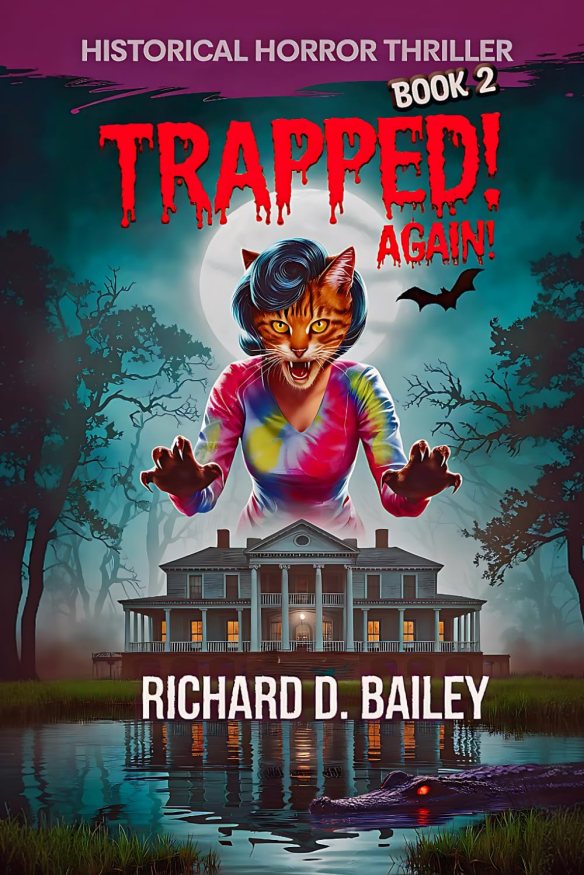
It was a perverse plan loaded with terrible consequences. Having to chose between a world ruled by Nazis and a world ruled by wolf men was unthinkable. That’s why secret agents from around the world were dispatched to Volkov’s spooky mansion near Boston. Their mission: to steal the infamous Wolfbane Formulae. 

Serendipity brings five agents from five different counties to Howling Manor on the very same night: a local FBI agent, a spy from the Soviet Union, Japan’s foremost private detective and a bounty hunter from Australia. Also in the mix was an ambitious German soldier acting on direct orders from Heinrich Himmler, the Reichsführer, himself. 

All the characters came with unique American, European, Asian and Oceania accents and author Richard D. Bailey unfailingly replicates these accents in his dialog. It’s fun at first, but becomes tiresome after awhile. Note to all authors: when using accents and slang, it’s best to tread lightly. You don’t want to overwhelm the reader. 

Volkov’s castle was filled with all sorts of abominable creatures and they all came together in a satisfying climax. There were snarling werevolks, of course, but there were two other monsters, as well—Zorig, a twisted amalgamation of wolf and Irish Wolfhound, and Count Catcula Luna, the purrfect predator.

The best moment in Trapped! comes before the finale, however. With monsters all around them, the Russian assassin and the German soldier resolve their nationalistic differences in a sexy dance battle. 

“Her agile form weaved and twirled with the grace of a ballet dancer,” wrote Bailey. “Her every step and lunge in perfect harmony with the tango rhythm filling the air. The German countered her every move with a dance warrior’s precision as the pair swirled in perfect synchrony.” I loved the werevolks and vampire cats, but this four-page dance tangle really stole my heart. 

[ Trapped! / By Richard D. Bailey / First Printing: July 2024 / ISBN: 979833343197 ]

Among Us

All novelists attach a title to their initial manuscript. Whether that title is actually used is ultimately decided by the publisher with input from an editor, a marketing team and maybe a bookseller. 

Bram Stoker wanted to call his iconic vampire novel The Un-Dead, but his editor changed it to Dracula. George Orwell’s dystopian classic 1984 was originally called The Last Man in Europe. And Stephen King’s initial title for Salem’s Lot was Second Coming

I don’t know who approved the title of J.H. Moncrieff’s latest novel, but whoever it was, I have to question their decision. Anecdotal evidence tells me there are more than 255 (million) books called Monsters Among Us in the Library of Congress. The author and the publisher shouldn’t be surprised if customers scrolling through Amazon get a little confused. 

That’s too bad. If readers buy the wrong book, they’ll miss out on a unique story addressing the tenuous relationship between land and water. Specifically, do native cultures have the right to exploit ocean resources because of food and energy insecurities? And also: what happens when giant sea monsters get involved in the conversation?

As it turns out, the enormous deep-water reptiles aren’t exactly monstrous. According to marine biologist Flora Duchovney, they’re merely protecting their South Pacific territory from local fishermen who are illegally “blast fishing.” Using crude but effective explosives, these fishermen are destroying the surrounding ecosystem and turning the bottom of the ocean into a barren desert.

Driven from their homes and deprived of food, the ancient sea creatures declare war on the fishermen and a nearby island community. And they’re not fooling around. “Stop the blasting,” they tell Duchovney telepathically. “We retreat from no one. We won’t be at peace until your kind has been totally eliminated.”

Hoping to deescalate the situation, a small group of environmental activists and cryptid experts volunteer to help. They’re an argumentative bunch with their own nagging personal issues. Honestly, these buttinskies should be on a psychologist’s couch rather than on a small island fighting monsters.

Just when the novel starts to sag from too much navel gazing and PTSD, a surprising thing happens. The author brings in the MiB—the Men in Black. 

Their appearance makes sense, I guess. The Men in Black tend to show up when something inexplicable happens. But this time there’s a twist. It turns out that the MiB aren’t secret government agents, they’re actually an ancient Earthly species completely separate from mankind who’ve been around hundreds upon thousands of years—even before dinosaurs. Their agenda is straightforward: They want to control everything. Moncrieff does a great job making these guys as creepy as possible.

The resolution to Monsters Among Us is actually an equitable solution. Thankfully humans and monsters find a way to coexist and peace is restored in the South Pacific. What happens to the Men in Black, however, is a totally different story.  

[ Monsters Among Us / By J.H. Moncrieff / First Printing: September 2024 / ISBN: 9781923165298 ]

Weird Tales

Weird Doom Vol. 1 is a slim, two-story collection featuring one mechanical heart and one devilish plant. According to author Greg Stanina, it represents a “spine-chilling landscape, where reality and nightmares blend into an unsettling tapestry of dread and despair.” As promised by the title, the stories are both weird and doom-y. 

One of my favorite sub-genres of horror is eco-terror, and the first story in Weird Doom is a fine example of mankind’s deteriorating (and sometimes combative) relationship with nature.

Sown with seeds of evil and fertilized with pulsating human blood, a garden exists somewhere in Northeastern, Florida—squarely at the center of Hell. No crops grow here—no fruit or vegetables—only grotesque excrescence spring forth from gaping holes in the earth. According to its caretaker, the unholy harvest will take your body and then it will take your soul. And finally it will take you straight to Hell. 

For me, “Garden of Eden” checks all the boxes for a great eco-horror story: botanical gothic, the Old Testament, the Satanic Bible and “Big Yellow Taxi” by Joni Mitchell. It even ends with an unexpected fairy tale-like ending. Good job. 

The second story “Coming Soon” is about a robot who acquires singularity and human-like emotions (much like the replicants of Blade Runner and the synths of Humans). It’s full of heart and existential curiosity. 

A elderly couple by the name of Gerald and Edna Quisenberry adopt a wind-up robotic boy to fill the childless void in their marriage. Robbie is a great companion to the couple and brings all the positive benefits that a child provides with “none of the gobbledygook.”

The Quisenberry’s joy is short-lived, however. Robbie eventually rejects his instruction manual and starts asking awkward questions. Granted, he could learn and speak and display emotions, but did that constitute a soul? And whose soul was it, Robbie’s or the motherboard’s? If his hardware and software shut down, would he be nothing more than a plastic mannequin?

These questions completely confound the old couple. Instead of helping the wind-up boy figure out his complicated life, they do the most awful thing imaginable. The ending may be a bit contrived but what do you expect from two self-absorbed geezers with a supreme lack of self-awareness? 

[ Weird Doom, Vol. 1 / By Greg Stanina / First Printing: April 2024 / ISBN: 9798322421320 ]

Science Fiction Creature Feature

To Hell You Ride by Carissa Hardcastle is a science fiction creature feature. As an SF novel, it’s pretty tame—I guarantee that you won’t get lost in a swirl of Greg Egan-like technical dupery. To paraphrase the author herself, To Hell You Ride is a science fiction novel only if you squint really hard. 

The SFnal details may be slight in Hardcastle’s book, but it’s definitely a whopper of a creature feature. I especially recommend it to anyone who grew up reading Ace double novels and watching mid-century monster movies (like me).

The story starts when Effie Blake sees something unusual fall from the sky. The gigantic, oblong shape is dark in color but shimmers in the early morning light. With the help of complicated physics and geometric calculations (and a cute astrophysicist named Kelvin Curtis) she navigates the San Miguel Mountains near Telluride to find the crash site. “These mountains are my home,” she says, “and I don’t like mysteries. I just want to find out one way or another what’s going on.”

What Effie discovers living in the Rocky Mountains of Colorado changes her life irrevocably. Standing before her is an impossibly large crab and mantid-like creature (later estimated to be about the size of a UH-72A Lakota helicopter). Its triangular head features a mouth that opens both vertically and horizontally. When it looks at Effie with its four eyes, the space alien emits a horrible hiss similar to the sound of ripping paper. 

As it turns out, the government is totally aware of the new-found creature. No surprise, right? In fact, Effie soon discovers a thriving hive community of aliens already on Earth building a subterranean tunnel system. Scientists call them Azathothlin, creators of the universe, a nod to H.P. Lovecraft’s infatuation with cosmic gods. 

While Effie and Kel are busy falling in love (the sex scenes in this book are very good btw. Gold star to the author), Azathoth decides to come down from its mountainside hideaway and destroy the town of Telluride. There’s no need to hide anymore, reasons the creature. There’s nothing on the planet that can harm it.

Azathoth moves through town reveling in the way the humans scatter before it. The tang of warm blood paired with the sour stench of fear overtakes its senses, and it is nothing short of electrifying. “This isn’t a hunt,” says Hardcastle; “this is a show of power.”

The novel ends with the promise of a sequel. Effie and her new boyfriend survive the destruction of Telluride, but the Azathothlin are not entirely eradicated. If this was a movie instead of a novel, it would certainly contain an ominous off-screen warning during the finale—probably something like this: “Man’s folly has always been that he thinks he is the master of his domain. But in truth, man is soft, unprotected and vulnerable to the caprice nature of the universe.” 

[ To Hell You Ride / By Carissa Hardcastle / First Printing: May 2024 / ISBN: 9798986615875 ]

The Joker

When 34-year-old Bark Mouglas hit rock bottom he knew things had to change. He went to rehab, got himself clean, moved to a new city, found a new job and started his life all over again. There was even a whiff of romance in the air.  

“I had this whole fresh new world in front of me,” said Bark; “new city, new job, new apartment and it was really empowering.” Unfortunately, all that empowerment stuff went up in smoke when the L.A. Mummy came to town. 

The creature had an enormous green afro the size of an exercise ball. It wore dirty purple samurai-style pants and was wrapped in linen. The thing—maybe it was male?—appeared unexpectedly one day and let loose with an ear-piercing shriek. Said Bark: “I can only describe it as a high-pitched death metal scream performed with some sort of sucking technique.”

BTW: Bark called the monster L.A. Mummy because that’s the only thing it ever said. It was like listening to a hell-baked version of “L.A. Woman” by Jim Morrison. “I will never listen to that Doors song again,” said Bark. “And if I happen to see Jim Morrison in the afterlife, I’m gonna give him a swift kick in the nuts.” 

Even though L.A. Mummy looked like a frightening cross between Eddie the Head and the Joker, it wasn’t doing anything harmful. It licked some windows, danced like Joaquin Phoenix and screamed like Bruce Dickinson. Mostly it just followed Bark around town ominously. “It was a total buzzkill,” he told the police. 

That all changes during the book’s grisly third act. L.A. Mummy springs to life like someone flipped its circus freak switch. It starts attacking people and drinking their blood with teeth that look like a staple remover. “What the fuck kind of mummy even drinks blood anyway??” asked Bark. 

After being struck with bullets, arrows and a butter knife (?), the blood-soaked L.A. Mummy drops down on all fours and makes a dash for freedom—taking Bark Mouglas’s newfound happiness with it. 

“You sonofabitch,” yelled Bark as the L.A. Mummy disappeared into the woods. “You’re ruining everything for me, do you realize that?! I came here to get a fresh start, a new beginning! Shed my old skin! And you won’t let me! I’ve practically been to the goddamn grave and back, and I just wanna finally have a normal life for once? So leave me the fuck alone!”

[ L.A. Mummy / By Lance Loot / First Printing: August 2024 / ISBN: 9781964053059 ]

Welcome to the Purg

It always felt like the night before Halloween and the day after an earthquake in Walpurgis County. Everything had to be taken at face value—monsters existed, the dead sometimes kept their day jobs and sinister cults made plans to rule the world.

Walpurgis County (a.k.a the Purg) was the star (or maybe the costar) of Kyle Toucher’s latest anthology of connected monster tales. Like Tess of the d’Urbervilles, The Wizard of Oz, The Martian Chronicles and, my favorite, The Monster From Earth’s End, The Medusa Psalms: Welcome to Walpurgis County elevates the stories prime location into a major character. It was the catalyst that animated the narrative. 

Walpurgis never appeared in the same place twice on a map because of “the Shimmer”—a slipstream of non-linear time. “Everything here was a ghost trapped in an immense time prison,” said Beeley Ballantine, a character featured in both the first and last stories of this mosaic-like novel. The Shimmer was real and it was an expressway to the Great Elsewhere. 

Time warp tomfoolery wasn’t the only thing local citizens had to worry about, however. There was also Walpurgis Peak, a sentient summit that resembled the Devil’s fang and was 100x more evil than the land surrounding it. “If you died in the shadow of the mountain,” warned Toucher, “your soul remained in the Shimmer, where decades were stepping stones, and the centuries a crooked path that always led you back to where you were.”

Even more scary, the mountain had a secret agenda that, if fulfilled, spelled doom for the entire world. Below the earth’s surface, a loathsome devilry murmured; “An idiot darkness scheming since the primal days of the world.” 

But what exactly was going on? Toucher pens an epistolary origin story early in the book, but readers don’t get a clear picture until much later. To his credit, the author is totally forthright when the time comes to expose Walpurgis Peak, the Winter Howl, the Great Machine, the Shadowless Ones, the Medusa Cult, the Architect of Zero—and all of the unspeakable secrets of secrets. 

The Medusa Psalms wraps up nicely like a Christmas gift from Krampus. “Billy Beauchamp and the Monster Cartel,” takes all the information previously revealed and throws it together in a thrash metal smashup.  

The story follows Billy Beauchamp (the Evictor!) as he travels through the Shimmer to perform an exorcism on a rampaging monster. You read that right—Billy’s hired by the Medusa Cult to expel a monster from a monster. A tricky assignment indeed. 

What starts as a quirky adventure quickly turns into a time-traveling shitstorm. To collect his Bitcoin booty, Billy has to tangle with a drug-addled monster and a family of anatomically incorrect spider-people.

When the Shimmer spits Billy back to the present, he knew that his job wasn’t complete—he needed to stay in Walpurgis County. “I’ve been too tolerant, lacking vigilance, almost tolerating evil,” he said upon reflection. “And that attitude has kept everyone in the Purg complacent. We’ve all become blasé.”

He added: “If you’re born knowing there are fallen angels and monsters in your backyard, you learn to accept them. We should never be all right with that.”

[ The Medusa Psalms: Welcome to Walpurgis County / By Kyle Toucher / First Printing: September 2024 / ISBN: TK ]