Million Dollar Mummy

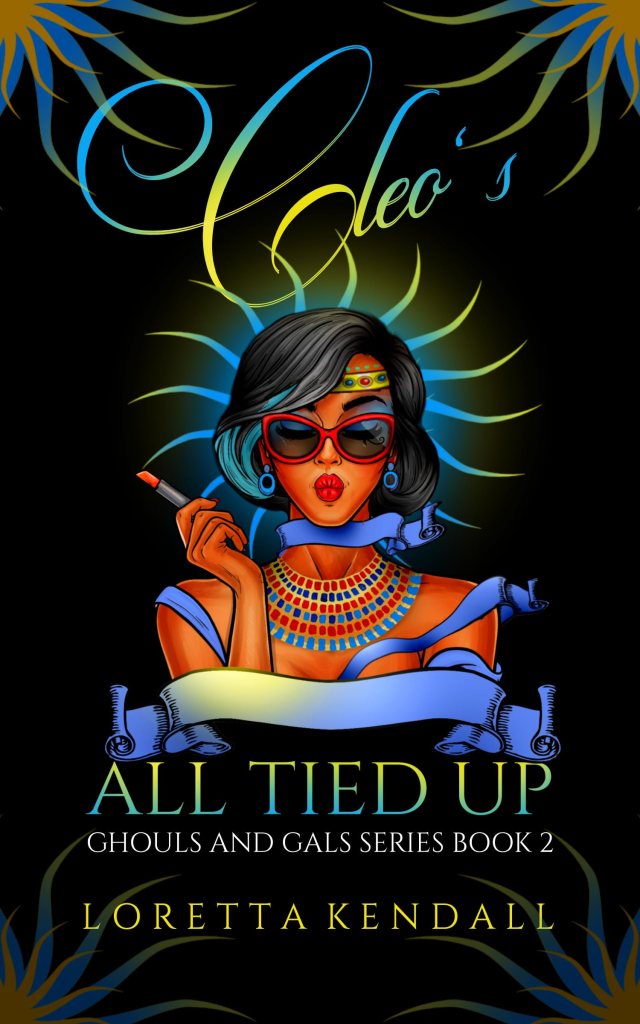
Cleopatra was the monster darling of Hollywood—a 4,000-year-old mummy gal who looked like a rockabilly version of Marilyn Monroe. Everyone agreed, she was stunning. “A vintage throwback horror dream of every man’s fantasy.”

Her career was in overdrive, but her personal life was a total wreck. Her father was a manipulative jerk and her fiancé was Frank N. Stein, the mad creation of Doctor Victor Frankenstein VII. 

Author Loretta Kendall described Frank in this way: “He looked like a typical greaser, complete with leather boots, a white T-shirt with the sleeves rolled up and matching rolled-up blue jeans. It was like looking at a Frankenstein version of 1950s Fonzie from Happy Days.” Cleo described him another way: “He was an asshole.”

Frank N. Stein and Papa Imhotep had plans to rule the world together. They were in possession of a powerful grimoire called The Necronomicon, but they also needed Cleo’s elemental power of regeneration in order achieve their dastardly goal.  

The one person uniquely capable of thwarting them was Victor Frankenstein himself. After all, he  was the guy who created Frank N. Stein and understood the art of reanimation intimately. Once a villain, he was now attempting to atone for his crimes against humanity. “I’m trying to fix the damages I’ve done,” he told Cleo. “I’m working hard to become a man of integrity.”

Victor and Cleo shared common goals, but they didn’t automatically click when they teamed up. He thought she was a bleach-blonde Botox bimbo with fake tits, and she thought he was a sex maniac and a colossal jackass. 

In truth, they weren’t totally wrong. Cleo was undeniably hooked on her glamorous Hollywood lifestyle and Victor was an unrepentant egomaniac who built his fortune by reanimating dead folks as sex slaves.  

Despite their differences, however, Cleo and Victor formed an alliance to smash the evil machinations of Frank N. Stein and Imhotep. Along the way, something surprising happened—the mummy and the mad scientist fell in love.  

Like Kendall’s previous novel in her Ghouls and Gals series (read my review here), Horror Earth is a place awash in midcentury monster miasma. Mummies, ghouls, werewolves, vampires and one-eyed, one-horned, flying purple people eaters mingle with humans in a hootenanny of rockabilly and bop. It’s a ginchy mix of monsters, romance and kinky sex with lots of laffs and clever word puns.

For me, Kendall’s latest effort really comes alive in Chapter 25 when she brings back a handful of popular characters from her first book, Gigi’s Monster Garage. To save the world, they all agreed to form a confederacy of monsters. 

At the very end, Fox Adams (the romantic object of lust from the first novel) asks: “Are we like a superhero team now? I feel like we’re superheroes.” A seven-foot Sasquatch named Barrett Jackson shakes his head no, “That’s not possible,” he says. “Monsters are real, but superheroes are fake.”

[ Cleo’s All Tied Up / By Loretta Kendall / First Printing: September 2023 / ISBN: 9798861406765 ]

Attack of the Crab Monsters

Wingaersheek Beach in Massachusetts was a place people went to wash away the weekly work struggles with the ebbing tide, crunching sand between toes, relaxing under the setting sun—these were the ways to forget about the troubles in the world.

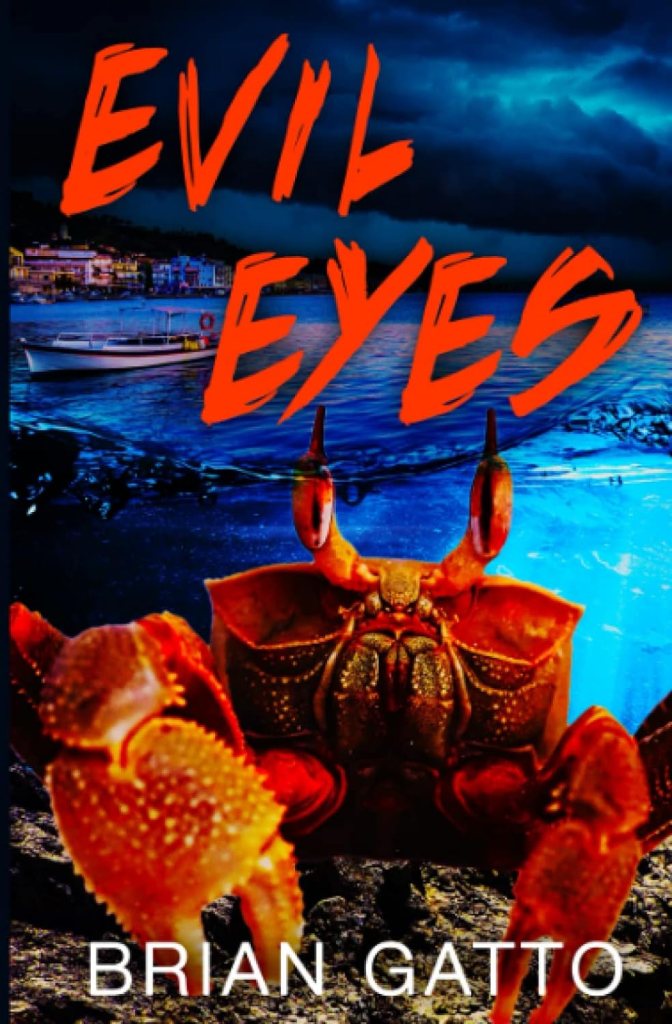
In Brian Gatto’s novel Evil Eyes, Winga Beach was also ground zero for a devastating giant crab invasion. “It was like something out of an apocalyptic scenario,” wrote Gatto. “The crabs came and conquered—today Gloucester, tomorrow the world.”

Before the crabs arrived, Massachusetts’ North Shore was a peaceful place home to generations of fishermen, young families, comic book nerds and headbangers. It was also the adopted hometown of 29-year-old Paula Lucile, a sexy adult model hoping to escape her manipulative manager and ex-boyfriend. 

One day, without warning or provocation, five enormous crabs emerged from the boggy beach. Besides being over 12 feet tall, they were not normal New England crabs. They had hate and bloodlust in their eyes and they enjoyed torturing their victims before gobbling them up. Hearing them eat, said the author, was like hearing someone slurping ramen noodles through a sippy cup—the kind with an attached straw. “We’re all going to die!” cried police deputy Vince Drayton. 

The crabs were tearing up downtown Gloucester, but somehow there was still time for a little romance. Paula had bumped into Nick Anderson at the local comic book shop and the pair quickly bonded over their love of Galacta Girl and Annihilator: Crime Zone. They made plans to celebrate Nick’s 18th birthday that night at a popular local restaurant called the Catch’n’Feast. 

Nick was totally shocked that someone like Paula was interested in him. He was scrawny and not very attractive and she was a glamorous pin-up gal with boobs the size of watermelons. The curvy model didn’t care that Nick looked like a homeless wet dog. After ditching her former salacious lifestyle in Los Angeles, Paula was looking for something a little more sober. Nick was everything she could have wanted. He had a beautiful soul, she thought. 

As you’d expect, the crabs had a nefarious origin story linked to a secret military experiment. The government wanted to create a squadron of crabs with human intelligence that could hypothetically control the waterways. If coastlines weren’t safe, then water traffic wouldn’t be safe. Supply chains would be disrupted, world economies would crumble and the U.S. would rule the Seven Seas like a modern-day Poseidon. 

Unfortunately things didn’t work out exactly as planned. The crabs grew large, escaped from captivity and pursued their own agenda. Massachusetts was the first stop on their ravenous world domination tour.  

Admittedly there were problems with Evil Eyes that could have easily been fixed by an attentive editor, but I enjoyed reading it nonetheless. There’s no way I could ever give a giant crab novel a bad review—that’s just the way I’m wired. 

I have two specific comments however. One: Nick was clearly a wish-fulfillment-type of character. That meant he was a little bit annoying. And two: Readers might be disappointed that Nick and Paula don’t have time to consummate their relationship. Male readers in particular may suffer from epididymal hypertension by the end of the novel. 

[ Evil Eyes / By Brian Gatto / First Printing: February 2023 / ISBN: 9798378460113 ]

Classic Monsters

I’ve said it before and I’ll say it again—I don’t think it’s possible to write a bad Bride of Frankenstein story. Mary Shelley only mentions the bride intermittently in her novel, but hundreds of writers have since been inspired by the idea of a female Frankenstein monster.

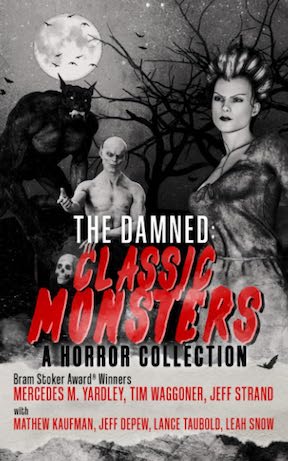
There’s a terrific Bride of Frankenstein story in a new anthology called The Damned: Classic Monsters. The bride (named Marieke by author Mercedes M. Yardley) was only 30 minutes old when she learned that she’d been created solely to be a monster’s mate. Trigger alert: She wasn’t given an opportunity to express her feelings one way or another because her lips were sewn shut. 

At first Marieke was confused by her contradictions. Dr. Pretorius professed that she was created to rival the gods and Dr. Frankenstein called her a work of art. But she knew, after being paired with her ghastly betrothed and fleeing a mob of angry villagers, that she was a monster herself. She was inextricably the “Sum of Her Parts.”

A couple of stories from Classic Monsters featured vampires from two decidedly different perspectives. “Renfield’s Journal,” for one, was a first-person account from Dracula’s infamous majordomo. What was it like eating rats and cockroaches in the castle dungeon while devoting your life to the king of vampires? Author Lance Taubold knew the shocking truth. 

“What Was Once Flesh” by Tim Waggoner was a story about an old vampire named Al who was mentoring a newly turned vampire. Dylan, the enthusiastic rookie, had questions about his new undead reality. “I’m an apex predator now, the very tip-top of the food chain,” he asked. “But am I more than that? Am I evil?”

The answer, of course, was yes. But Dylan’s idea of evil paled in comparison to the evil machinations of his wizened partner. Drinking blood from the animus (the soul) was like ambrosia to Al and he was using Dylan as a pipeline to his addiction. Even though he wasn’t technically alive, Al had found a way to live the good life.  

For personal reasons, my favorite story was “The Invisible Man” by Jeff DePew because I know firsthand how it feels to be invisible. It sucks. Being unseen can be an effective survival tool, I guess, but it’ll drive you crazy in the end. 

I can’t end this review without mentioning Jeff Strand’s zany contribution. Carl, a 25-year-old werewolf, reluctantly agrees to appear in an adult movie. It’ll be the ultimate porno flick, promised the director. “A bestially masterpiece beyond anything the world has ever seen.” 

“Werewolf Porno” was funny, but it wasn’t without considerable collateral damage. During filming Carl the psycho werewolf killed everybody on set. Not to worry, however; the movie’s director got exactly what he wanted. Blood Orgy Rampage of the Werewolf became the #1 bestselling underground DVD of the year. 

[ The Damned: Classic Monsters / Edited by Mathew Kaufman / First Printing: October 2023 / ISBN: 9781734131123 ]

Marvel Zombies

Back in the day, they were called Marvel Zombies—those comic book zealots who were hopelessly devoted to Marvel Comics. No Ralph Dibny for them. No Darkseid, no Swamp Thing and no Batman either. It was all Reed Richards, Thanos, Man-Thing and Moon Knight. There were no copies of Eightball in their long boxes, only Speedball

Initially it was a derisive term. If you called someone a Marvel Zombie you were questioning their taste level and dismissing their comic book cred. But in 2005 Marvel successfully flipped the script. That’s when the company published a titular series about superhero zombies. It was a big hit and spawned numerous sequels and reboots. As a result, nobody had to be embarrassed to be called a Marvel Zombie anymore. 

Now we have a prose novel called The Hunger by Marsheila Rockwell. Like the comic, the zombie virus came from a piece of space rock. While investigating the crater hole in Midtown Manhattan, Captain America caught the infection first and immediately passed it along to Ant-Man. One thing led to another and all of the Avengers quickly became flesh-eating monsters. It was Spider-Man who infected Doctor Strange. The Sorcerer Supreme quickly beat a path back to his Bleecker Street mansion for a tasty snack—i.e. his friend Wong. 

Within the first few pages of Rockwell’s novel, the world becomes overrun by superhero cannibals. Nobody could figure out what was going on because all the best minds had been exposed to the virus: Richards, Stark, Banner, Shuri, Nadia Pym, Lunella Lafayette—they were all “rotters.” 

A small group of unlikely heroes rose from the rubble. There was goth witch Nico Minoru from the Runaways, a monster hunter named Elsa Bloodstone and—because of a little time traveling hiccup—two versions of Wade Wilson. 

Most importantly, the group included Doctor Strange’s young librarian and apprentice, Zelma Stanton. She knew some of her mentor’s tricks, but most importantly she had access to the Chamber of Shadows, the Sanctum Sanctorum’s vast library of grimoires. 

With these books at their fingertips, she and Nico started looking at time spells, reality-altering spells, and realm shifting spells—anything they could use to move the zombies from the here and now to the elsewhere and elsewhen. 

Eventually, they concocted a plan to go back in time and nip the zombie apocalypse in the bud. They would tap into the time stream and create an infinite loop, open a portal to it, gather all the zombies together and toss them into the abyss.

It was an iffy plan. But what was the alternative? There was no Plan B. Even if it was possible, Zelma wasn’t convinced she could pull it off. To paraphrase a well-worn Spidey catchphrase: “With limited power came little ability to change things, but huge quantities of guilt.”

To be honest, The Hunger had some good moments, and a whole lot of bad moments. The good stuff was LOL funny I have to admit, but the bad stuff made me cringe. 

The good stuff included an endless series of guest appearances from the expansive Marvel Universe. It also featured an improbable battle involving Fin Fang Foom and Zombie Hulk onboard La Santa Gallega in 1492.

The most ridiculous thing (a.k.a. the best thing) was when the time-traveling heroes went all the way back to 1,000,000 BC. They didn’t bump into Raquel Welch, but they did meet Odin All-Father and his Stone Age Avengers. Crazy things like that kept me reading late into the night. 

But like I said, there was a lot of bad stuff in The Hunger as well. For one thing, the unending and repetitive navel-gazing wore me out. Plus, the author tried to make me care about the death of a character who wasn’t even in the story—that’s a writerly skill that most writers can’t pull off. 

And finally, there were two moments in the book that were underwhelming to say the least. The first was Elsa Bloodstone’s emotional confession at the half-way point of the story. The second underwhelming moment came at the end. There’s one thing that all readers demand from a time travel story: The author needs to stick the landing. Marsheila Rockwell didn’t.

[ The Hunger / By Marsheila Rockwell / First Printing: October 2023 / ISBN: 781839082453 ]

Uncharted Realms of the Human Experience

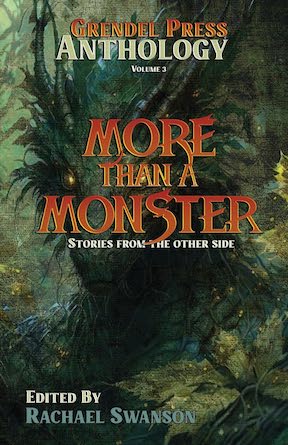
Monsters aren’t just wurms, woodwoses, wolf-men and spider whores. Like everyone else, they can be brothers, sisters, mothers, fathers, rappers and cowboys. According to More Than a Monster, a new anthology edited by Rachael Swanson, they can even be anti-Santa’s little helpers. 

It’s true, as Swanson writes in her brief introduction to this volume, that monsters occupy uncharted realms of the human experience, but they remain monsters nonetheless. Big or small, old or young, they all share the same history—at some point in their lives they’ve done monstrous shit. 

That’s what author Bert S.G. says in his nuanced story called “The Last Days of Monster Park.” Located somewhere in the radioactive hellscape of the Mojave Desert, Monster Park is a place where scary creatures and mutants are safely quarantined. Once captured by the authorities, they’re encouraged to work out their issues with therapy sessions, meditation, journaling and lots of weed. 

Unfortunately, it’s hard for such a disparate group of monsters to coexist. In Monster Park there are gill men, spider ladies, animated skeletons, werewolves, blobs and vampires mingling with each other. There’s always going to be some sort of conflict brewing—sometimes fatally. 

Monsters generally don’t get along with other monsters and they certainly don’t get along with their human neighbors either. Even shapeshifters have difficulty fitting in. That’s the case with stories by David Rider, Zachary Rosenberg and T.M. Morgan. Whether it’s a gang of preteen werewolves, a suburban jorögumo or a hungry monther, nobody can hide their monstrous nature forever. 

But who are we to judge? Larry Talbot didn’t ask to be bitten by a werewolf, King Kong didn’t want to leave Skull Island and the Bride of Frankenstein didn’t want to marry a monster. Like Howard the Duck, all monsters are trapped in world they didn’t make. 

For balance, the editor includes a couple of stories in her collection which feature monsters and humans finding common ground: “Take My Hand” by Christie Hansen and “Vesper’s Garden” by Ville Meriläinen. 

Hansen writes about an awkward meeting between a female troll and a distressed woman lost in the swamp. What follows is a series of misunderstandings (some comical and some not) between the two ladies. Everything works out for the best, thank goodness. The story’s charitable title turns out to be both figurative and literal. 

More profound is Meriläinen’s story about a tightly knit family of enchanted woodland creatures. The moondeer are generally shy, but when provoked they embrace a tribunal of ultra-violence. 

There is no wisdom in anger, however, and one fateful night teaches the moondeer to take responsibility in the face of unresponsive nature. By living harmoniously with their human neighbors, they learn that forgiveness is a gift they can give to themselves. 

[ More Than a Monster / Edited by Rachael Swanson / First Printing: September 2023 / ISBN: 9781960534057 ]

Monsters Unleashed, Part 3

It’s been several months since dinosaur eggs were found in a sea cave along the San Francisco coastline  (click here for more details). The time had finally come for a group of cave-diving commandos to embark on a  journey to the center of the earth. 

These potholers were comprised of various military and security personnel, doctors and scientists. The assignment was straightforward: Explore the cave system and destroy the eggs. They all knew their mission was a one-way ticket to Hell. 

The leaders of the expedition were Callie Breyer and Lara Newcomb, the heroines from the two previous novels in the series (including Rise of the Titanosaurus and Rage of the Titanosaurus). Both women felt a personal responsibility to protect their hometown of San Francisco from an insurrection of giant monsters. And, if necessary, they were willing to protect the rest of the world too. Their commitment was unwavering. 

In the past, Callie and Lara were the champions of their own separate narratives. This time, I was hoping to finally see them working together side by side. Unfortunately, rotating chapters and divergent catastrophes kept the alpha ladies (mostly) apart. That’s too bad. It was like they were on two separate adventures. 

As expected, the cavern contained a sundry of prehistoric dangers, but the biggest threat was the spelunking itself. Twisty passages, vertical shafts, unstable bridges, claustrophobia and hallucinations plagued the search party the entire time. It didn’t help matters that the roar of a baby Titanosaurus was like a sonic boom. Each roar caused a seemingly insurmountable mini-disaster of its own. 

The underground labyrinth was completely baffling to Callie, Lara and everyone else. From the git-go they became disorientated and didn’t know up from down. The tunnels, caverns and cliffs weren’t random, however. It was obvious they were created with a purpose. 

The passageways all pointed toward a vast common area that looked like a Garden of Eden for dinosaurs. It was, wrote John Grover, a primordial ecosystem that had somehow blossomed beneath the world of man. “An emerald green carpet blanketed the cave floor in the form of moss, algae, liverwort and ferns. A thin river ran right through the cavern. The air was moist and the area was lush—a place untouched by human existence.”

Paleontologist Theo Stanfield wasn’t too surprised to discover the underground oasis. Dinosaurs were a lot more intelligent than anyone realized, he said. “Some were even smarter than dolphins. They were social creatures and they had the capability to work together.”

Despite the discovery of the idyllic prehistoric paradise (and all the invaluable biological information it contained), the spelunking squadron still had a mission to complete. To save San Francisco from any future dinosaur attacks, they brought the cavern down with enough explosives to obliterate a micro-neighborhood. Only four members of the original troop survived the ordeal, but the dinosaurs and their eggs were destroyed. I guess you could call that a success. 

[ Den of the Titanosaurus / By John Grover / First Printing: September 2023 / ISBN:9798860661530 ]

The Night Time Is the Right Time

David Agranoff’s outstanding new novel begins on April 30, 1945, the night Adolf Hitler kills himself in an underground bunker below the streets of Berlin. 

With the Führer dead, the end of WWII is imminent. Germany’s surrender is just days away, but there’s still a couple of loose ends to tie up. A radical OSS agent named Noah Samvovich is determined to chase down and execute 150 high-level Nazi Party members on their way to Manchuria via the Berchtesgaden Alps. 

This group includes members of Hitler’s inner circle, plus an assortment of military officers. The most infamous of these goons is Heinrich Himmler, the Reichsführer of the Schutzstaffel. “No one short of Hitler is more responsible for the crimes of the Final Solution than Himmler,” says Samvovich who’s seen firsthand the horrors of the concentration camps. Like Batman and other emotionally damaged vigilantes, he wears his rage like armor and carries it like a weapon. 

The clock is ticking for the avenging OSS agent and his suicide squad. Once Germany surrenders and the Nuremberg trials begin, they won’t be able to get close to their Nazi prey. They have one chance to get it right. It is, as the novel’s title makes clear, the last night to kill Nazis. 

Samvovich knows that Himmler and his retinue are resting warmly and comfortably inside Hitler’s reclusive alpine chalet. All he needs to do is drop his secret hellspawn weapon into the middle of the Eagle’s Nest. He figures it’ll take a monster to kill a bunch of monsters. He’s right. 

Count Reiter is a 400-year-old vampire with a personal grudge against Germany. Because his ancestral home sits on the highest peak in Romania, the Nazis consider it a key to protecting or taking the most valuable regions of Europe. Reiter isn’t happy about the Wehrmacht knocking down his doors. In truth, he’s pissed off about it. He enters the war the moment he hears German boots echoing inside his castle atop the Carpathian Mountains. 

Reiter is a monster imbued with powers from Hell. He understands that he’s evil, but he has a little bit of self-control. He’s not a heartless creature after all. Here in the twilight of WWII, Reiter is more than willing to help the Allies permanently squash the Third Reich. “I assure you, I hate the Nazis too,” he says. “I consume to survive, but the things they do, the way they wield misery, is an insult to monstrosity.”

As promised, Count Reiter is an excellent Nazi smasher. He’s also a great tool for exposition. Because vampires absorb the memories of their prey, the author uses Reiter to illuminate the sins of his victims. “The souls of those he consumes, and their memories, joys and fears are like a universe to which he is God,” writes Agranoff. No one escapes judgment day.  

[ The Last Night to Kill Nazis / By David Agranoff / First Printing: September 2023 / ISBN: 9781955904728 ]

The Heroic Trio

Bramley was a college dropout working the graveyard shift at an all-night gas station. Because of his shitty job, he could barely pay rent. He lived in the urban slum of Leedham, the armpit of Massachusetts, and had no friends and a two-timing girlfriend. On top of everything else, he couldn’t leave his apartment during the day because there was a zombie pandemic raging in his neighborhood. 

The zombie outbreak turned out to be a kick in the butt for Bram. Here was his opportunity to reinvent himself, leave his dead-end job, dump his cheating girlfriend, kill some zombies and go back to school to get a business degree. There were monsters in the streets but the future looked bright, he told himself. 

Jeff O’Brien’s latest novel, The Halloween Orgy Massacre, Part 2, was a loopy horror comedy and a randy harem romance rolled into one. Love and danger were in the air and Bram had no problems surrounding himself with a battalion of pretty girls to keep him warm during the apocalypse. 

There’s Bianca, an olive-skinned dominatrix who didn’t go anywhere without her whip and cat-o-nine tails. She wasn’t afraid of any man, dead or alive. “Isn’t this exciting?” she said enthusiastically. “I can’t wait to slay some zombies!” 

Then there was Tess, the buxom spitfire who favored pink wigs, skimpy outfits and Meiji Matsumoto anime. When she wasn’t watching Galaxy Express 999 and Captain Harlock videos, she was dancing at the Bursting Cherry strip club on the edge of town. She and Bramley hit it off immediately. “Let’s fuck like the world’s ending,” she said, “and then I’ll make some pancakes for us.”

And finally there’s Lilly, a perky goth girl with a big boner for Bram (if you’re curious, Lilly’s the one on the book’s front cover). She knew how lonely the zombie apocalypse was for a young man, so she sent him a selfie of herself masturbating. “What’s a little nudity between friends?” she asked innocently. 

It was Lilly—the smart one—who figured everything out. She wasn’t a conspiracy theorist or someone who jumped to illogical conclusions, but it was easy for her to connect the dots between the state’s governor, the military and the zombie virus. She knew the zombies were part of a nefarious plot to flatten the slums of Leedham in order to erect high-rent apartments and lavish restaurants. Everyone agreed it was a dirty rotten plan. 

Along with a good-natured pimp named Stone Stallone Trombone (who dressed not unlike the Joker), Bram and his sexy heroic trio unite to save the world. Their madcap adventure includes lots of bra-busting action but no sex (all the hardcore stuff happens off the page btw). 

In the end, the author wants you to know that his novel isn’t just about male titillation. It’s about grrl power too. The zombie invasion was squashed by three gutsy ladies. “Women,” he said, “were in the right place at the right time and rose to the occasion when America needed some true heroes.” Let’s all say it together: “God bless America!”

[ The Halloween Orgy Massacre, Part 2 / By Jeff O’Brien / First Printing: July 2023 / ISBN: 9798854468527 ]

New Gods, Part 2

This second Megadrak novel from Christofer Nigro picks up immediately following the events of the first book (read my review here). It was 1954 and a gigantic  reptilian monster with ill intent was racing toward Japan’s largest island Honshu.

Spawned by the atom bomb, but deadlier than the bomb itself, Megadrak wanted to topple humanity from its exalted place at the top of the planetary food chain. The 55-meter-tall behemoth perceived Honshu’s largest city Tokyo as an affront to its primal cognitive directive. Megadrak was, according to one eyewitness, “the beast of the apocalypse—Leviathan manifested.”

Megadrak was the first daikaiju the world had ever seen, so it made sense for people to compare it to age-old religious and folkloric monsters such as  Jörmungandr, Tiamat and Yamata no Orochi. Said the author: “It was a beast that looked as if it could be challenged by nothing less than one of the gods themselves.” 

Unfortunately, there were no benevolent Shinto or Christian gods available for duty. It was up to Japan’s ground and air forces (along with some help from nearby U.S. troops) to counter the oncoming titan. Spoiler alert: the military couldn’t stop mighty Megadrak from tearing up Tokyo. That was bad news for Tokyoites, but good news for the rest of us. 

Megadrak’s attack on the city’s metro railway system was particularly memorable, and featured (perhaps) the best descriptive writing in the volume. Take my advice, when a giant monster comes to your prefecture, stay away from trains and the subway. You’ll never get out of the city alive.

The destruction of Haneda Airport and the National Diet Building were also pretty awesome. Somehow Megadrak instinctively knew that destroying these two locations would break the spirit of Japan. Here and elsewhere, the author does a good job of describing what it would be like to be inside a building being torn apart by a super-monster. Before the dust even settled “the kaiju announced his multiple triumphs with a roaring hiss that seemed to evoke a sense of sadistic glee.”

Nigro drops a bomb during a brief moment at the Yasukuni Shrine. I’m not 100 percent what happens here, but it definitely opens the door for numerous sequels to come. There are other moments throughout the book that provide a bit of foreshadowing—the epilogue, in particular, is filled with a mad jumble of clues for future volumes. 

The novel ends with an intense double-fisted climax featuring an unlikely crucifixion and a heroic kamikaze gambit. Does Megadrak survive? Do other mutant monsters reveal themselves? And what’s up with the Kaiju Kombat Force? Monster fans (like me) want to know. 

[ Megadrak: Tokyo Screams, Book 2 / By Christofer Nigro / First Raven Tale Edition: June 2023 / ISBN: 9798396849945 ]

New Gods, Part 1

It all started in 1954 on a small man-made island located in Tokyo Bay. That’s when humanity came face-to-face with the wrath of nature’s vengeance in a manner few besides Biblical literalists could ever have imagined. 

I’m talking about the appearance of Megadrak of course, the first daikaiju the world had ever seen. Fifty-five meters tall, covered in bluish-gray bony armor and adorned with tiger-like stripes, the Brobdingnagian über-beast rose from the Philippine Sea and quickly asserted its alpha status over mankind.  

In chapter two, author Christopher Nigro spends five chunky paragraphs describing the fearsome reptilian monster. All you really need to know, however, is that Megadrak is a proxy for Godzilla. 

The author freely admits that this novel (and its sequel) represent a dark retelling of the early mid-century Gojira films. It’s all part of his inclusive DragonStorm Universe of giant monsters and tokusatsu superheroes. After reading Megadrak: Beast of the Apocalypse, Book 1, I look forward to future volumes in an ever-expanding DSU.

Before Megadrak makes his big screen debut though, a clew of giant mutant bloodworms invade the island of Odaiba. The hideous annelid were 12-meters long with proboscides filed with copper-metallic fangs. In many ways, the worm onslaught reminded me of a creepy Jinji Ito manga.  

It became clear right away that Japanese response teams and U.S. naval support weren’t ready for Megadrak. They were dealing with a beast considerably larger and more deadly than anything outside of the darkest and most frightening passages of world mythology—larger than Tiamat, Jörmungandr or Fin Fang Foom.

The story is told through the eyes of a marine biologist, an amateur naturalist and a local fisherman. All three knew firsthand how destructive and unrivaled Megadrak was. They also understood how the leviathan could be a serious threat to dethrone mankind from its position at the top of Earth’s food chain. 

I must confess that I never fell into a comfortable rhythm with Nigro’s (somewhat) awkward writing style. Even though it’s not a translated manuscript, to me his text read like a literal translation in need of a rewrite. For example, he calls a fisherman a “procurer of aquatic food.” But I know literal translations have become popular these days because of manga pirate sites—sometimes more popular than officially approved translations. So who knows? Maybe Nigro is doing it on purpose. Maybe I’m the one who’s not in sync with current reading preferences. 

On the other hand, all G-fans will undoubtedly enjoy the occasional nods to the original Gojira source material. It’s a lot of fun and personally I’m always open to new interpretations of the classic Toho films. 

There’s also a funny callback to the original King Kong movie from 1933. In one memorable scene, a pretty police secretary named Kei is grabbed by the towering colossal reptile. Like Kong, Megadrak is curious about attractive human females and wants to get a closer look. Unlike Kong and Ann Darrow, Megadrak doesn’t remove Kei’s clothing in a fumbling, naive manner. The monster simply gives her the stink eye and stuffs the struggling woman into its cavernous mouth.

[ Megadrak: Beast of the Apocalypse, Book 1 / By Christofer Nigro / First Raven Tale Edition: June 2023 / ISBN: 9798396850156 ]