Down the Rabbit Hole

A cave entrance was accidentally discovered in a small Missouri town during the Civil War. To be honest, says author Judith Sonnet, it wasn’t exactly a cave. At the time it was just a burrow, no more than a rabbit’s hole. 

One hundred years later, the rabbit hole had been expanded into a deep, circuitous chain of caverns that sprawled underneath southwestern Missouri. At some point, an ambitious developer spent a ton of cash to turn the area into a popular tourist destination. The Rabbit Cave Resort was built at the cave’s entrance and offered “an experience unlike any other—dining dancing and spelunking.” The resort also featured a Playboy Club-like lounge called the Rabbit Den. 

Things were going well until the spring of 1974. That’s when everything went pear-shaped. The resort was overrun by a horde of giant prehistoric creatures emerging from the cavern’s deepest recesses. Giant newts with saw-blade skulls, a millipede the size of a school bus and a couple of bats the size of German Shepherds. Ironically, there were no rabbits down the rabbit’s hole. 

The two giant bats provided one of my favorite moments in Sonnet’s book. Descending upon a vulnerable group of hotel guests, the bats were hoping to score a quick snack. Things turned absurd when the bats found themselves in a fist fight. Even now, the image of a man punching a bat truly makes me laugh out loud. 

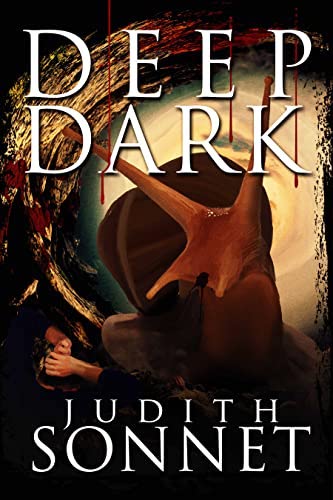
Easily the most aggressive creatures to emerge from the cave were the snails. There were snails the size of baseballs and snails the size of doormats. There was even a snail that was the size of a small automobile. Writes Sonnet: “They came in a wave of mucus and roiling slime—an orgy of tendrils, flickering proboscis and wavering eyestalks. A malignant amalgamation of gunge and stink.”

In one memorable scene, a giant snail was seen swallowing an unlucky bastard. It lifted its head, opened its mouth and sucked up its prey with a mighty slurp. Afterward all that could be seen was a mangled hand hanging from the creature’s quivering throat. It reminded me of the iconic poster for the 1972 movie Frogs.  

The snail invasion was terrific. Who knew that gastropods could be so compelling? They were unlike any snail you’d ever seen. “They were more like living tumors,” writes Sonnet, “huge bubbles that waggled obscenely.” 

Snails had one fatal weakness, however. They didn’t work in concert with a hive mind or under any instructions from a queen. I’m not even sure snails had brains. There was no strategy to their attack. They simply pursued food as it was presented to them. 

Nonetheless, at some point during the invasion a snail the size of a lion tried to establish some sort of alpha status. It crept atop a stalagmite, raised its lumpy head toward its peers and released a triumphant snotty sneeze.

Here was the moment (perhaps) when the snails would coalesce around a charismatic leader and destroy the human race. But it wasn’t to be. Only a few snails swiveled their eyestalks toward the elevated one. The wannabe alpha snail quickly fell in with its peers and was swallowed by the crowd. It was over. The moment was gone. 

[ Deep Dark / By Judith Sonnet / First Printing: May 2023 / ISBN: 9781959778417 ]

Creature from the Black Pit

Summers in Arkansas are the pits (pun intended). It’s “hotter than a whore in church” and there’s not much to do except stay inside, drink your mom’s beer and watch horror movies on Shudder. I guess you could get a job at Walmart if you were ambitious. But who wants to do that?   

Looking for some teenage kicks, a carload of drunk, stoned and rowdy kids decide to spend an afternoon at a nearby rock quarry. It’s been abandoned for years, but the open-pit mine still provides ample opportunities for diversion and mischief. 

The gang includes Pete the punk rocker and his girlfriend Hailey, best buddies Stacy and Kenneth and a couple of random girls named Ana and Megan. Little did they know that this was going to be their last adventure together. 

Forty-five minutes later, after hiking through the woods and passing an abandoned school bus (symbolism noted), the kids finally reach their destination. There’s nothing sexy about the dilapidated quarry, but there’s romance in the air nonetheless. Stacy and Megan, in particular, find a secluded spot and engage in some kissing and frottage. 

Unfortunately for the lovebirds, We Shouldn’t Have Let It Out is a short book and their petting session doesn’t last long. It was time for author Jonathan Tripp to introduce his monster from the black pit. 

At first there’s nothing remarkable about the creature. Based on the book’s cover and the author’s early descriptive language, it resembles a simple Susuwatari—one of the dust mites from the movie My Neighbor Totoro. Even though these things generally hang out in dark empty houses, they’re not very scary. 

That changes pretty quickly. The creature from the quarry is clearly malevolent and seems to have a pinch of mind control power. Also: it’s hungry. “Feed meeee!” it hisses impatiently.

One by one, the monster drags its victims down into the pit. Pete and his girlfriend are the first to go, but all of the characters eventually get their own tragic (and somewhat humorous) ending. “A perfect day has gone completely to shit,” grumbles Stacy when he realizes he’s not getting out of the quarry alive. 

There’s lots of gore and humor here (thank you very much), but unfortunately the author isn’t much of a stylist. Awkward syntax, inconsistent grammar and shifting points of view undermine the narrative. Ultimately, We Shouldn’t Have Let It Out exists as an immature effort from an emerging talent.

Checking out his author page on Amazon, I can see that Jonathan Tripp is putting out books at a rapid clip. That means he’s spending a lot of time pounding on his keyboard. After awhile he’ll figure out craft and style. Here’s a bit of advice for the young author: Keep typing until you start writing. And good luck! 

[ We Shouldn’t Have Let It Out / By Jonathan Tripp / First Printing: April 2023 / ISBN: 9798388816474 ]

Blood and Roses

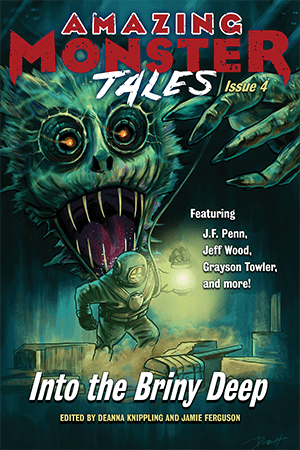
Here it is. Resting comfortably between the covers of Amazing Monster Tales, No. 4: Into the Briny Deep is the most titanic earthly creature of all time. After years of reading books and comics about swamp things, man-things, giant lizards, great apes and cyclopes, I have finally stumbled upon the greatest primordial monster the world has ever seen. I’m referring to the Brobdingnagian beast from Lee Allred’s short story “Murmuration of a Darkening Sea.” 

The thing lurked for uncountable eons beneath the sea. Now on land, the green black waves of water and brine seemed to shift and wriggle into one sinuous monster born from the deepest fathoms. 

The composite creature wasn’t made of mere pisciforms of flesh and bones and fishy scales, said Allred. “It was made of the sea water itself, translucent iridescent things not bound by the laws of nature.”

There wasn’t anything else in the latest edition of Amazing Monster Tales that compared to Allred’s “great murmuration from the deep.” The creature was a bit Lovecraftian, I have to admit, but it was still a unique and wondrous creation all its own. 

That said, however, the mighty leviathan in Grayson Towler’s story was remarkable as well. “Crotar” looked like a mutant Sperm whale with a dash of Humpback, Orca, dolphin and a dozen other marine mammals thrown in for good measure. “It was as if some essence of each animal, from the mightiest of the great whales to the humblest porpoise, had been drawn together and assembled into a single Olympian entity,” observed the author. 

The latest monster anthology from editors DeAnna Knippling and Jamie Ferguson also contained compelling stories about a Mediterranean sea queen, a lovelorn (horny?) sea dragon, a shark woman and a Ponyo-like fish boy. “The Late Bloomer” by coeditor Ferguson was about a young man and his family who vacationed yearly by the seashore. Only later, with the help of his girlfriend, did he realize how important the sea was to himself and his family.

And finally: There’s a little bit of Disney’s The Little Mermaid in “Blood and Water” by Alethea Kontis. Instead of being a beloved mermaid like young Ariel, Kontis’s siren was death personified. She was the shark, she was the thing to be afraid of. 

Rose was a siren who drank the blood of her victims. It wasn’t just the blood she craved, said Kontis, it was everything. She needed the sense and the feelings, the emotions and the pain, the good and the bad. She needed to feel love. She consumed souls to fill the barren places inside her. 

She finally gets what she needs when she’s introduced to her benefactor’s young daughter. The ending is hopelessly tragic, but you know what they say: “Love is a wonderful and horrible thing.”

[ Amazing Monster Tales, No. 4: Into the Briny Deep / Edited by DeAnna Knippling and Jamie Ferguson / First Printing: April 2023 / ISBN: 9798391563198 ]  

The Evil of Men’s Imagination

Platoon Lake was located deep within the Powamac Forest of Nova Scotia. It stretched for miles and provided a magnificent and inspirational view of eastern Canada.

But there was a curse upon Platoon Lake according to First Nations folklore. Stories were passed from generation to generation about a hideous creature called the Q’thahkral living at the bottom of the lake. Anybody who got too close to the water’s edge would instantly be snatched by the horrible sea monster with a thousand eyes and tentacles. 

Powamac locals didn’t believe in the centuries-old folk stories. Even though dozens of dead bodies washed ashore every year, Platoon Lake remained a popular camping and fishing site for nearby families.

Unlike his friends and neighbors, Reece Napier believed the old native stories were true. In fact, he didn’t understand how people could believe in Jesus, angels and miracles but not the strange things that lived in their own backyards.  

Reece was convinced Platoon Lake was a paranormal hotspot and he wanted to check it out. Because he was an amateur cryptid investigator, he packed up his camera and electromagnetic field recorder and hit the road. He was determined to catch a glimpse of the elusive Q’thahkral. If he did, perhaps his meager podcast audience would increase. 

As Reece got closer to the lake, strange things started to happen. Not only did he glimpse giant tentacles lurking in the shadows of the forest, but the radio in his truck started playing the sound of people screaming. At some point he was overcome with the feeling that he was being closely watched. 

By the time he arrived at his destination, Reece was ready to turn back and go home. He knew that he had made a big mistake the second he saw the lake begin to churn and bubble. 

The legends were true: the Q’thahkral was real. “It’s large serpentine head rose from the water and blotted out the shine of the moon,” said author Sédrie Danielle. “It’s gargantuan body had dozens of tentacles both small and large, and its head was full of eyes. The monster’s mouth was as wide as the abyss and its demonic wailing was loud enough to wake the dead.”

There were a handful of random characters at Platoon Lake along with Reece to witness the emergence of the Q’thahkral. They weren’t important characters in any way, but they all competed vigorously to be the “final girl” of the story. You’ll never guess who survives. Hint: It ain’t Reece.

Two surprises await readers at the end of the novel. One: the Q’thahkral wasn’t a sea monster at all. It was something else entirely. And two: the author may be working on a soon-to-be-released sequel. If that’s the case, I’d say we’re probably gonna see Reece Napier one more time. 

[ The Tail of the Q’thahkral / By Sédrie Danielle / First Printing: April 2023 / ISBN: 9798390635391 ]

Mean and Green Hotrod Queen

Gigi Stein is a monster woman living in a human world—a green-skinned, pinup, hotrod beauty queen with a bad temper. Like all the best green ladies (such as Gamora, She-Hulk and the Wicked Witch of the West), Gigi is hell on wheels. 

For some reason, hotrods have played a big part in monster culture over the years, and Loretta Kendall’s novel Gigi’s Monster Garage is definitely part of that continuity. I can’t tell you why monsters and nitro-burnin’ muscle cars hooked up in the first place—blame it on Ed Roth, I guess, or George Barris, Robert Williams or maybe Elizabeth Watasin. And don’t forget about Rat Fink, Mr. Gasser, the Weird-ohs, Odd Rods and the Munster’s Drag-u-la Coffin Car.  

Kendall’s novel is an adult monster romance starring a Bettie Page-like Bride of Frankenstein, an abusive Frankenstein greaser and a sexy human fboy. Also in the mix are a sundry of memorable supporting characters to make things extra spicy. My two favorites of the bunch are Barrett Jackson, the seven-foot Sasquatch who talks like a 90s-era sit-com hipster and Izzy, a blue imp who’s described as “a sparkling, glitter-bombed, rhinestone-loving weirdo.”

The drama began five years ago when some kind of “flashpoint” created a single world shared by humans and monsters. It was like everyone went back in time to relive Halloween circa 1953. “It’s just crazy,” reflects Fox Adams, the dreamy drifter who ultimately falls in love with Gigi. “Until recently, monsters were just stories on a movie screen. Then bam! Here they are.”

In this version of “Horror Earth,” Victor Frankenstein VII is a rich billionaire who digs up dead people, sprinkles them with fairy dust and sells them as sex slaves. Gigi Stein isn’t like the other “Frank-n-People,” however. She’s not a reanimated love doll lacking brains and emotions. She’s smart and has feelings. Despite what she’s been told by Frankenstein and all the other monsters, she knows deep down that she has a soul. She won’t let anyone use her body as a tool for their pleasure.

But, alas, Gigi is a monster with a raging monster libido. She needs some relief. She’s got an impressive collection of sex toys in her closet and often uses her motorbike as a vibrator, but what she really wants is a tumble between the sheets with a willing partner. Because she refuses to have sex with Frank N. Stein—the monster she was originally made for—she needs to start dating.

That’s when Fox Adams arrives. Described as “sex on raw steel,” he immediately catches the attention of Gigi. She offers him a job at her auto shop and starts flirting with him right away. After a few weeks of stop-and-go action, the pair agree to go on a romantic date.

There’s only one problem: Poor Gigi’s never been on a date before. After all these years she still doesn’t know the first thing about humans and their mating rituals. 

For advice, she asks her best friend Izzy what to expect. “Here’s what you do,” says the sassy blue devil girl. “Get down on your knees and suck him like a lollipop. And if you’re lucky that boy will eat your cookie like the Cookie Monster.” That sounds like pretty good dating advice to me. 

[ Gigi’s Monster Garage / By Loretta Kendall / First Printing: April 2023 / ISBN: 9798338418074 ]

Ungeheueres Ungeziefer

When Danny found out his girlfriend Stacy was pregnant he sorta freaked out. They were both recent high school grads who worked 100 hours per week at a local amusement park. Having a baby wasn’t exactly on Danny’s bucket list. 

He asked Stacy to consider a procedure that would fix the problem, and (as expected) she didn’t take it very well. “I’m keeping the baby,” she told him in a huff, “and it’s up to you to decide if you’re gonna stick around and help raise it.” 

At the Lone Star Land Amusement Park, Danny was the foreman for Shock Waves, a herky-jerky rollercoaster with multiple loops that flipped passengers upside down and sideways. Not only was it the scariest ride in the park, it represented exactly the way Danny felt about becoming a teenage parent. He was literally in “shock.”  

But that wasn’t the only symbolic coincidence to slap Danny in the face. An explosion near the amusement park opened a gash in the earth that released all sorts of nightmarish monsters. There were so many of them climbing to the surface that the ground seemed to move. “Thousands of limbs, clicked, clacked and scratched,” wrote author Matt Kurtz. “Their musky scent, an acrid stench like ammonia and rotting fish, rode the wind.” 

In a way, it was like Mother Earth was giving birth and her babies were all shapes and sizes. Some had exoskeletons, others coated in scales or leathery skin. They spewed out of the gaping crevasse like a rolling parade of insectoid and reptilian newborn invaders. 

It was an absurd Kafkaesque moment for the young carny. What would he do? Would he run from the “monstrous vermin” (ungeheueres Ungeziefer), or would he stay and face the problem? 

Danny decides to stay. He was afraid of becoming a father, but he instinctively knew that he had to conquer his fears no matter what form they took. Like it or not, he would have to overcome ticks the size of rats, ants the size of Chihuahuas and crabs the size of rhinos before he could fully commit to raising a child of his own.

Shock Waves is exactly the sort of novel that hits my sweet spot. I love monsters and I truly lost count of all the monster variants roaming the Lone Star Land Amusement Park. Based on this effort alone, I can tell Kurtz is a generous writer indeed. 

There were a million creatures in Shock Waves, but Kurtz saved his iconic “Big Mama” until the very end. Believe me, this thing was a doozy. The giant mantis-scorpion shredded the scenery like a classic Ray Harryhausen creation. 

When it was all over (hint: it’s never really over), Danny, Stacy and all of the survivors take a moment to reflect on what just happened. The carnage they witnessed didn’t represent the insignificance of life (as Franz Kafka might suggest). Instead, it emphasized the profound power of existence and the struggle it takes to define oneself.  

[Shock Waves / By Matt Kurtz / First Printing: April 2023 / ISBN: 9788377005629]

Bigfoot Hi-Jinks

Even though marijuana is steadily becoming legal in this country, I bet most weed farmers in the U.S. reject legit distribution channels. Why bother with taxes and annoying Department of Cannabis Control regulations when it’s simpler to go through the existing blackmarket? 

Unfortunately, operating a rogue marijuana farm comes with a host of problems. Farmers don’t have to worry about the DCC, but they have to deal with nosy neighbors, local police and saboteurs. That’s why these enterprises are generally located in the most remote areas possible. 

Author Armand Rosamilia doesn’t specifically say where the farm in High on Bigfoot is located (he merely says that it’s in the middle of nowhere), but I presume it’s in Northern California or Oregon—in an area hidden deep in the forest on a mountaintop in hard-to-navigate terrain. 

There are other problems these outlaw farms have to wrestle with. A lot of dangerous creatures live in the Pacific Northwest—such as mountain lions, grizzly bears and giant hornets. It’s also the home of Bigfoot. And you can bet your bippy that this reclusive cryptid doesn’t like having its territory trampled upon. 

Buck and Aiden thought getting summer jobs working at the marijuana plantation would be great fun. They figured they’d smoke a ton of weed and earn enough money to attend community college in the fall. So what if they were doing something illegal—it was a better gig than flipping burgers at McDonald’s, right? 

Things didn’t quite go as planned for the two best friends. The first day on the job, they’re assigned latrine duty. And that night, they were duped into paying extortion money to a gang of bullies. The two stoner kids got straight pretty quick.  

Plus, there’s a lingering Bigfoot problem to worry about. “We do what we need to do,” explains Gestapo Karl, the Neo-Nazi boss of the farm. “We feed it and make sure it stays on top of the mountain and never comes down to hunt. We made a deal with it.”

BTW: How do you make a “deal” with Bigfoot? Is there some type of negotiation process? A lawyer review? Adequate compensation? Signed court documents? Maybe a handshake? I dunno. It sounds iffy to me. 

Whatever the case may be, Bigfoot isn’t playing by the rules any longer. It’s tired of eating weasels and chipmunks and starts eviscerating farmworkers left and right. In a botched rescue mission, Buck and Aiden are coerced into entering the beast’s lair to look for missing coworkers. They know it’s probably a suicide mission, but anything is better than shoveling shit eight hours a day. 

The end comes fast and furious with nearly 100 farmworkers dying in a single late night massacre (Bigfoot tore through the camp like it was made of tissue paper, says the author). Buck and Aiden survive the onslaught by locking themselves in a safe room and eating cookies all night. Thank God for munchies, amirite? 

[High on Bigfoot / By Armand Rosamilia / First Printing:  April 2023 / ISBN: 9781922861641]

Creatures of Salt and Soil

If you wanted to see a monster in the wild, there were many places to go—caves, mountain tops, castles, islands, Salem, Massachusetts. You might even look under your bed if you were so inclined. 

But real monster hunters knew the sea was the best place to look. There were all sorts of horny Octomen, clever octopods, gigantic kraken, lonely mermaids and restless sea-hags living in the briny deep. 

“Deep down below, where the pressure would crush you in an instant and the dark is midnight black forever, life teems in abundance,” wrote editor Mark Bilsborough at the beginning of this excellent short story collection. “Who’s to say this life is not intelligent? Who’s to say it’s not curious? Who’s to say we won’t see it one day wrapped around an ocean vessel or singing to us from sun kissed waves?”

The unfathomable ocean manifested itself in many surprising ways. One deep sea monster, for example, came from a primordial soup of shit and piss, oestrogen and crude oil. On land for the first time, the mutant creature breathed the sweet smells of carbon and sulphur, and filled its lungs with fossil fuels and greenhouse gasses. It was ambulatory trash born from the ocean and it represented a new “Food Chain” according to author Morgan Melhuish. 

In other ways, the ocean provided a home for otherworldly castaways. “Reshaping Tentacles” by Jennifer Jeanne McArdle was a story about an alien race trying to acclimate itself on a strange new planet. 

The Octomen, who resembled super octopuses in their original form, were allowed to stay on Earth if they twisted their bodies into human effigies (“We can never not be human,” said one conflicted alien). Problems arose when the tentacled creatures tried to assert their sovereignty.

More than anything, the watery depths were a metaphor for identity, fate, freedom and emotional rescue. “Beneath the Glass Dark” was a story about a grieving brother’s search for solitude at the bottom of a lake. The story becomes even more poignant when you read N.V. Haskell’s author bio.

A nature spirit, trapped in the wooden mast and figurehead of a pirate ship, finds companionship with a friendly mermaid in Lynne Sargent’s story “Creatures of Salt and Soil.” Women on the seas were rare, after all, and the loneliness of a dryad and mermaid were palpable. “I don’t want to lose her like I lost the forest,” cried the fairy. 

And finally, there has always been curiosity between marine lifeforms and surface-dwellers. Michelle Tang addresses this eternal attraction in the book’s final story “Depth Becomes Her.” When a human-like sea creature rescues a drowning man, a surprising (not surprising) connection is made. 

“I tried to see myself through his human eyes,” said the aquatic maiden. “I was a glowing creature with wild sea-kelp hair and large, dark eyes. My lips were like his though my nose was nearly flat. Maybe, to him, my amorphous body resembled a dress billowing in the current. He looked neither displeased nor afraid. Though I was unversed in the ways of such creatures, I detected a glint of … interest in his stare.”

[From the Depths / Edited by Mark Bilsborough / First Printing: March 2023 / ISBN: 9781914417153]

Beware the Squish

The sun will burn out in five billion years (give or take a few million years). And when it does, our earth will eventually wither and die. 

There’s a pretty good chance that humankind will be extinct long before the sun goes dark, however. With population exploding worldwide, land resources won’t be able to regenerate fast enough for people to survive.  

The world will soon be starving, confirmed Dr. Janice Fuller during her five-page novel-ending soliloquy. What was everyone going to eat in the future? “Bugs were a solution,” she said. “Vegetables and meat substitutes made from plants were another. They both had great potential, but each of these solutions relied on land mass for production. There wasn’t enough of it, even if we found ways to grow food on every desert and iceberg on the planet.”

Fuller and her colleagues at England’s National Nutrition Laboratory had a crazy plan to solve the existential crisis. They developed a squid-salmon hybrid that was fast growing and easy to farm. They called it “Squish.”

Unfortunately, all their ambitious gene manipulation and recombinant DNA techniques only resulted in an unpalatable mess. the Squish tasted like ammonia, apparently. With a shrug, they flushed their failure down the toilet.  

Not only did the hybrid creatures survive, but they also mingled with sludge from a nearby nuclear plant. Readers will undoubtedly be thinking to themselves: “Wait a minute. Why was a secret research laboratory located next to a nuclear facility anyway?” It sounded like a conspiracy theorist’s dream scenario, didn’t it? 

The Squish quickly mutated into a squad of unfathomable “squid things” that traveled up and down the Bristol Channel eating cows, dogs, pretty girls, fishermen and naked witches. After filling their bellies, they were pumped up and ready to spawn. And that was a bad thing according to an NNL biologist.“Squid males get extremely aggressive at mating time,” he warned.  

In order to stop the fast and aggressive waterborne predators, a former M15 agent and a local journalist get together to compare notes. They both agreed that the Squish could spark a worldwide disaster if it wasn’t destroyed. 

Feeding Frenzy is told through the eyes of Hickory Hollis, an independent contractor with Her Majesty’s Armed Forces. Hollis is an affable fellow who travels the countryside in his unglamorous Fleetwood Tioga. Interestingly, he keeps a copy of The Kraken Wakes by John Wyndham at his bedside for late-night reading. 

The novel ends in a scramble of Tom Cruise-like military heroics. Helicopters, high-tech harpoon guns, explosives and derring-do combine to eradicate the Squish. Or maybe not. 

Hollis couldn’t help but wonder what other unholy hybrids the scientists at the NNL were working on. He had a feeling that he would be recruited again to help squash another Squish-like monster in the near future. To be continued?

[Feeding Frenzy / By Robert Fael / First Printing: March 2023 / ISBN: 9781922861573]

Monsters Unleashed, Part 2

Three years ago, a pair of over-sized dinosaurs trashed the entire city of San Francisco (see my review of Rise of the Titanosaurus here). Fisherman’s Wharf, Haight-Ashbury, City Lights Bookstore, Lombard Street and the Painted Ladies were all destroyed. 

Now, in John Grover’s latest effort Rage of the Titanosaurus, the City by the Bay was slowly rebuilding itself. A new Golden Gate Bridge was put up, although nobody knew exactly what to call it. And Alcatraz, the iconic prison island, was now a science and military outpost. 

Unfortunately, the good folks of San Francisco didn’t totally eradicate their dino problem at the time. Not only was a new Titanosaurus raging across the landscape, but something else had arrived—something from beyond the Mesozoic Era.

The quadrupedal, sail-fin Dimetrodon was arguably  the premier apex predator during the Permian period and was long gone before the first dinosaurs appeared. When the giant-sized synapsid was spotted in San Francisco’s Sunset District, residents with PTSD knew their neighborhood was going to be demolished again. 

The two monsters battled endlessly and with no fear of consequence. Nothing could stop them. There were no comic book heroes coming to wrestle the behemoths into submission—no Shang-Chi, no Ant-Man, no Wasp, nobody. Said the author: “The two mega-giants shrieked and roared, rolling, tumbling in clouds of smoke and debris. They barely noticed the jets buzzing around them as they bit and clawed at each other.”

“Where does the world go from here?” wondered a dispirited onlooker. “This could just happen again and again. Will we have to live forever with the threat of giant dinosaurs appearing at random?” 

These questions (and more) remain unanswered by the end of the book. But that’s okay, I’m sure the author is working on a sequel at this very moment. There are a few tidbits to ponder in the meantime. 

First and foremost, we know there are dinosaur eggs incubating in a subterranean labyrinth below the streets of San Francisco. If I had to guess, I’d say there’s probably a yet-to-be-discovered interior world of monsters in the area. Expect some spelunking in the near future. 

And finally, I hate to say it but the writing is lackluster overall. I expected better from the author. Rage of the Titanosaurus is a perfunctory sequel filled with unsatisfying descriptive language and unearned emotional moments. And, as a former resident of the area, I can tell the author’s knowledge of San Francisco comes directly from a popular phone app. 

But who knows? With so many giant creatures running amok, my Google Maps criticism might not be relevant. In the next installment, there’s a good possibility that the entire Bay Area may soon disappear from all maps completely. 

[Rage of the Titanosaurus / By John Grover / First Printing: March 2023 / ISBN: 9798385502981]