The Bat Cave

Question: While reading a murder mystery (or any other type of novel), do you parse the clues, track the characters and second-guess the narrator in an attempt to figure out the resolution? Or do you simply enjoy the plot twists as they unfold?

In the past, I would spend a lot of energy attempting to solve the murder case before the final chapter—but I rarely got it right. These days, I generally sit back and allow the author to tell their story one way or another with no expectations from me.  

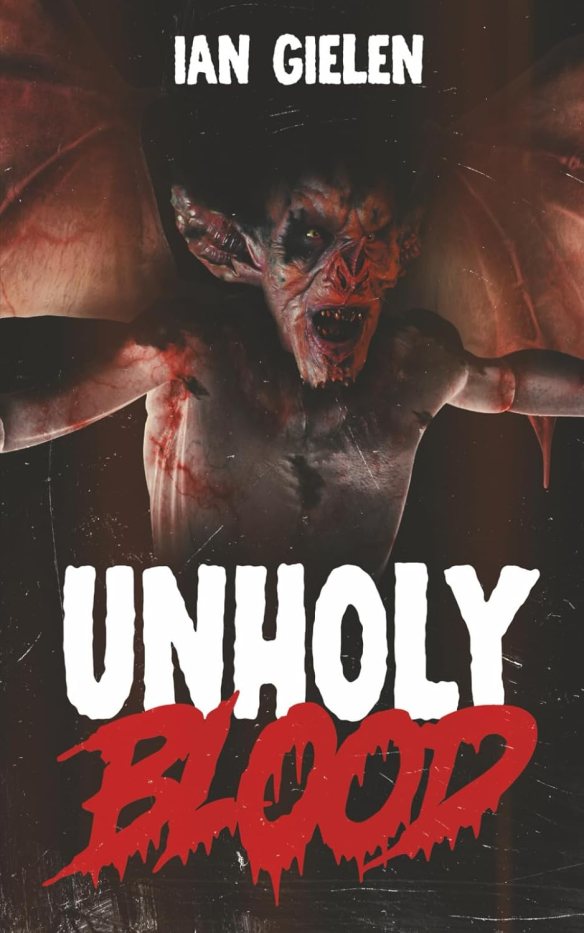
While reading Unholy Blood by Ian Gielen, however, I slipped up and misinterpreted a bit of baseless foreshadowing. “Aha!” I thought immediately. “I know exactly how this book’s going to end. The girlfriend is gonna take a hammer and smash her boyfriend in the back of the head.” 

Boy, was I wrong. There was no skull-smashing whatsoever. Instead of reading between the lines like I did, I should have focused more on the imminent danger—id est, the giant, otherworldly bat living in a cave beneath the Adirondack Mountains. 

What begins as a fun Halloween party for a bunch of jocks and their cheerleading girlfriends quickly escalates into a grisly subterranean nightmare. It’s messy, pulpy and deeply unsettling. 

Without question, the Coon Mountain cave and its labyrinth of tunnels were truly magnificent. It was an intricate tapestry, a rare ecosystem untouched by human hands. The kids were understandably awed by the splendor before them. 

What they didn’t know was that a horrible, bat-like creature was living in the cave. And now it was furious that its lair had been invaded by the sound of laughter and loud music. “There was something about these humans that made it angry,” said Gielen, “something from long ago that slipped through its mind like sand.” Driven by ancient suffering, the bat’s rage becomes a metaphor for forgotten trauma passed down through time. 

For 200 pages, the creature stalks the college kids through the meandering tunnels. I have to admit that the spelunking travelogue often overshadows the monster horror, but overall, Unholy Blood builds to a solid (yet bleak) finale. The author has written a novel with a unique blend of American splendor and American carnage. He even throws in a little bit of bat sex. Just like in Las Vegas, whatever happens in the caves of the Adirondack Mountains, stays in the Adirondack Mountains.  

[ Unholy Blood / By Ian Gielen / First Printing: July 2025 / ISBN: 9781764012614 ]

Turtlepocalypse

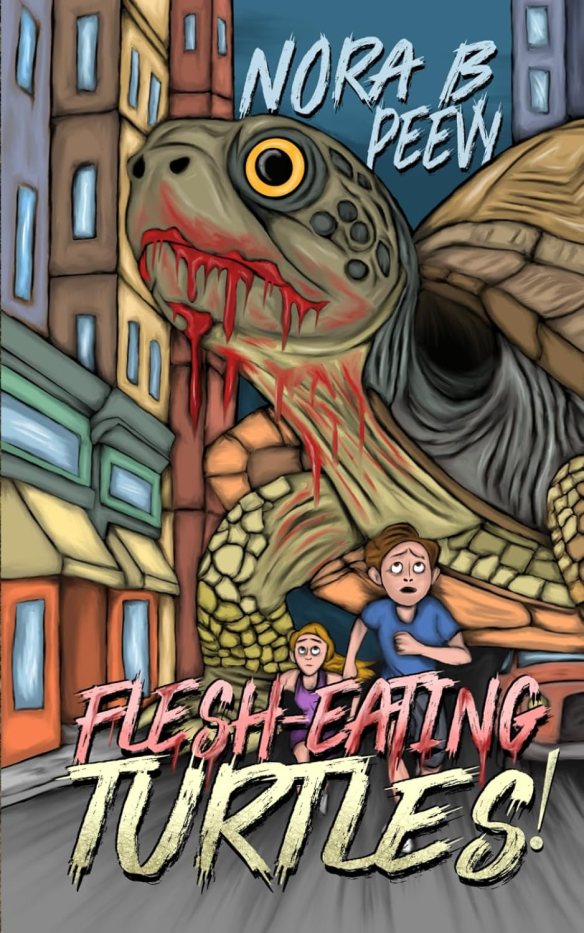
The Turtlepocalypse begins when giant flesh-eating turtles escape from a biotech laboratory in Milwaukee. Even though these abominations eventually reach a height of 20-30 feet, they aren’t exemplar proxies of Gamera, Japan’s much-loved fire-breathing, flying turtle.

Instead of being a kaiju smackdown, Flesh-Eating Turtles! by Nora B. Peevy (my new favorite author) is a genre-busting novel that’s equal parts eco-horror, science fiction satire and absurdist comedy. I guarantee that you’ll be laughing and cringing while reading this delightfully quirky book. 

Hoping to solve the escalating global demand for sustenance, Agne Labs (not Acme Labs) invent a way to engineer farm animals to grow bigger and faster. By doing this, they’re able to provide more food and be economically efficient at the same time. And for some reason, the scientists of Agne Labs are using turtles as their test subjects. 

Unfortunately, these genetically altered giant turtles aren’t docile or cute. Says Peevy: “There’s nothing cute about being eaten by an animal that is at least 5x larger than you.” They’re aggressive and omnivorous, with a particular craving for raw flesh (with a big scoop of mushrooms and insects on the side). In an early scene, two of the turtles invade a Golden Corral Buffet where one ransacks the salad bar like Godzilla and the other one bites fingers off patrons for a pigs-in-a-blanket-like snack. 

If bitten, scratched—or otherwise exposed to the artificially created DNA mutagen—all living creatures turn into horrible turtle hybrids. Events spiral out of control when all of the animals caged in the Milwaukee County Zoo are infected.

The author goes to town with all the hybrid monster variants. For example: A turtle/spider hybrid that looks like it came from an H.R. Giger painting, a half-turtle/half-snail monstrosity with over 10,000 teeth and over 10,000 beaks crammed onto one head and a turtle/deer creature as large as a Hummer H1 Pickup. “I don’t dare tell you what turtle/shark hybrids look like,” says Peevy, “or snakes and octopi, because they’re so eerie they belong in the pages of Weird Tales.” 

As the chaos builds, the narrative digs deeper into philosophical questions about genetic manipulation, speciesism and humanity’s habit of pushing nature too far. 

Peevy’s novel eventually reaches a satisfying climax when the giant turtles wobble toward the Reptile Expo in Schaumburg, Illinois. Overall, Flesh-Eating Turtles! is an outrageous and sharply satirical critique of scientific hubris packed with awesome mutant mayhem. 

[ Flesh-Eating Turtles! / By Nora B. Peevy / First Printing: June 2025 / ISBN: 9798317498030 ]

From Dusk to Dust

Nineteen-year-old James Evans hadn’t blown his load in a week and was almost ready to break his no self-fiddling rule. “A guy like me shouldn’t have to jack off,” he said. 

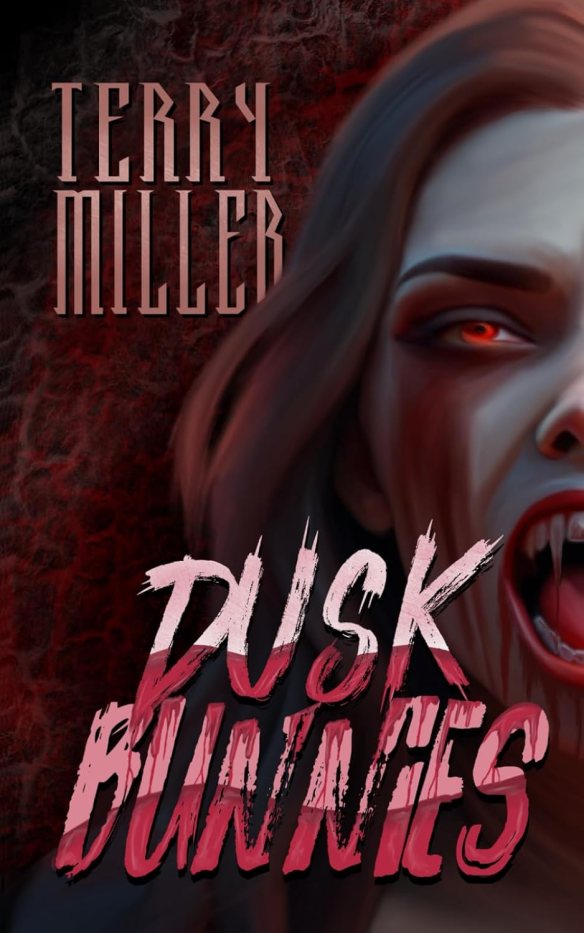
With no other options available, he allowed a sexy vampiress to bite his cock and suck blood from it. “She went down on him,” wrote author Terry Miller, “eliciting a scream which echoed off the brick walls of the alley. Two sharp teeth punctured through the skin of his favorite organ. The pain mixed with pleasure.”

And just like that, James became a bloodsucker himself. But that was okay. Being adopted by a coven of beautiful fiends named Charisma, Lucretia and Lilith, he would enjoy nightly sexcapades for the rest of eternity. I think all horny boys would agree: it was nice work if you could get it. 

That said, there’s more to Dusk Bunnies than vampire orgies. The dark ladies were being pursued by an obsessive slayer who doggedly followed them from New Orleans to Portsmouth, Ohio. Like Blade the Vampire Hunter and Abraham Van Helsing, Michael Irving was the real deal. He wasn’t a comic-book-collecting poseur like the Frog Brothers. 

Michael was 100 percent anti-vampire, but he had an embarrassing secret. Somewhere along the line, he developed a taste for vamp blood. It was the ultimate pick-me-up, he said. “Coffee and cigarettes were never as satisfying.” 

He wasn’t proud of his habit, but at least a sip of blood came with positive attributes like enhanced strength and healing. Hunting vampires was a dangerous job, and he was glad to have something to level the playing field. 

No matter what kind of supernatural boost he had, however, Michael was still no match for the three she-devils. As soon as he got to Portsmouth, Lucretia promptly and efficiently decapitated him. 

What happened next was totally unexpected. No spoilers from me, but the age-old rumors about the transformative power of vampire blood turned out to be true. 

Once the main characters were all brought together for the finale, Dusk Bunnies came off the rails like a crazy train (R.I.P. Ozzy). The author’s descriptive details were excellent, notably the initial transformation of James into a vampire and Michael’s transmutation into an apex predator. And finally: I had to laugh at the novel-ending tiff between the vampire gals and a cauldron of bats. Good stuff.

I only had one problem with the novel. There’s no clearly defined protagonist. It wasn’t James or the weird sisters or their pet wererat down in the basement. It’s not even Michael, although he was clearly the most compelling character of the bunch. His personal journey awakened a metamorphic crucible where blood boiled and bones reshaped into something not meant to walk this earth. 

[ Dusk Bunnies / By Terry Miller / First Printing: July 2025 / ISBN: 9798291825471 ]

The Heroes’ Journey

Alex was a get-rich-quick motherfucker. He was a proud dropshipper who never once laid his hands on actual merchandise. His automated system took online orders and activated shipments from warehouses around the globe. All Alex had to do was hang out in his bedroom and keep an eye on his favorite dating app.  

Mary was a bored housewife who sat on her couch watching Wheel of Fortune from morning till night. Ordering a cheapie lemon sprayer from Alex’s company Business Industry LLC provided a hit of dopamine that helped her get through the day. 

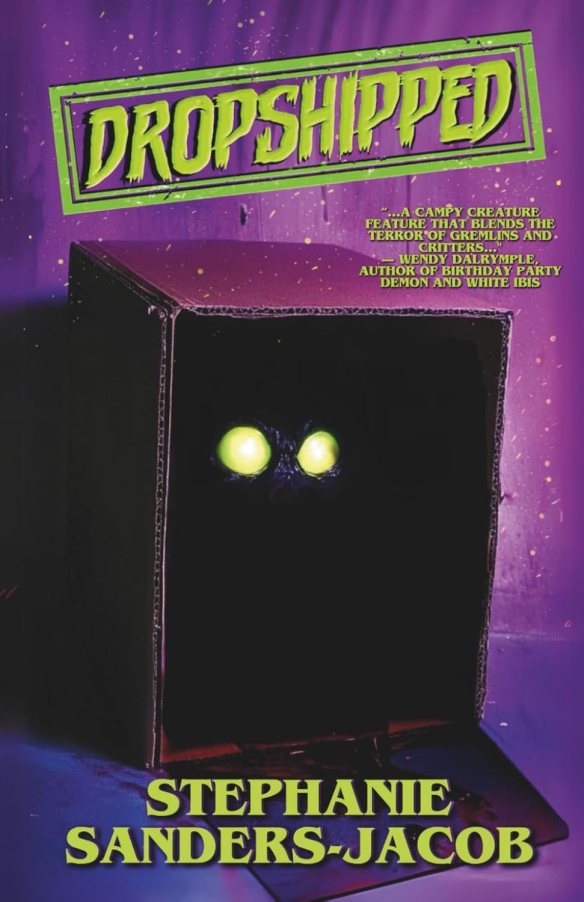
What Mary received in the mail, unfortunately, wasn’t a cute, little kitchen gadget. She opened up the package and found a strange orb wrapped in a nest of shredded paper. It was some sort of fantastic egg—cold like stone and smooth as marble. The smell of sulfur, struck limestone and fungus immediately made her gag. 

When the mysterious egg hatched a few minutes later, a gangly monster emerged. It looked like something you’d see a 4-H kid make at the county fair—slightly humanoid, like vegetables glued together, and sitting in a hot barn for a few days. 

Aghast, Mary put the creature on ice and stuffed it into the trunk of her car. She was determined to drive to the company’s headquarters in Illinois and rub the abomination in Alex’s face. 

Like Mary, Alex was mortified when he saw the pint-sized monster. As a dropship merchant, he had nothing to do with the shipment, but he figured there were probably more freaky creatures being sent through the mail. (Spoiler alert: he was right.) As a result, Alex and Mary decided to team up and drive to the east coast and infiltrate the original distribution warehouse. 

Even though author Stephanie Sanders-Jacob refers to the drive across America as Mary’s hero quest, I’m not 100 percent sure that’s correct. Is Mary the hero of Dropshipped? That’s debatable. 

It’s young Alex, I think, who best represents the 12 steps of Joseph Campbell’s “Hero’s Journey.” He commits to the adventure, couples with a mentor, defeats the monster queen and returns to his (new) family. Maybe I’m wrong—it’s totally possible that Alex and Mary were characters participating in a dual monomyth. I would love to hear the author’s opinion on this. 

While driving to the coast, the pair noticed fewer and fewer cars on the freeway, seeing instead broken and bloodied bodies, missing limbs and squished organs like roadkill. It was obvious the little dropship critters were on a bender. 

It was all too much, they agreed. Whoever was sending the tiny effigies through the mail needed to be stopped. Together, Mary, the lonely housewife, and Alex, the get-rich-quick motherfucker, vowed to end the carnage. They were on a Heroes’ Journey to save the world.  

[ Dropshipped / By Stephanie Sanders-Jacob / First Printing: July 2025 / ISBN: 9781763725614 ]

When Colossal Creatures Attack

Attack of the Colossal Creatures from Planet X asks one simple, yet unanswerable, question: What will it be like when giant monsters invade our planet? Will it be epochal? Apocalyptic? Biblical? I don’t know, but one thing is certain: life on Earth will change dramatically. 

Undoubtedly, there will be tragedy. People will die and buildings will topple. In the beginning, our defensive response will be inadequate. But eventually, over time, the fellowship of mankind will likely find a way to work together against the common threat. 

That’s the way it goes in the story “Dear Madame President” by Brendan Cottam. In a series of letters written to the President of the United States, Dr. Miles Bowman synthesizes data from recent kaiju activity around the globe. Together, the scientist and politician successfully rally other sovereign nations to develop a successful strategy for upcoming emergencies. Quick comment: The whiff of romance at the end of the story made me swoon. I loved it.

Of course, not all the “Colossal Creatures” will be evil. Some will be good, like the giant lizard bear in Ian Gielen’s story “In the Shadow of Giants.” The monster (named Cuddles) emerges from the Adirondack Mountains in New York and is friendly to humans, displaying a shy curiosity and intelligence. And in “Serum 87-F” by Tee Linden, a shot of “communalis gland secretions” enables a human to befriend a massive rock-like crustacean named Bribie, as large as a four-story building. 

Not everyone responds to rampaging monsters in the same way. Some people simply ignore the situation completely hoping that it will eventually disappear. Such is the case in Hamish Rankine’s story “Never Getting Out.” When a giant tentacled beast comes to her suburban neighborhood, a young girl named Blair is confused by her parents complete disregard for safety in favor of blissful ignorance. Eventually, like well-trained school children from the 50s, the parents scurry under the kitchen table for protection, leaving Blair to fend for herself. “She wished she had run so much earlier,” writes Rankine. 

In a similar story called “Front Page Scoop,” Kevin Anderson writes about a group of newspaper reporters debating what article to put on the next day’s front page. Hollywood fashion? A famous athlete’s infidelity? The world’s ugliest dog competition? Their journalistic instincts are blind to the towering alien climbing out of a nearby flying saucer. One reporter shrugs. “Whatever happens,” he says, “I’ll be glad not to read about it in tomorrow’s paper.”

And finally, according to “Mega Xeno Titan Kaiju” by Mark Oxbrow, some people will simply take matters into their own capable hands. When “vast alien monsters” emerge from a nearby space rift, only one person can stop them: Yoshi, the owner of the largest collection of kaiju toys and statues in the world. “It’s fate,” he says. “Out of everyone in the whole stupid galaxy, I know the most about battling kaiju.” 

[ Attack of the Colossal Creatures from Planet X / Edited by T.C. Phillips / First Printing: July 2025 / ISBN: 9780975621141 ]

A New Recipe for Disaster

There’s a specific moment in life when pop culture gets imprinted on your brain forever. It’s a period when movies, books, music (and everything else) sticks to you like bubblegum on the bottom of a shoe. My wife, for example, has an undying fondness for Duran Duran. For me, the primordial soup of my youth includes Charles Schulz, Ed “Big Daddy” Roth and Mad magazine. 

For author Dustin Dreyling, his influences are pretty transparent. His latest novel Primordial Soup: The Second Batch is clearly the result of a childhood spent watching kaiju and super robot films, playing video games and listening to hardcore 80s metal. 

Continuing the storyline from Primordial Soup: The First Batch (read my review here), the world was being crushed by the “horrible things” being created by competing biotech companies. Chicago, St. Paul and Minneapolis, in particular, had been reduced to fiery pits filled with rubble. 

Demons, vampires, were-creatures, changelings, trans-dimensional beings, spirits, the Great Old Ones, Elder Things and even biblical Nephilim were all mixed together in Dreyling’s second batch of hybrid monsters. Add a pinch of human DNA and it was truly “a new recipe for disaster.” 

Like the first installment, Dreyling doesn’t skimp on the action. The first 120 pages are basically an extended “Daikaiju Big Battel.” In addition, the monsters themselves represented the craziest menagerie of creatures I’ve ever seen. For example: “the cheetah-terror-bird-griffin combo” or “the reptile-squirrel-goat monster” or “the furry snub-nosed monkey-shark-frog hybrid.”  

All of these gigantic, man-made pests needed to be exterminated, but militaries from around the globe couldn’t contain the mega-beasts. The U.S. deployed a squadron of impressive 20-foot-tall robotic tanks that looked like something from a Japanese cartoon. But even these super robots ultimately failed. 

Mankind’s only hope for survival came with the arrival of a giant monsterbot named Volk’narr. Living on the dark side of the moon since the Cretaceous Period, his galactic assignment was to protect Earth at all costs. With an array of awesome otherworldly weapons at his disposal, Volk’narr immediately got to work killing daikaiju chimeras.  

As a result, the mechanical galactic soldier quickly became a global sensation. Said Dreyling: “Pictures of the giant robot went viral. He had become the closest thing to a superhero the world had ever seen.” 

Volk’narr was a hero, no doubt about it. But he wasn’t the hero that we all needed. Spoiler alert: His mission statement said nothing about saving humanity. He had come to Earth to save the planet but not the people living on it. I’ll be interested to see how things shake out in Primordial Soup: The Third Batch

[ Primordial Soup: The Second Batch / By Dustin Dreyling / First Printing: June 2025 / ISBN: 9798990366183 ]

GiganTick

Right from the beginning of Tick Town, a fun new creature feature from author Christopher A. Micklos, I knew I would fall in love with the character of Emmaline Blackdeer. As a cub reporter for the Tomahawk Hollow Gazette, her enthusiasm for the tenets of journalism warmed my cold heart. 

She didn’t care that traditional media like newspapers and magazines were dying. To Emmaline, being a reporter was a sacred civic responsibility—journalism was her superpower. 

With that power, she was able to save her small Wisconsin hometown from an attack of mutant ticks (sort of). Believe me, the entire townlet of Tomahawk Hollow would have been sucked dry in seconds if the sheriff or the mayor had anything to say about the situation. 

It was Emmaline who was able to connect the dots between a rash of recent deaths and the old abandoned pesticides factory at the edge of town. Even though it seemed preposterous that an infestation of giant bloodsucking arachnids were marching toward Main Street, her nose for news uncovered the truth (and lies) of the escalating emergency.  

It started one night when a couple of lovebirds died from exsanguination in the woods. “Rarely does anyone die from tick bites,” said a baffled  arachnologist, “and no tick on earth was big enough to suck all of the blood from a human corpse.”

Little did the acarology expert know how wrong she truly was. These mutants were big. Really big. Tens of thousands of times bigger than any tick ever seen before. They could easily suck the blood out of a stone. 

The town’s municipality immediately fell mute. The mayor, in particular, didn’t want any bad publicity to affect the upcoming Harvest Moon Jubilee. Newspaper reports of giant mutant ticks would undoubtedly affect the celebration’s attendance. 

Emmaline didn’t care about the success or failure of the upcoming Jubilee—she had to warn her friends and neighbors about the monster invasion. And when she was done with that, she had to find a way to defeat a group of shady mercenaries whose mission was to nuke Tomahawk Hollow back to the Stone Age. 

Events coalesce and escalate quickly in Tick Town, but the author found time to include some nice personal moments here and there. For example, one satisfying subplot concerned the complicated romantic history of Emmaline and the town’s chief of police. 

The best sub-narrative in the novel involved the two fathers of the young lovers killed at the beginning of the novel. Although the men didn’t like each other very much, they deeply loved their children. Together, they scoured the woods each day, hoping to find their missing kids, and the search became a profound bonding experience. Their novel-ending bromance was a sweet way to bring the story to a close. 

[ Tick Town / By Christopher A. Micklos / First Printing: June 2025 / ISBN: 9798991785549 ]

The Moanin’ Mummy

Bioarchaeologists have to be careful when excavating mummies—mostly because the burial shroud, the body and everything else in the sarcophagus might turn to dust if mishandled. There were other reasons to be careful, of course, and that’s because mummified cadavers usually came prepackaged with some sort of arcane Egyptian curse. 

Not all curses originated in ancient Kemet, however. For example, the mummy in Kristopher Rufty’s latest novel acquired its curse after it was smuggled into the U.S. back in the 1950s. Originally used as a tool for revenge, the mummy was still out there mindlessly killing people in the 90s. Says Veronica Leer, the monster’s reluctant caretaker: “It continued killing because that was what it had been awakened to do.”

Now roaming the woods of Bushy Hill, North Carolina (more likely Archdale, NC), the mummy was having a ball killing unsuspecting teenagers on Halloween night. If you grew up watching trashy horror videos from the 80s and 90s (like me and my sick friends), The Sleepover Mummy Massacre was written just for you. 

You’ll recognize all the main characters: the three high school girls having an unsupervised sleepover, all the horny guys hoping to crash the slumber party, an ex-boyfriend making trouble, a quirky cast of doomed red shirts and, don’t forget, the ever-lovin’ monster. 

It’s clear that the author had no interest in deconstructing these well-worn horror tropes. And that’s okay with me. The mix of gore, teen angst and softcore porn was all part of the fun. There’s nothing meta going on here. 

Although Rufty avoids anything overtly self-referential, he does play around with some cruel foreshadowing. For example, one of the sleepover girls briefly worries about her younger brother traipsing through the nearby woods at night. Oh well, she says with a shrug, he’s just a dumb kid. “If he’s out causing mischief, then he has to suffer the consequences that come with it. Whatever they may be.” 

To be honest, the only disappointing thing about The Sleepover Mummy Massacre was the mummy itself. Despite having an axe buried in its skull for most of the book (!!), the mummy was basically a generic avatar for any living corpse wrapped in linen. In other words, it slouched, it shambled, it mumbled and it smelled like an open grave. Even the author admitted that it looked exactly like every mummy ever seen in film or animation. “It was just a mummy,” he said, “a moanin’ mummy.”

[ The Sleepover Mummy Massacre / By Kristopher Rufty / First Printing: May 2025 / ISBN: 9798283020174 ]

Dog Eat Dog

Author Lucas Pederson calls the werewolf in his latest novel a dog. Even though dogs and wolves share the same DNA, I’m not 100 percent sure why Pederson conflates the two. My best guess is that he’s using the word “dog” in a derogatory manner. After all, if I was the Wolfman, I wouldn’t want to be called a dog.

In addition, there’s very little description of the titular dog anywhere in the book. At night, Lon Crandle sprouts a muzzle and claws, and—when he walks into a room on two legs—his head brushes against the top of the ceiling. But that’s about all the information we get. Rightly or wrongly, I pictured him as a cross between Lon Chaney Jr. and a drawing by comic book artist Reed Crandall. 

Dog Fight begins with a cage fight between Lon and a young, inexperienced adversary. As the eldest and strongest participant in the underground dog fighting circuit, Lon defeats the pup easily. He isn’t happy about it though. He has to win, there’s no other options. Kill or be killed. Eat or starve. He knows the rules. 

Later after the match, Lon grapples with an existential crisis. He’s 40 years old and can’t keep fighting like this forever. What kind of future is waiting for him? Like Ivan Martin in the 1972 movie The Harder They Come, Lon is tired of being a puppet and a slave. He yearns to be free—he needs to escape from his life of ritualized violence before it’s too late. 

But even after he escapes from his underground prison, Lon can’t shake his oppressors. His newfound life in Minnesota’s Chippewa National Forest turns into a deadly TV gameshow that pits him against a handful of eccentric assassins competing for a $5 million grand prize. There’s even a mysterious feral dogman on his trail.

It’s too bad that Lon’s Fight Club experience turns into a perverse Hunger Games experience. During his time in the woods (before everything turns into a shit show), he briefly finds peace in nature. I wouldn’t exactly call him a Henry David Thoreau- or John Muir-like transcendentalist, but for a moment his savage breast is calmed by the purity and splendor of the environment surrounding him. Writes Pederson: “In the trees, squirrels played and birds sang without a care in the world. A little jealous, Lon smiled. Ah, to be a carefree squirrel or bird. Just living your life. Living free.” 

[ Dog Fight / By Lucas Pederson / First Printing: June 2025 / ISBN: 9781645620419 ]

The Cretaceous Flop

According to author Cassian Eldreth, “Isla Necrosa exhaled an aura of primordial menace, a raw untamed power that whispered of impending doom.” The island was not merely a place of volcanic activity, it was a cauldron of biological chaos, a breeding ground for horrors born of scientific hubris. 

The island was home to a subterranean laboratory run by NeoSynth Labs. Scientists and technicians were hoping to bring back prehistoric life by manipulating ancient dinosaur DNA. Because of sloppy work, arrogance and greed, however, their crazy experiments went horribly wrong. 

They successfully brought dinosaurs back from the past, but they also unleashed an ancient retrovirus, dormant for millions of years, which mutated the beasts into a horrifying menagerie of monsters. The results were a grotesque fusion of nature and nightmare. 

The virus affected all the flora and fauna on the island. Trees and other plants began sprouting scales, armor and osteoderm, but the most overt mutations were the reanimated dinosaurs themselves, two of the most savage were the Crimson Stalker and the Alpha Ravager. 

The Crimson Stalker was a 15-foot-long snake-like creature. Its body was thick and powerful, a coiled spring ready to strike with a venom laced with neurotoxins capable of paralyzing a human in mere seconds. 

The Alpha Ravager, on the other hand, was a super intelligent Tyrannosaurus rex mutant that roamed Isla Necrosa with a predatory grace. “It had intelligence in its eyes that truly set it apart,” said Eldreth. “These weren’t the vacant predatory eyes of a mindless beast; they were sharp and calculating. They held a cold, analytical gleam that spoke of cunning and strategic thinking.”

NeoSynth tried to cover up its malfeasance, but the retrovirus quickly spread across the globe. Mutated creatures resembling horrifying chimeras of humans and dinosaurs overwhelmed the biosphere. Cities descended into panic, hospitals were overwhelmed and governments struggled to maintain order. The world was on the brink of collapse. 

The basic narrative of Cretaceous Curse wraps up pretty quickly. Readers witness the decline, the fall and the ultimate resurgence of civilization in the span of 135 pages. The remainder of the book features a lengthy (and ponderous) postscript commentary by the author on the sociopolitical and ecopolitical fallout from the prehistoric virus. Cassian Eldreth has written a lousy book, but like Edmund Burke, Mary Shelley and Herman Melville, he’s seen the intensity, the divine and the terror in nature. 

[ Cretaceous Curse / By Cassian Eldreth / First Printing: May 2025 / ISBN: 9798283638850 ]