Lovely Bones

Since time immemorial, bones have been the connection between life and death. In every culture throughout history, they’ve been the symbols of mortality and permanence. 

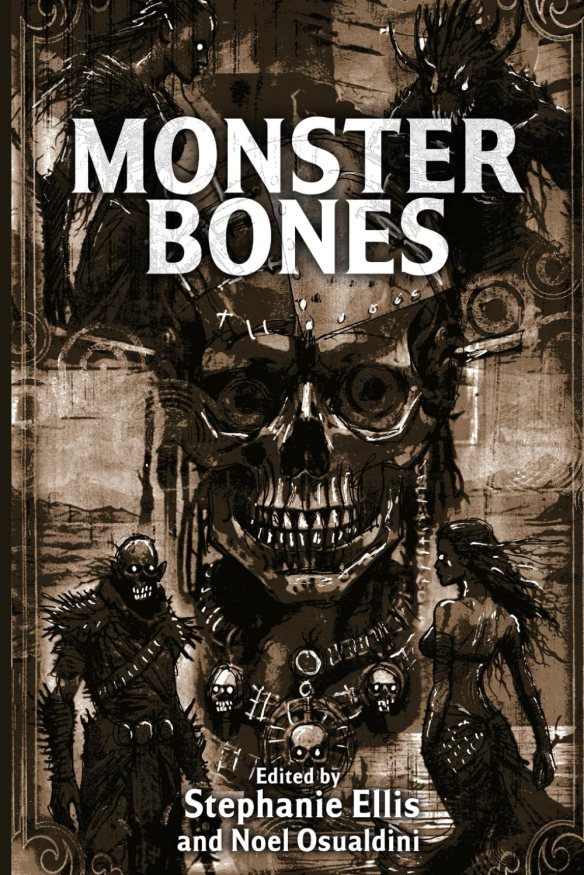
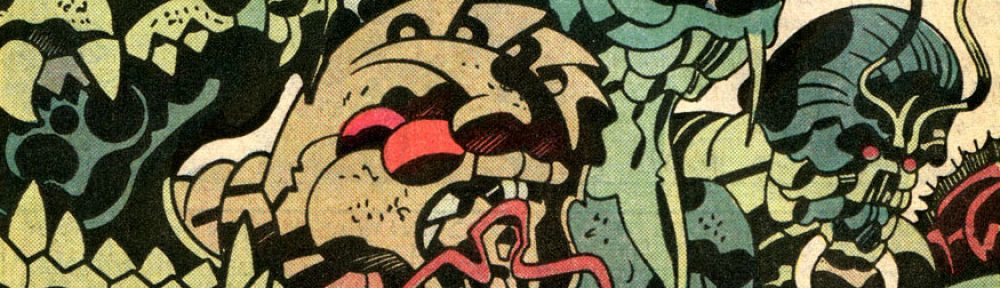
In Monster Bones, a new anthology from editors Stephanie Ellis and Noel Osualdini, the most overt use of skeletal symbolism can be found in “You’re Back,” a story by David Wellington. 

In a Groundhog Day- and Edge of Tomorrow-type of situation, a corpse is somehow reanimated anew each night. But for what purpose? That’s the question. 

Instinctively, the cadaver drags itself through the town looking for something—for someone. Even though it loses pieces of its body each night, it continues its search. At some point, the confused axial skeleton starts having an existential crisis. 

“The Corpse Eater” by Maxwell I. Gold is about a particularly loathsome Buddhist monk. Because of his lifelong avarice, he’s cursed for eternity to feast on human carrion. The greedy bastard fills his hut to the rafters with carcasses in various stages of mastication and decay. Regurgitated bones, flesh and hair are stacked everywhere.

Similarly, in a story called “Charnel Moon” by Ben Monroe, a man makes a living cutting up murder victims and feeding their bits to sharks off the coast of Monterey. His comeuppance occurs when he meets a beautiful woman named Sahira and her odious family of ghūls. “We like you,” she says not surprisingly. “We think that maybe you could be one of us.”

Other excellent stories feature a devil doll living in the jungle of Patagonia (“Milk, Honey, and Blood” by Lucy Taylor), a Tanzanian Popo Bawa (love that name) that preys upon distracted men (“The Guest” by Eugen Bacon) and my favorite story (“Rusalka” by Gwendolyn Kiste) about a young woman’s monstrous mother. The only turd in the bunch is “The Companion” by Joe R. Lansdale and his two kids. It’s not much of a story—and, to be honest, I’d argue that it’s not even a story at all. 

At the heart of Monster Bones is a 65-page story about the vampire apocalypse called “Midnight Mass.” The vampires knew their easiest targets, says author F. Paul Wilson. Whenever they swooped into an area, they singled out Jews as their first victims. A crucifix held power over vampires, but for Jews to hold a cross was to negate 2,000 years of Jewish history. They were doomed. 

The war was over and the vampires had won, but the crisis of faith raged on. Rabbis and priests wondered if the undead monsters would ultimately topple a lifetime devoted to religious vigor. “Honor, justice, integrity, truth, decency, fairness, love—would they become meaningless in a world rewritten by vampires?”

[ Monster Bones / Edited by Stephanie Ellis & Noel Osualdini / First Printing: March 2025 / ISBN: 9781964780245 ]

With Great Power Comes Great Responsibility

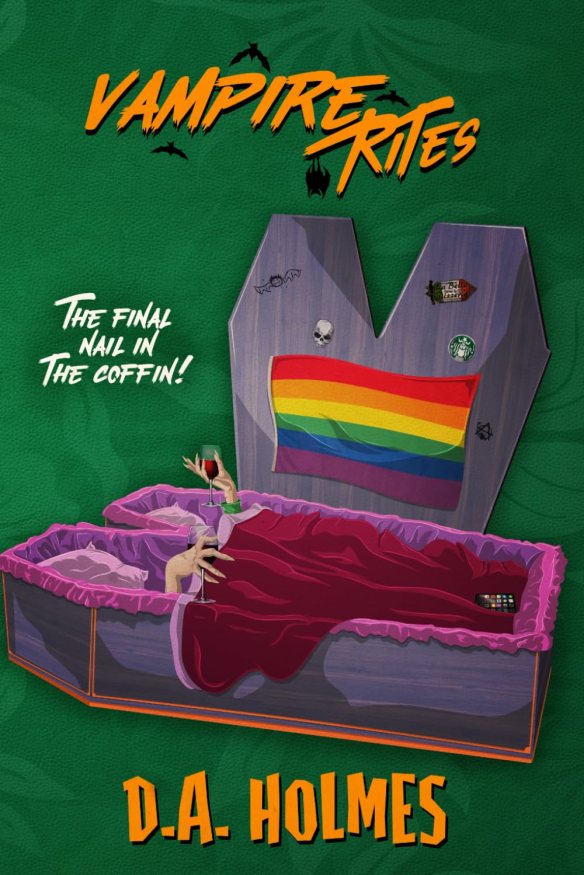
In two previous novels from author D.A. Holmes a winsome, young laggard tells his parents that he’s gay (Coming Out of the Coffin) and then later he tells the rest of the world via social media that he’s a vampire (Bottoms and Bloodsuckers). 

And now, with the release of Vampire Rites, the latest (and final?) novel in the series, 23-year-old Vladimir Radu is grappling with the inevitable consequences of his actions. 

“All my life I’ve been struggling with expectations,” he laments. “My parents expected me to be just like them. They wanted me to fall into the same old bloodsucking routine. I didn’t want to lurk in the shadows and drink human blood—I just wanted to be me.” 

But as the poster boy for all vampires, Vlad realizes that he has a unique opportunity to shift the narrative. To paraphrase Voltaire and Stan Lee: with great vampire power comes great vampire responsibility.

The first thing he does is form a confederacy of likeminded vampires. The mission of the Fang Society is to help them all come out of the shadows (and coffins). There’s only one teensy-weensy problem, however. After nine months of hard work, Vlad and his disciples have failed to recruit any vampires except for an actor being paid to cosplay as Count Dracula. 

Fang didn’t have a lot of requirements, but there was one major ground rule—namely, the abandonment of human-sourced blood for the foreseeable future. After all, vampires and humans couldn’t live peacefully side by side if human blood was always on the menu. 

Lots of people aren’t thrilled with Fang’s longterm agenda—vampire hunters in particular. Nobody will ever convince them that vampires and humans can coexist. “The future is here,” says a rattled slayer. “The suckers are changing, tricking the world with their nice act. When the world embraces them with a hug, that’s when they’ll take a chunk of your neck.”

The novel’s climax features a war between these two age-old combatants (as expected). Popular characters die, complicated family relationships are mended and long-time rivalries form a winning alliance. Like always, the author displays an effortless knack for combining horror, tragedy and humor in one big tangled mess. 

Most importantly, Vampire Rites contains an emotional undercurrent that trumps everything else. Vladimir Radu has spent three novels looking for love and he finally finds it. Props to the author for giving his reluctant hero and his readers what they wanted. 

[ Vampire Rites / By D.A. Holmes / First Printing: May 2025 / ISBN: 979-8316976768 ]

Kaiju Unleashed

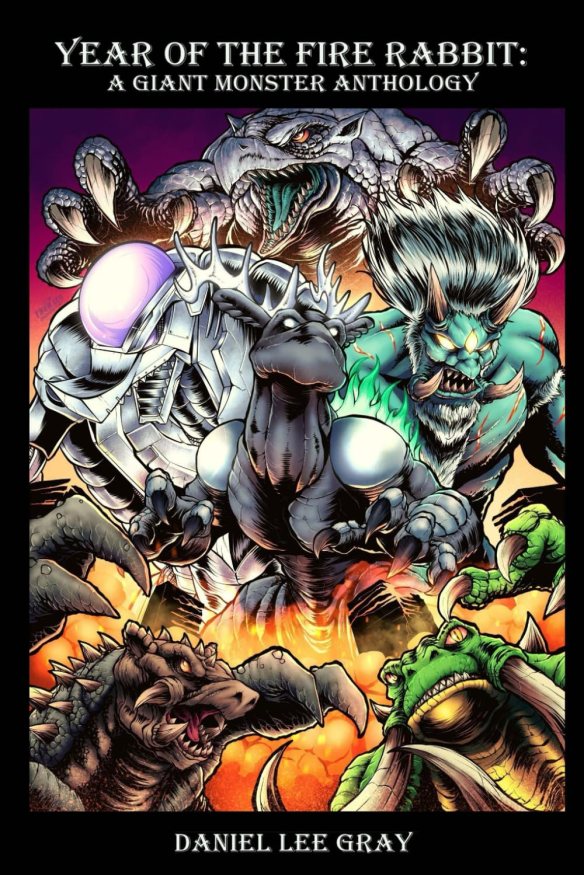
Year of the Fire Rabbit is a slim, 105-page kaiju anthology. There’s only four stories in the collection, but it contains a wild assortment of creatures, madmen, inter-dimensional shenanigans, Biblical mythology, nods to Jack Kirby, H.P. Lovecraft and a sundry of other pop culture delights. Like a crazy Rube Goldberg contraption, the stories begin with simple events that quickly escalate in overcomplicated ways. 

For example, take the volume’s first story. Author Daniel Lee Gray begins “Apex” with a little preamble that could easily double as the book’s overall theme. “Organized chaos seems to be a fundamental rule of the cosmos,” he says. “Nothing is permanent except change.” 

In this case, a giant monster named Xolesis becomes involved in the war between Heaven and Hell. Things go pear-shaped pretty quickly as angels and fallen angels discover that the gigantic cosmic beast is not interested in forming a strategical alliance with either side. “I hold dominion over the galaxy,” proclaims the colossus “It is my home and I am the alpha. To try and usurp it from me is suicide.” 

After destroying Heaven and Hell, Xolesis dips into another dimension to destroy Cthulhu and all the other Lovecraftian monsters. Later, after a minor hiccup, Xolesis ends up being exiled on Planet Earth like the Silver Surfer. 

The 10-page story (!!) ends when astronomers discover a cluster of asteroids barreling toward Earth. Now what will Xolesis do? Will he continue to kill religious deities and elder gods and remain the undisputed slayer of galaxies? Or will he change his tune and save his adopted planet from total annihilation? What a pickle!

Similarly, “Missing” and “Statue” continue Day’s affection for organized randomness and giant monsters. One story is about a mysterious cryptid who may (or may not) be the seed of all life on earth, and the other is about the age-old alliance between mankind and the faerie realm. 

Year of the Fire Rabbit wraps up with a kaiju version of Richard Matheson’s novel I Am Legend (with a little bit of Herman Melville’s Moby Dick). The year is 4021 and most of the world has been overrun by daikaiju. The only safe haven is New Arcadia, a super secure city located in what was once Nebraska and South Dakota.

The city’s leader Nash Vance is fighting a losing battle. Deep down he knows mankind is on a path to extinction, but he won’t go down without a fight. The climax comes when Mama Superior, a 700-foot-tall eagle-honey badger-like beast, attacks New Haven with a couple of her friends. 

Along the way we discover that Big Mama represents Vance’s “Great White Whale.” And, like Moby Dick and Captain Ahab, she kills her adversary in the end. The battle is finally over. Mama Superior lets out a roar that echoes across the land. Earth is now her world and humanity is no longer welcome.

[ Year of the Fire Rabbit: A Giant Monster Anthology / By Daniel Lee Gray / First Printing: April 2025 / ISBN: 9798998729027 ]

Mega Centipedes

Since leaving the U.S. Marine Corps, Maxwell McTavish bounced around from one dead-end job to the next. Currently, he was employed as a security guard at a bar in Arizona. 

But he never forgot his tour of duty in Afghanistan. During the day, while monitoring al-Qaeda strongholds, he experienced a quiet dread. In the thick of a firefight, however, there was no time to be scared. Like all good soldiers, Max put his head down and did his job. 

He felt the exact same way during his vacation on Paradise Island, a très cher French Polynesian resort. At first, he felt awkward mingling with all the rich and beautiful people. But later, when giant (and hungry) mutant centipedes erupted from the island’s beaches, Max’s military training kicked into hyperdrive. 

He had witnessed men blown apart by rocket-propelled grenades and shot to hell with AK-47s, but he’d never seen anything like the destruction caused by the “mega freaks” from Paradise Island. Not only did these mutant bugs look like prehistoric monsters, but their appetites were insatiable. 

Exploding from the postcard-perfect beach, the first centipede was a 50-foot blur of red and black that announced its arrival with a horrific hissing noise that sounded “primal and angry,” according to author Mike MacLean, “yet almost mechanical.” Its horrible mouth pulsated with anticipation ready to rip and tear. Take a look at the book’s front cover for a highly stylized version of the titular creature. 

Max was somewhat successful in his attempt to keep the resort safe from the Hexbug-like baby centipedes, but he needed help stopping the bigger freaks. He needed a sidekick. Enter Erin Johansson, a cute and funny bartender who looked a bit like Merida, the Disney Princess of DunBroch. 

Armed with a decorative spear taken from a nearby cabana, Erin quickly went to work. She immediately  “killed the fuck” out of a large 50,000-pound centipede all by herself. Max was impressed with her bravery. “You handled yourself like a true badass,” he told her. “You would’ve made one hell of a Marine.”

Erin was certainly tough, but she was also kinda sexy—even when she was wrassling a baby centipede in the shower. And if you’re curious, there were lots of sexy ladies on Paradise Island being attacked (and devoured) by the creepy-crawly mega freaks. 

Over all, Mega Freak: Bloody Paradise is exactly the sort of monster novel you’d expect from MacLean, the writer responsible for movies such as Sharktopus and Piranhaconda. It’s zany and sexy and violent and icky. And the best part? I bet we’ll see Max and Erin again sometime soon.

[ Mega Freak: Bloody Paradise / By Mike MacLean / First Printing: April 2025 / ISBN: 9781923165588 ]

Lonely Is the Night

Do you remember all the fuss surrounding Y2K? Back in 1999, some people thought computer networks would shut down on January 1, 2000, and widespread chaos would ensue. Personally, I knew a married couple who drained their bank accounts and bought a self-sustaining cabin off the grid in Utah. They were prepared for the collapse of civilization. 

The “millennium bug” never happened of course, but it was certainly something people talked about—including the characters in T.D. Lawler’s novel Super Beast ’96

It was 1999 and Matt, Zach, Jose, Becky, Tracy and Jenny had just graduated from high school. They knew they were the last graduating class of the decade. Heck, they were the last class of the century. On a personal level, they felt the ever-looming specter of Y2K.

“What do you guys think is actually going to happen when the clock rolls over to 2000?” asked Jenny one night during a camping trip. The answers she received from her friends were all over the map. An Alien invasion? Zombie apocalypse? The arrival of the Antichrist? Jenny herself had the best answer. “Moon Nazis will finally come back to Earth and try to take over the world,” she said. 

There were no zombies, aliens or moon Nazis in Lawler’s book—just a scruffy eight-foot-tall werewolf. When it first appeared, the beast was described as looking like a grotesque parody of a wolf. The facial features were all there, but they were wildly distorted. “The elongated muzzle was twisted into a manic grimace,” wrote the author, “revealing yellowed fangs that jutted from its maw. Glowing red eyes burned with a furious inhuman intelligence.”

The werewolf had recently come to the outskirts of Pembine, a Wisconsin townlet. After feasting on easy prey like farm animals, it started hunting humans. It was bad luck that Jenny and her friends were camping smack dab in the middle of the beast’s kill zone. 

But like all monsters, Lawler’s werewolf was a lonely  wretch. For 50 years he’d been unsuccessfully trying to share his lycan gift with someone. “I’ve been alone so damn long,” he cried. “I want a companion who’s the same as me … someone to be my friend.”

A friendly werewolf doesn’t rip people to shreds, however. A local hunting party and the Pembine police couldn’t stop the beast, and now it was up to the unwitting teenage campers to kill the wolfman. 

Lawler is a young author (this is only his second novel, I think), but he already shows great promise. He’s got a nice flair for descriptive language and his characters talk like real human beings. Confession: as a reader, there’s nothing that makes me cringe more than stilted dialog. 

In addition, Lawler has put a lot of effort into compiling a 90s-era soundtrack for his novel. Megadeth, Metallica, Static-X, Slipknot, Machine Head, Korn—you could easily cobble together an entertaining mixtape of tunes based on his recommendations. He’s obviously a music nut. After all, even the title of his book is a ripping Rob Zombie song. 

[ Super Beast ’96 / By T.D. Lawler / First Printing: January 2025 / ISBN: 9798302706102 ]

The Scream Queen vs. the Aztec Queen

With over 50 horror films under her belt, Desiree Starr had earned her status as a scream queen. Twenty years ago, she appeared in He Knows When You Are Naked and she’s still, for better or worse, churning out the same kind of sexy, exploitive and scary movie to this day. 

Sure, she’d love to make the transition to mainstream fare. What cult actress wouldn’t? Unfortunately she’d never been offered a substantial role in an Academy Award-winning movie like Jamie Lee Curtis. Instead, like Linnea Quigley, she supplemented her income with writing books and appearing in horror-inspired workout videos. 

When she was asked to star in an upcoming horror flick being filmed on a college campus in Northern Florida, Desiree jumped at the opportunity. Bullet City, her latest attempt at respectability, was a box-office bomb and she needed the paycheck to pay for her lux Long Beach condo. 

She took the gig but was immediately disappointed by the movie’s nubile cast. She didn’t like seeing the overabundance of busty gals flouncing in front of the cameras. Desiree’s expectations for College of the Living Dead hit rock bottom. She knew from experience that the bigger the actress’s cup size usually meant the lower the film’s budget. 

Desiree would soon discover that the movie had more serious problems than gratuitous nudity. Even before principal shooting began, actors and wannabe actors were being abducted and murdered by a demonic Aztec queen from the 16th century. 

Five-hundred years ago, Zyana, the half-sister of King Moctezuma II, traveled from Mexicana to La Florida in search of the Fountain of Youth. During her journey she was magically transformed into a human-spider-vampire-mole creature. After all those years of searching for the fabled Fountain of Youth, Zyana had turned into a crazy, obsessed monster. 

The scream queen and the Aztec queen don’t tangle until the last four pages of the book—which was kinda disappointing. But I promise there’s more to Return of the Scream Queen (the sequel to Night of the Scream Queen) than a brief novel-ending diva showdown. 

For one thing, it’s pretty funny. Anyone who subscribes to Monster Agogo Magazine and enjoys the quirks of the cult movie industry will get a chuckle from the mix of A-list, B-list and C-list characters in the book. A favorite character of mine was Desiree’s ex-boyfriend, Dr. Donald Becker. The authors really go hard with his obsession with white teeth and his idolization of Tom Cruise.

And finally, Desiree herself was totally awesome. Being a middle-aged scream queen wasn’t easy, but she always found a way to rise above the absurdity surrounding her.   

[ Return of the Scream Queen / By Michael McCarty, Linnea Quigley & Stan Swanson / First Printing: February 2025 / ISBN: 9781946874689 ]

The Walking Shitbags

What do the grapes of wrath taste like? What exactly does the sound and the fury signify? Why is the lightness of being so unbearable? And does water have a particular shape??

Sheesh! Why do writers and filmmakers continually  pick flowery (and vague) titles for their creative projects? Instead, let’s celebrate simple declarative titles like Cowboys vs. Dinosaurs, Killer Klowns from Outer Space, Hollywood Chainsaw Hookers and Earth vs. the Flying Saucers. With titles like these, you know exactly what to expect. 

You can add the latest novel from Melissa Lason and Michelle Garza (collectively known as the Sisters of Slaughter) to the list. There’s no poetry in the book’s title, but readers know exactly what they’re getting with Janitors vs. the Living Dead.

It all starts when Serenity Canyon—an exclusive resort-like community in Sedona, Arizona—becomes ground zero for the zombie apocalypse. Since none of the posh residents have any survival skills whatsoever, it falls to the maintenance staff to battle the neighborhood scourge. 

But first, here’s a little backstory: The 35,000-year-old zombie parasitoid is discovered by accident during a scientific excavation in Siberia. When it’s brought back to the U.S., the government hopes that it might be an effective weapon of war (and profit). Instead, all it does is kill and reanimate the dead. 

The Serenity Canyon zombie outbreak is an unmitigated disaster. Everyone instinctively knows that if it spreads beyond the gated community it will surge like wildfire in a summer wind. It could even signal the end of mankind. 

Thank goodness the collected members of Serenity Canyon Maintenance are on the case. Disparagingly known as the Scum Crew (Scüm Crüe?) by their snooty employers, the team arms itself with all sorts of things to neutralize the undead army—a couple of mop handles, two screwdrivers, a razorblade gum scraper, a fire extinguisher, a leaf blower and a ride-on lawn mower. They probably have access to a variety of desiccants and sorbents as well.  

The zombies (called “walking shitbags” by the authors) don’t move very fast, but their stamina is unending—like an unstoppable apocalypse in slow motion. The soundtrack to their attack is a chorus of flatulence and belching followed by a glissando of vomit. 

The reason why these zombies are called shitbags is because their bodies are “frankensteined” together with human waste from an old derelict outhouse. This origin story allows the authors to gross out readers with neverending descriptions of shit, piss, snot and vomitus eruptus. Their enthusiasm for bodily excretions is truly impressive. 

[ Janitors vs. the Living Dead / By Melissa Lason & Michelle Garza / First Printing: April 2025 / ISBN: 9781639511891 ]

Wereroids

In her introduction to this new lycan-lovin’ anthology, editor Annie Knox recalls her youthful affection for monsters. “I was convinced that they must be real,” she writes. “The idea of monsters lurking in the world around us, unseen but felt, both thrilled and frightened me.”

Given her life-long proclivity, it makes sense that Knox would someday curate a terrific short story collection that takes werewolves seriously. They are, she says, symbolic of a thousand things. For example, they’re an allegory for puberty and a metaphor for transformation and change. They also represent mental health disorders and the uncontrollable animalistic side of humanity. 

Werewolves can also draw inspiration, and exist side-by-side, with classic literature. Contributions from Simon John Parkin and Nora Studholme (in particular) borrow cultural cachet from William Shakespeare and Margaret Atwood. “One Last Kill” is about the tragedy shared by brothers and “A Dark Place to Hide” explores the loss of female agency and other Gilead-like themes. Both stories are very good. 

Some authors are empowered to forgo the familiar horror tropes associated with lycanthropy. Or, I should say, they willfully subjugate the hysterics inherent in the genre. I have to admit that these are my least favorite stories in the collection. But that’s my problem. Others may disagree. In general, I greatly enjoy the gnashing, the shapeshifting and the howling. 

Personally, my favorite thing in the first volume of Creature Feature Classics is “Wolves Only Come Out at Night.” Not only is it well written (props to author Davey Cobb), but it balances a whole bunch of disparate points of view in a mere 23 pages. 

The story begins with a prologue of sorts. Seeing the moon in the sky was a bad omen, writes Cobb. “When it was present so too was evil, the sickness that plagued humanity under night’s blanket. Vagabonds, murderers, harlots, thieves. The moon was their beacon, confirming that the hour was for malice.” 

To eradicate vagrancy and dangerous fauna, the town of Butterwood hires a mercenary to cull wolves, bears and foxes—anything and everything that threatens the townsfolk is butchered to extinction or driven out.  

Butterwood’s artificial tranquility is shattered by the arrival of a werewolf. Cobb handles the ensuing chaos like a champ. The manner in which the werewolf, the werewolf hunter and the werewolf hunter’s daughter disrupt the town’s citizenry and municipality is unexpected to say the least. The resolution is totally crazy. No spoilers from me, but I’ll just say this: in Butterwood there is no truth in justice. 

[ Creature Feature Classics, Vol. 1: Lycanthropy / Edited by Annie Knox / First Printing: February 2025 / ISBN: 9798310686472 ]

The Antipodean Sasquatch

Who doesn’t enjoy a good old fashion home invasion yarn with a big dose of cryptid fuckery? I’m ngl, few things in life are more beautiful than a pulse-pounding story about a monster in the basement and the roar of a chainsaw.

This paradox of horror is on full display in Trog, the latest novel by Zachary Ashford. Looking for kicks, three masked serial killers smash their way into a house in rural Australia. The homeowners do the best they can to defend themselves, but things escalate dramatically when a huge bigfoot-like creature escapes from a subterranean prison.

There are no bigfoot or yeti in Australia, but there is something called a yowie, an antipodean sasquatch-like beast with roots in Aboriginal mythology. Caged for decades in an underground cavern, the monster—named Trog by an old carny with a hankering to become the next P.T. Barnum—capitalizes on the the surrounding chaos to set himself free. 

According to Ashford, Trog is truly hideous. “His teeth, jagged and pointed and full of rot, drip with foaming saliva,” he writes. “His eyes are deeply intelligent, but it doesn’t take a genius to realize the monster is possessed with insane rage.” 

Throughout the book, the yowie is nigh unstoppable. And he’s pissed off too. The pesky humans have hurt him and he wants to pull their limbs from their bodies and smash their faces with his fist. One victim’s body snaps like dry spaghetti as the yowie rips her in half.

Trog is a monster, no doubt about it, but he isn’t evil like the trio of home invaders. Wearing zombie, skull and wolf masks (which define their personalities more or less), the gang roams Australia’s hinterlands killing people indiscriminately for fun. “This isn’t a political statement,” explains the brute wearing a wolf’s mask. “It’s entertainment.”

Wolf is by far the most dangerous member of the gang. He’s a large man who carries a sledgehammer resembling the kind of weapon a Norse god might use. Later, he picks up a chainsaw for further emphasis. Says Ashford: “Even if he wasn’t a psychotic home invader, everything about him screamed fuckwit—the howling, the over-the-top approach to the invasion. almost like he was trying to be a movie character and not a real person.”

As it turns out, Wolf is the lucky bastard who gets a one-on-one showdown with the yowie. It’s man-against-beast as the novel ends with both combatants getting a taste of their own brutality. It’s beautiful. 

[ Trog / By Zachary Ashford / First Printing: March 2025 / ISBN: 9781998763450 ]

Clash of Titans

Every novel—whether it’s genre fiction or literary fiction—has to have a beginning. Some books start slow and some books start with a bang, but either way, the author needs to figure out a way to open a door into the story. 

Gore vs. the Cryptid Kaiju by authors Zachary Cole and Cody Bratsch ends with a big monster battle royale. That’s no surprise. But how does it start, you might wonder?

Cole and Bratsch make a commonsense decision. They begin their novel with an origin story of Gore, their titular monster. Not only does the prologue establish the course of the narrative going forward, but it also builds the framework for an upcoming war of gods.

The prologue accomplishes its mission, but does so in the most artless way possible. I’ve been stumped for days trying to come up with a way to summarize the opening sequence of events without sounding like a complete dunce. Here’s the best I can do: A man throws his ex-girlfriend and her date down a mountain cliff. Surviving the fall, the teenage girl eats her dead companion to stay alive. Eventually, she turns into a 100-foot-tall wendigo.  

After the cringy prologue, the writing settles down into a comfortable groove. And that groove includes various iterations of kaiju and cryptid battles featuring (among others) a skinless centaur, a giant bat beast and the aforementioned wendigo. 

The first clash occurs 100 miles outside of Las Vegas at Area 51. The facility, notoriously known for sheltering space aliens, was actually filled to the brim with terrestrial horrors. People called it a monster prison but Doctor Mark Hudson liked to think of it as a monster zoo. 

A professional cryptozoologist, Hudson is a member of the world’s top monster-fighting force. With the help of a handful of military colleagues, he travels around the globe chasing and studying beasts of folklore and legend. “I’m a monster geek,” he admits with a shrug. 

The monster jailbreak at Area 51 is terrific. This is where the centaur demon from Scotland is first introduced. The 95-foot-tall nuckelavee ravages the military base and later chases its wendigo rival to the West Coast. Dr. Hudson and his crew are in hot pursuit as well. 

Since the transformation from human to wendigo, Gore was torn by conflicting emotions. “Her mind was split in two,” say the coauthors. “Half of her was human, revolting against the violence and hunger that the other half, the wendigo half, called out for.”

After the Area 51 smashup, Gore drops to all fours and gallops to Los Angeles for some long-simmering retribution. She’s on a personal journey to kill the man who threw her off the mountain cliff. She can smell him in LA despite all the aromatic distractions from Randy’s Donuts, In-N-Out Burger, California Pizza Kitchen and Trejo’s Tacos.

The ensuing battle between the nuckelavee and the wendigo (plus a little interference from another cagey cryptid) turns Los Angeles into a hell pit. But that’s okay—the wendigo finally gets what she wants. To quote Dr. Hudson: “Never underestimate the fury of a vengeful monster.”

[ Gore vs. the Cryptid Kaiju / By Zachary Cole & Cody Bratsch / First Printing: March 2025 / ISBN: 9798311615747 ]