A World Ruled by Monsters

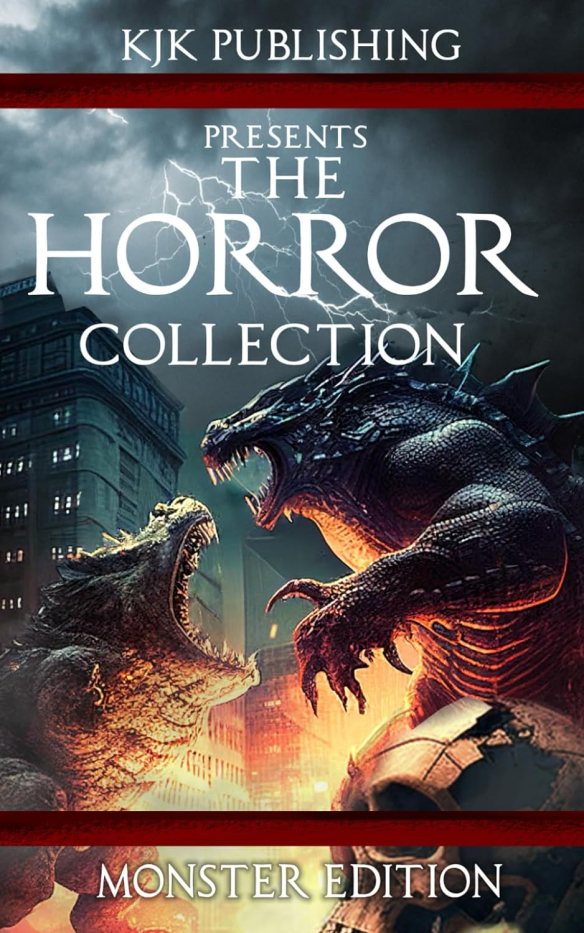
Consumer alert: There’s a dynamic image of two daikaiju beasts on the cover of this new horror anthology. Be forewarned, however. There are no corresponding stories of Godzilla-like monsters included in the volume. That’s too bad. 

But in all other ways, The Horror Collection: Monster Edition includes a terrific sampling of all sorts of monstrous creatures—spiders, more spiders, water nymphs, shapechangers, more shapechangers, asynjur, aliens from outer space, mummies, bogeymen, giant gila monsters and sneaky demons. 

Dr. Jekyll and Mr. Hyde even show up in a story by Mark Young called “Beneath the Lunar Light.” A man named Blakeman who is suffering from a monthly shapeshifting curse travels to London to consult with Henry Jekyll about his affliction. The collegial conversation ends abruptly when Edward Hyde shows up and reveals his dastardly plan to Blakeman. “My intention is to create a world ruled by monsters,” he says. “Using the blood of you and I, we will be agents of chaos and disorder!”

Will Hyde succeed in his mad plan? Maybe. Maybe not. But either way, I’m all for it. Another story that speculates on “a world ruled by monsters” is “Gone Witness” by Chris Panatier. The only difference is this: the author’s “extinction logic” is more cruel and apocalyptic than anything Mr. Hyde could ever hope to execute. 

The closest thing to a kaiju story in this collection is “Salvia Sunset” by Brennan LaFaro. His giant gila monster (dubbed “Big Mama” by the locals) is as big as an 18-foot-long Conestoga wagon with fangs longer than a revolver barrel and “talons so sharp they could cut grains of sand in two.” The story takes place in Buzzard’s Edge, Arizona, and the author does a first-rate job of capturing the Sonoran Desert and the Arizona heat. As a former Zonie, I can confirm that summers in the Southwest are brutal, with or without gigantic venomous lizards. 

Heather Miller revisits an old 18th century English fairytale in her story called “In the Arms of the Annis.” The titular bogeywoman is creepy as hell, and her influence on a particular child is chilling. Here’s how the horror begins: “We made a kind of peace between us,” says the young village girl kept hostage by the monster. “I looked away when she brought in children captured from the hills and made meals of them. I shared the sheep with her when she brought them instead, cooking my meat over the fire, less and less over the years until I could eat mine almost as raw and bloody as she ate hers.” 

And finally, I enjoyed Veronica Smith’s story “Kill it With Fire” because of its offbeat humor. A woman wakes up to discover the insides of her home covered in massive webs. It’s “like a psychotic white winter wonderland in Hell,” writes Smith. A turf war immediately ensures between the woman and the spider-bat that’s responsible for the webbing. It’s like a goofball Silver Age Spider-Man comic book—trippy in all the right ways. 

[ KJK Publishing Presents the Horror Collection: Monster Edition / Edited by Ann Keeran and Kevin J. Kennedy / First Printing: January 2024 / ISBN: 9798877018709 ]

Invasion of Astro-Monster

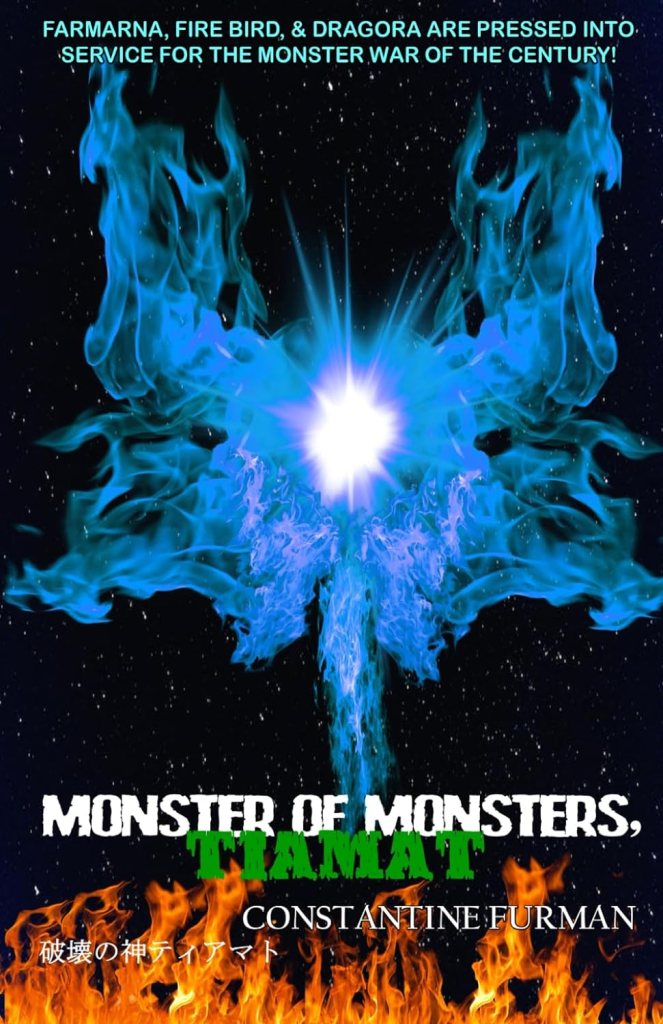
Emperor Tiamat, the space dragon in Constantine Furman’s latest novel, had nothing to do with Mesopotamian or Biblical mythology. Nor was he a Dungeons & Dragons or Final Fantasy rip-off. 

Instead, Tiamat was a five-headed monster with crazy laser powers from outer space. Nobody knew exactly where he came from but some people believed he escaped from an alternative universe where time flows backward. Other people said he was created by an unknown race at the center of the universe as the ultimate weapon of conquest. Another theory speculated that Tiamat hailed from the evil planet Gokemidoro at the very edge of space. 

Regardless of his origin story, the fact remained that Tiamat was coming to Upent (née Earth) to destroy the entire planet. “He’s the vanguard of a great evil from the outer depths of the cosmos,” warned a pretty and mysterious prophet named Maas Neekol Suiim.

What were the options for the people of Upent? A squadron of fighter jets? Nukes? Prayers? What could possibly defeat the “God of Destruction”? There’s only one hope, said Mara, the High Dragoran Priestess of the Almonds from Dragora Island. Upent needed to enlist the help of three titanic kaiju monsters. 

It’s too bad Dragora, a large grub, Farmarna, a giant sea creature, and Fire Bird, a Rodan-like Pteranodon, were a fractious bunch with no affection for humans. “They built weapons to hurt us,” said Farmarna with a sneer. “Why should we help them now?”

Monster of Monsters, Tiamat was a sweet homage to mid-century Toho kaiju movies. G-fans will love the various creatures and the city-destroying battles (the buildings went down like Jenga towers, said the author). Over all, Furman does an excellent job of capturing in print the awkward and comical clashes featured in those early films. in addition, there’s humor and enough cheeky moments to please any grumpy book critic. 

I really only have one negative comment. The author apparently doesn’t know the difference between an astrologer and an astronomer. At first I thought it was the kind of funny typo you often see in indie books without editorial support. But I was wrong. The author continually used the two words as synonyms throughout the entire novel. 

On the other hand, possibly my favorite moments in the book revolved around the princess-prophet Maas Neekol Suiim. She came to Upent with an urgent message from the stars. “Space is as vast as it is limitless,” she said. “It is time that mankind unites with members of other worlds.” Like Michael Rennie in The Day the Earth Stood Still, she was a harbinger of hope. 

[ Monster of Monsters, Tiamat / By Constantine Furman / First Printing: January 2024 / ISBN: 9798871660584 ]

What Lurks Within and Without

According to the latest Horror Zine anthology, you can find monsters in swimming pools, shopping malls, hospital morgues, cornfields and blackberry brambles. But monsters, as we all know, aren’t just limited to the physical world, they can also live inside your head. Truly they exist within and without. 

For example, in a story called “What Lurks Within” by Tyler John Kasishke, a man named Lewis (!!) lives in a parallel world of fantastical woodland creatures. Featuring requisite nods to Alice’s Adventures in Wonderland and Jefferson Airplane, Kasishke’s white rabbit is a monster that doesn’t respect the line separating dreams and reality. 

Similarly, Chris Allen’s psychological horror tale titled “Red Spider” is about a college student’s Poe-like obsession with a giant crimson spider. Is the spider real, or is it just a figment of his imagination? Here’s a clue: the author freely admits having a phobia of arachnids. ‘Nuff said. 

Like all psychological horror, monster fiction puts readers in an extreme space of untenable chaos. It’s cathartic and fun. After all, there’s not much you can do when you’re being attacked by a gang of mannequins, a family of trolls or an orchestra of crickets. You might as well sit back and enjoy the ride. 

No surprise, my favorite stories in the collection are less ambiguous and more overt. “Mouths” by Shawn Phelps is about a woman who becomes infamous for her ghastly art projects and “Nom Nom” by Elizabeth Massie is about a man who creates a stinky monster born from his “jism of loathing.” Elsewhere there are enough scarecrows, golems, demons, parasites and angry gods to satisfy any monster dilettante. The Jersey Devil even shows up to smash a small group of inept paranormal investigators. 

My two favorite stories come from co-editor Dean H. Wild and Bentley Little. There’s a sewer serpent living in the bowels of a three-story flophouse in “Where the Water Flows.” The “Pipe Slider” is suitably revolting (“wet and flabby,” says the author), but the antics of four dotty reprobates are a hoot. “We were a confluence, the four of us,” says the landlord, “a churning storm that hailed the thing in my basement with the acuity of a dog whistle.”

Easily the most queasy thing in this Horror Zine compilation is a story called “That Summer.” Like me, you’ll wince when a small boy gets a slimy fishy mouth kiss from a mysterious bog creature. It’s gross, but not untoward. “Yore mama loves you,” drawls a nearby acquaintance with a smile.  

[ The Horror Zine’s Book of Monster Stories / Edited by Jeani Rector and Dean H. Wild / First Printing: January 2024 / ISBN: 9781953905864 ]

Full of Vim and Hybrid Vigor

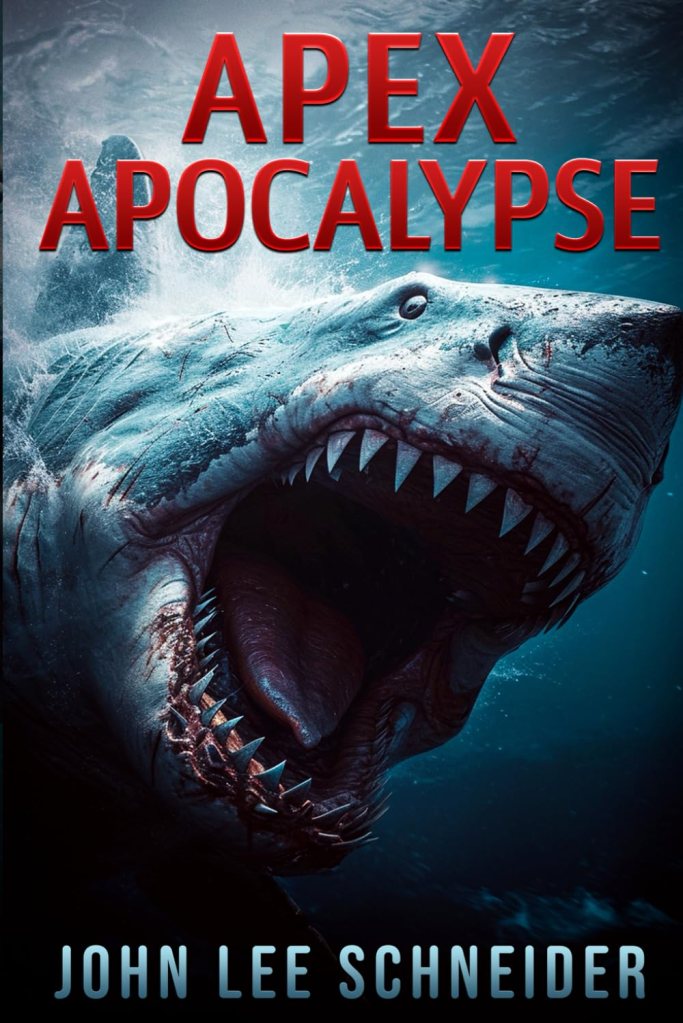
“Monsters are real,” says the back-cover blurb for John Lee Schneider’s latest novel Apex Apocalypse. That’s an indisputable fact, isn’t it? The world is filled with all sorts of monstrous creatures such as killer whales, reticulated pythons, great white sharks, Humboldt squids, Komodo dragons and Nile crocodiles.  

Many of these monsters roam wild and free in the Florida Everglades. With exotic invasive species arriving daily, the wetlands is arguably the most dangerous place on Earth. The swamp is a primeval ecosystem that borders Florida cities like a prehistoric preserve, says author Schneider. “There are a lot of things that can kill you in the bog.”

Mutated vipers and anacondas lurk around every riverbend, but crocodiles are far and away the biggest problem. According to an Everglades National Park ranger, crocodiles aren’t just an invasive species. Many of them are hybrids. And because of a phenomenon called heterosis (commonly known as “hybrid vigor”), they are growing larger and faster. “These hybridized offspring carry a variety of traits from American crocs, salties and Niles. And there are definitely new generations of crocodiles with a mix of all three.”

Abigail O’Neil knows first-hand how deadly the wetlands can be. The daughter of a real-life boogeyman, she grew up on a gator farm in an isolated lagoon in the darkest corner of the swamp. “Wherever you go,” she says, “the monsters are always there to get you.”

Now Abigail finds herself in the middle of nefarious intents. In order to survive, she must return to events detailed in a previous novel from 2019 called Hybrid Vigor (read my review here) and relive the horrors of her past. 

Hot on her trail is a mysterious gin-soaked, barroom queen from California. This lady sees an opportunity in the swamp, but she needs to get rid of Abigail first. In tow with an army of burly henchmen, she’s a formidable foe with a heart full of napalm.  

Separately there’s also some kind of pesky zombie-like beast hanging around and causing trouble. The author describes it as a one-armed, one-legged swamp ape (or semi-amphibious Bigfoot) carrying a massive Stormbreaker axe. Just like every other monster in the bog, it is inexplicably drawn to Abigail.  

Apex Apocalypse starts slowly—the entire first chapter is a big info dump and there’s a lot of jibber jabber about Man being the ultimate apex predator—but the novel eventually gains momentum and reaches a satisfying confluence of swamp monsters and mayhem. The novel ends with an outrageous (and nutty) Squid Game-like death match.  

Ultimately, the author leaves a few important plot points unresolved. Will there be a sequel? I dunno, but my bet is that even Schneider doesn’t know how the ongoing situation unwinds. The swamp is jealous of its secrets and keeps them hidden from the eyes of God and man, he admits. “It was the last place in the developed world that dark secrets could truly be kept forever.”

[ Apex Apocalypse / By John Lee Schneider / First Printing: January 2024 / ISBN: 9781923165014 ]

Gods and Monsters

Seventeen-year-old Krescent Dune fought monsters for a living. Like all gladiators before her, she entered the battle arena each time knowing it would be an unforgiving playground of cruelty and death. 

Young Kress earned her reputation as the undisputed champion of the pit by compiling 78 straight kills. Scythe crabs, mutated aquabats, one-horned derinos, byotors, raptors, varmee and wurm lizards—they were all vanquished during her six-year winning streak. “I’m a fighter,” she said at one point. “I kill despite myself and I will not go down so easily.”  

Because of her prowess in the pit, Kress was recruited to join an expedition into a labyrinth of tunnels and caves below the surface of her homeland Kar Atish. Along with several redshirts, her mission was to explore the final frontier. Like the crew of the USS Enterprise, she agreed to boldly go where no man or woman had gone before. 

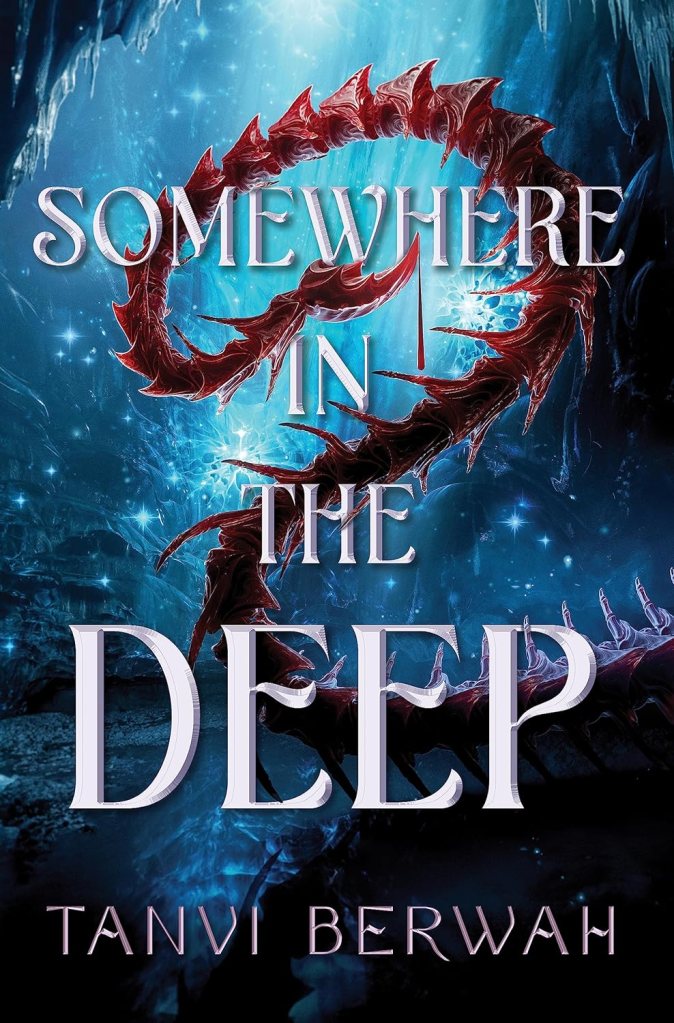
Kress knew the expedition was basically a death sentence. Undoubtedly, there would be indescribably horrible creatures below waiting to pounce on her. In fact, entering the tunnels for the first time was like stepping inside the mouth of a beast, its teeth sharp and pointed beneath her feet. 

And, as expected, Kress and her crewmates encountered a multitude of creepy-crawly things almost immediately—mostly giant insects and multi-tentacled ocean beasts. Even though she was a famous monsters killer, she couldn’t protect all of her redshirts. In my opinion, the best bits of Somewhere in the Deep were these epic belowground battles. 

After weeks of spelunking, the doomed patrol finally reached the end of their journey to discover they were merely pawns in a mad game of political power and greed. No reader will be surprised by this plot twist. The entire endeavor was an open secret from the very beginning. 

There were a couple of unexpected moments along the way, however. At one point, Kress and her gang encountered an entire community of Shadefolk living in the hollow mountains below the surface. Born in darkness, these people existed side-by-side with the monsters in an uneasy subterranean détente. More importantly, the Children of Shade were the protectors of a supercharged holy substance that, if mishandled, would remake (or destroy) the entire world. 

Before leaving the underworld and returning home, Kress gets the biggest shock of her life. She’s swallowed by a giant cloud monster (!!) and experiences a transcendental moment. Transformed and imbued with godlike mental perception, she accepts her true mission in life. No spoilers from me, but here’s a hint: Her career as a monster slayer was now over.

[ Somewhere in the Deep / By Tanvi Berwah / First Printing: January 2024 / ISBN: 9781728247659 ] 

The Justice League of Monsters

There was a huge monster craze in the United States from the late 50s and continuing into the early 70s. It all began when local TV stations started airing monster movies at midnight and lead directly to the publication of Famous Monsters of Filmland. After that, you could see the trend quickly escalate to The Outer Limits, “The Monster Mash,” Rat Fink, The Munsters and Dark Shadows

Monster mania probably ended in 1973 when a young Linda Blair used a crucifix as a dildo in the original Exorcist movie. But while it lasted, the groovy age of monsters was a happy time when all monsters hung out in the same timeline. According to journalist and pop-culture historian Mark Voger, it was a time when all monsters were best friends who shared thrilling adventures like the superheroes in the Justice League of America. 

And now, 50 years later, editor James Palmer presents his version of the Justice League of Monsters—a fearsome fighting force for freedom, made of the ghastliest ghouls and goblins of man’s imagination come to life. Membership includes (in slightly altered versions) the Wolf Man, the Creature from the Black Lagoon, Frankenstein’s monster and Count Dracula. 

Together with Moira Harker, a world-renowned monster hunter, this extraordinary league of gentlemen fight all sorts of creatures and spirits—including the Last Reich, a group of zealots who continue to aggressively promote Nazi politics. More generally, the League of Monsters simply call themselves occult researchers. 

The anthology begins with a prologue-like story by Palmer called “Gods and Monsters.” It efficiently introduces readers to the world of Monster superheroes. The League’s headquarters is a rambling Victorian mansion on the edge of the New Jersey Pine Barrens. They are mostly autonomous but have a working relationship with a shadowy government organization. It’s the early 50s and Harry S. Truman is the President of the United States. “The world,” says wolf man Ned Nyland, “is a weird and deadly place.” 

The five remaining stories are silly and preposterous in a good way. If you enjoy Universal monster icons and over-the-top antics you’ll probably like what you get here. Personally, my two favorite stories are by Russell Nohelty and Adrian Delgado. 

“Not Another Haunted House Story” follows Hank Clerval (Frankenstein’s monster) and Gill, the missing-link fish-man, to Portland in a Brave and the Bold-like adventure. It’s not the best story in the book, but it’s an excellent character study of the modern day Prometheus. Even though he’s saved the world countless times along with his colleagues, Hank can’t shake his monstrous origins. These days he’s compassionate and erudite, but he still has trouble with first impressions. “I only look like a monster,” he says. 

“Fear the Queen of Fangs” is about the rise of Sobekneferu, the first female pharaoh of Egypt and the crocodile god’s chosen herald. Flanked by a squad of gun-bearing crocodile-headed men, her goal is to kill President Truman and resurrect the dead city of Crocodopolis. Her outlandish plans are smashed by Dracula (wielding a submachine gun!) and features a thrilling superhero-like fight between a wolf man and a rhino man. It’s the final story in League of Monsters and it’s a crazy way to end the book. 

[ League of Monsters / Edited by James Palmer / First Printing: July 2023 / ISBN: 9798852078407 ]

Monster Book Club: Best of 2023

I’ll let you in on a little secret: Monster Book Club isn’t a horror fiction review site. Even though monsters are a sub-genre of horror, I try to keep my blog tightly focused. I’m not interested in reading demonic, paranormal or psychological novels about ghosts, witches or crazy men with big knives.

For me it’s all about the monsters. Any novel I review has to feature a colossal lizard, a swamp thing, a kraken and/or something else fantastical and otherworldly. In fact, the books I read don’t have to be scary at all. I’m totally open to reading romance, comedy and detective stories as long as there’s a giant ape involved.  

You may not realize it, but there’s been a bump of interest in monster fiction lately. Some of these new books are good, but many of them are bad. To help sort things out, here’s a list of my top-five favorite novels of the past year. I’m not particularly interested in producing a comprehensive consumer guide, but I wholeheartedly recommend the following titles as the best monster books of 2023.

1) From the Depths edited by Mark Bilsborough / Amazing Monsters Tales, Issue 4: Into the Briny Deep edited by DeAnna Knippling and Jamie Ferguson. Taken together, these anthologies are my two favorite monster books published in 2023. The relationship between sea and land has never been more profound. 

2) Project Vampire Killer by Jonathan Raab. According to author Raab, vampires are monsters and filmmakers are sorcerers. When the two meet, the spiritual axis of conflict will remake the world forever.  

3) The Last Night to Kill Nazis by David Agranoff. For war crimes committed during WWII, the Nazis were found guilty by Heaven and Hell. Not so for a 400-year-old vampire named Count Reiter. When he tore into a group of Nazi refugees, there were no gods or devils to punish him. 

4) Pulp: Monsters by Brad D. Sibbersen. Someone famously once said: “If you battle monsters, you don’t always become a monster. But you aren’t entirely human anymore, either.” That’s a perfect way to describe Sibbersen’s terrific collection. You’ve been warned. 

5) Deep Dark by Judith Sonnet. Who knew that giant gastropods could be so compelling? And who knew that Sonnet, the doyenne of splatterpunk, could engage readers so effectively by tamping down the extreme horror? 

The start of a new year always brings the promise of more exciting monster fiction to come. Now that 2023 has been bottled and capped, here’s an ongoing list of books that I’ll be perusing in the next 12 months.

2024 Monster Book Club Reading List

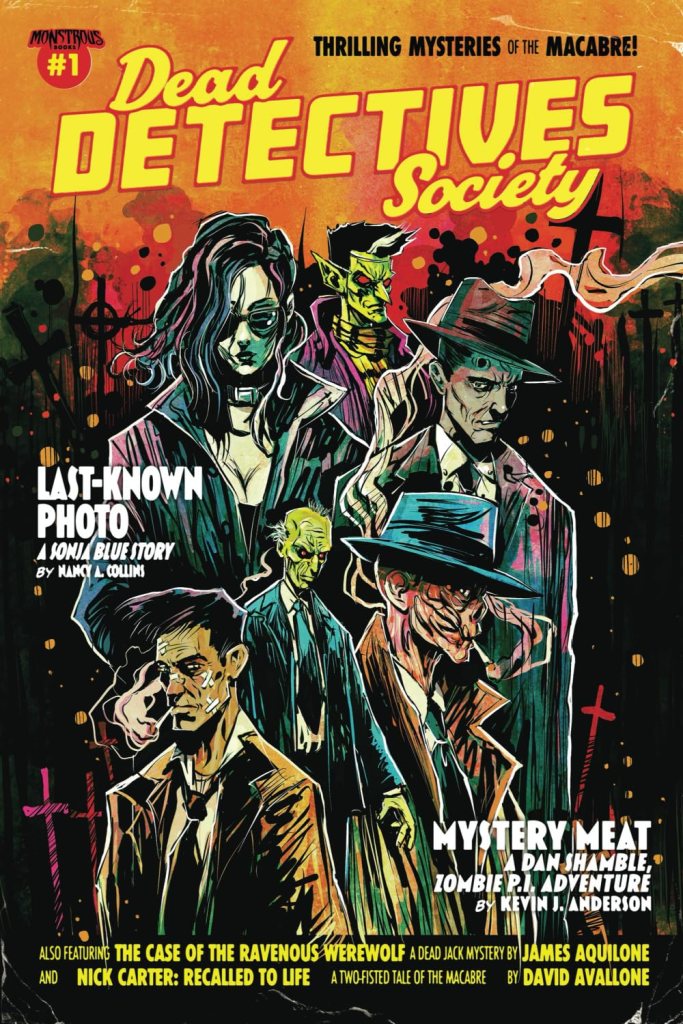
A Cut Below by Scott Drebit. All the Hearts You Eat by Hailey Piper. A Mayhem of Monsters by Mark Onspaugh. A Misfortune of Lake Monsters by Nicole M. Wolverton. Apex Apocalypse by John Lee Schneider. A Werewolf’s Guide to Seducing a Vampire by Sarah Hawley Backwaters by Lee Rozelle. Bering Sea Terror by Matthew Nefferdorf. Beyond Here Be Monsters by Gregory Frost. Bless Your Heart by Lindy Ryan. Boar War by R. Gualtieri. Bored Gay Werewolf by Tony Santorella. Bottoms and Bloodsuckers by D.A. Holmes. Bride by Ali Hazelwood. Cabaret of the Dead by Staci Layne Wilson. Dead Detective Society edited by James Aquilone. Devils Kill Devils by Johnny Compton. Doctor Strange: Dimension War by James Lovegrove. Eynhallow by Tim McGregor. Frankenstein Enterprises by Max D. Stanton. Frankenstein’s Monster by J.S. Barnes. French Tales of Vampires, Vol. 1 edited by Jean-Marc and Randy Lofficier. Full Metal Octopus by Carlton Mellick III. Giant Freakin’ Robots edited by James Young. Gigawoman x Iguanos by Harper Able Kite. Godzilla x Kong: The New Empire by Greg Keyes. Good Dogs by Brian Asman. Hell Pig by Anthony Engebretson. Her Frankenstein by Norikazu Kawashima. How to Help a Hungry Werewolf by Charlotte Stein. Immortal Pleasures by V. Castro. It Came from the Lake by Glenn Rolfe. It Watches in the Dark by Jeff Strand. Izzy’s Cursed Cabaret by Loretta Kendall. Kaiju Cataclysm by Sam M. Phillips. Kaiju: Deadfall by J.E. Gurley. Lucy Undying by Kiersten White. Love Vs. the Scarecrow by Cassandra Gannon. Monster by G.W. Thomas. Monster of Monsters, Tiamat by Constantine Furman. Monsters Among Us by J.H. Moncrieff. My Funny Frankenstein by Ward Parker. My Vampire Vs. Your Werewolf by Paul Tobin. Night of the Bubbies by Damien Casey. Prey of War by Brian Gatto. Redhead Town by Deborah Sheldon. Ruby’s Bite Me Bakery by Loretta Kendall. Russells in Time: Land Squids vs. Dinosaurs by Keven Shamel. Savage Prey by Gustavo Bondoni. Screams from the Ocean Floor edited by Heather Ann Larson. Silent Mine by C.M. Saunders. Solarpunk Creatures by Various. Somewhere in the Deep by Tanvi Berwah. So Thirsty by Rachel Harrison. Task Force E: The Reservation by Jason Rubis. Terrible Lizards edited by Kyle J. Durrant. The Horror Collection: Monster Edition edited by Kevin J. Kennedy. The Horror Zine’s Book of Monster Stories edited by Jeani Rector and Dean H. Wild. The Locust Bride by Ellis Goodson. The Old Gods Awaken by Donald Tyson. The Shriek-A-Rama Spook Show Experience by Judith Sonnet. The Z Word by Lindsay King-Miller. This Is Totally Normal by Tim Meyer. Tricksters by N.L. McLaughlin. Valentine’s Day with a Vampire by Tabitha Lovelace. Vigilante Sasquatch by Frank Cole. War of the Sea Monsters by Neil Riebe. We Mostly Come Out at Night edited by Bob Costello. Werewolf Art Thou by Ward Parker. We’re Not Ourselves Today by Jill Girardi and Lydia Prime.

The Triad of Terror

I’m certain that various Sesame Street characters have been reimagined as horror icons over the years by various authors, illustrators and filmmakers. Big Bird from the Black Lagoon, for example, or Mr. Snuffleupagus, the invisible man. Elmo, the most upbeat moppet of them all, would make a great Chucky or Freddie or Pennywise. 

That’s what happens in Yuletide Horrors, Vol. 3, a recent anthology of holiday-themed hair-raisers. In a story called “Be My Friend, Pweese?” by Dustin Dreyling, Elmo (I mean, Wilmo) is reinvented as a frizzy green monster that looks like it came from a nightmare world at the bottom of the ocean.

As a Yuletide gift for a little girl, Elmo (I mean, Wilmo) is the ultimate Christmas present from Hell. Right out of the box, he attacks everybody in the Preston family. “Wilmo is going to eat your faces!” he screams in an unnerving cartoon voice. “Rrrraaagggghhh! Kill you now!”

During the assault, the little green fuzzball is surprisingly chatty and vulgar (“Wilmo will fuck your skull with his little hard pecker,” he says), but he still can’t ruin the Preston’s Christmas. “Watch your mouth,” cries the Preston matriarch as she takes a power drill to Wilmo’s face.   

A big chunk of Yuletide Horrors is dominated by a qualogy of stories by Christofer Nigro. Taking place during the holiday season of 1977, his series of interconnecting tales brings the classic Triad of Terror to a small midwestern town called Marksdale. 

In the first installment, Wilson Chambers is excited to join his relatives for a Christmas dinner. As a vampire he’s looking forward to a feast of blood and viscera  with a little sweet revenge for dessert. Embarrassingly, a slice of garlic bread gets the better of him. 

In the second story, a werewolf rips apart his extended family during a yearly reunion. Apparently everybody forgot that a full moon was lighting up the night sky. Writes Nigro: “It truly was the most wonderful time of the year.”

Next, Dr. Frankenstein’s latest reanimation project comes to town. Newly reborn, Brad Iverson was now a giant flesh golem looking for some long-simmering payback. “I wasn’t turned into a monster,” he tells his mouthy cousin, “I’m now a superior being—a superhuman. No longer do I have to suffer the bullshit of other people.”

The qualogy reaches its climax with a “Christmas Monster Mash, or Two Triads of Terror Come to Marksdale.” The multiple fights between the vampire, the werewolf and Frankenstein’s monster are the highlights of the third volume of Yuletide Horrors. It’s kind of like a sequel to House of Frankenstein. Like everything else I’ve ever read by Nigro, the story is an enjoyable jumble of influences drawn from pulp magazines, comic books and monster movies. 

[ Yuletide Horrors, Vol. 3 / By Christofer Nigro with Dustin Dreyling and Kevin Heim / First Printing: November 2023 / ISBN: 9798990366107 ]

Reindeer Games

Every year people travel to the small town of Point Pleasant, West Virginia, to celebrate the first appearance of Mothman back in 1966. They visit the Mothman Museum, buy trinkets and memorabilia, eat some pancakes and get a selfie with the Mothman statue. The festival’s website says it’s “fun for the kids.”

But when Rian, a TikTok content creator, comes face-to-face with the legendary insect man, he questions the festival’s family friendly reputation. Nothing about what he sees would make a good plush toy or Funko Pop figure. This is a thing that should be hidden in a basement, he thinks. “This isn’t the ideal mascot for pancakes at a festival in September. Everybody’s wrong. This thing is real and not totes adorbs.”

Fittingly, the giant mutant grabs Rian and impales him on the Mothman statue on Fourth Street. Pinned on the stone effigy like a Christmas ornament, the grisly death goes viral with the song “Rudolph the Red-Nosed Reindeer” playing in the background. 

All ensuing Mothman attacks are underscored by a creepy soundtrack of “Rudolph” and “Frosty the Snowman.” Combined, the two songs become an ominous leitmotif similar to the famous Godzilla theme by composer Akira Ifukube. 

Mothman’s ongoing connection to “Rudolph the Red-Nosed Reindeer” is an important plot point in Red Ice, the latest monster novel from Damien Casey. The holiday song was originally used to comfort the cryptid in 1952 when it was birthed in a government-funded laboratory. 

“Rudolph” was more than a sonic pacifier, however. The bug baby instinctively related to the red-nosed reindeer’s outcast status. Like poor Rudolph, the young man-made creature longed for companionship and friendship. The song’s enduring sadness would inform Mothman’s motives for the rest of its life.

Unlike Rudolph, Olive and all the other reindeer, Mothman couldn’t be reimagined as a cuddly stuffed toy. It was a horrible-looking thing specifically created to be a weapon against America’s adversaries—a blasphemous blend of man, moth and bat. It could easily pinpoint and hunt down a single fly in a wide-open space as big as 15 miles with the same efficiency as a great white shark smelling blood. “It was the perfect killer,” writes Casey. 

Over the years, Mothman became a twisted mess of contradictions and eventually succumbed to its prime directive. It couldn’t escape its DNA code that provoked the thrill of the hunt and the love of bloodshed. Genetic scientists had done their job well: Mothman was the world’s deadliest soldier. 

As good as it is, readers may feel slightly adrift during Red Ice. There’s no protagonist and no dominant point of view to anchor the narrative. Readers will also notice that author Casey has an “interesting” relationship with grammar. And finally, Red Ice never realizes its true potential—it’s a short piece of work that could easily expand to over 90,000 words. 

Fortunately, the novel is packed with plenty of quirky humor and moments of excellent craft. The prologue, for example, which chronicles Mothman’s infancy, is terrific and exists as an effective short story on its own. 

Near the end of the book, a nine-foot-tall Mothman hovers over its final prey. The creature hesitates for a few seconds, processing how it wants to kill its intended victim. How long should it take? How much pain should it inflict? For Mothman, It was all just a game—a reindeer game. 

[ Red Ice / By Damien Casey / First Printing: November 2023 / ISBN: 9798868357374 ]

The Master of Monsters

There are lots of ways people become monsters. They can be bitten, sucked, born, reborn, reanimated and exposed to toxic sludge—the list of possibilities goes on and on. 

Dicky Illes, a small town hillbilly, will never forget the moment he became a monster. It happened unexpectedly one night in the woods when a strange old man puked into his mouth. “The curse is yours now, boy,”  says the graybeard with relief. 

The phlegmy body fluid turns Dicky into an eight-foot-tall rotting bear. His eyes were white and dead and his bones jutted from his body in odd places. It was as if his new body represented the ghost of a bear rather than the living, breathing variety. 

After a few shapeshifting experiences, Dicky realizes that he’s now a werebear. But he isn’t just any werebear—he’s a monster with a superhero origin story. He instinctively understands that with great monster power comes great monster responsibility. 

“Snare of the Werebear” is just one of a handful of terrific monster stories in Brad D. Sibbersen’s latest anthology Pulp: Monsters. As you can probably guess from the book’s title, Sibbersen infuses his stories with the spirit and adventure of vintage pulp magazines. 

Without a doubt, “Headless Jack, Part 1” is the most pulpy thing in the collection. The story features a flaming pumpkin head vigilante waging a one-man war against organized crime. Actually, that’s not exactly true. Headless Jack is working in tandem with a mysterious lady—“She was pretty, but harsh,” says one mobster. I’m definitely looking forward to reading more adventures about this dynamic duo. 

In true pulp tradition, most of these stories are serials, and I expect Sibbersen will revisit his characters at a later date. One excellent story that’s self-contained, however, is “The Great Dragon Burlesque Show of 1953.” 

American soldiers on a bender visit a mysterious Korean nightclub called Yong-ui (“Dragon’s House,” I think). Expecting bawdy humor and topless local girls, the servicemen are shocked to see a 20-foot dinosaur on stage. “It was really real, and not some sort of incongruously professional prop or illusion,” notes the narrator. People had paid lots of money to see a pretty young lady get eaten alive by a fire-breathing monster. 

Naturally, the U.S. soldiers cannot abide by such horror. They rush to the woman’s rescue and all hell breaks loose. The surrounding neighborhood goes up in flames, but the ending will surely put a smile on your face. 

In my opinion, Sibbersen’s best effort is “The Master of Frankenstein.” It’s another example of a great Bride of Frankenstein story. In this version, the patchwork girl is actually the reanimated corpse of Dr. Frankenstein’s wife. The twist is that Autumn Mary Frankenstein was murdered by her husband. And the mystery is: Why would Frankenstein kill his wife and then steal her body from the crypt?

Later, when she is told of her sad circumstances, Lady Frankenstein is struck with an all-consuming sadness. She knows that life is precious, but she wonders if there is happiness in a false life such as her own—a life that has been gifted by a devil. She answers her own question definitively after burning Frankenstein’s castle to the ground.

[ Pulp: Monsters / By Brad D. Sibbersen / First Printing: October 2023 / ISBN: 9798863056494 ]