The Triad of Terror

I’m certain that various Sesame Street characters have been reimagined as horror icons over the years by various authors, illustrators and filmmakers. Big Bird from the Black Lagoon, for example, or Mr. Snuffleupagus, the invisible man. Elmo, the most upbeat moppet of them all, would make a great Chucky or Freddie or Pennywise. 

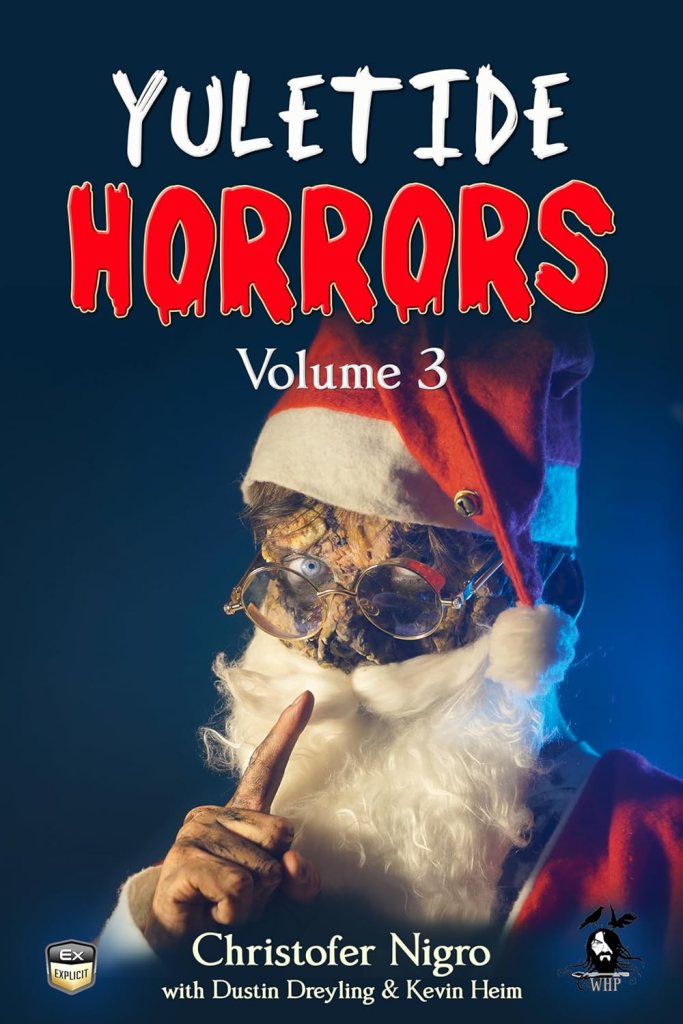
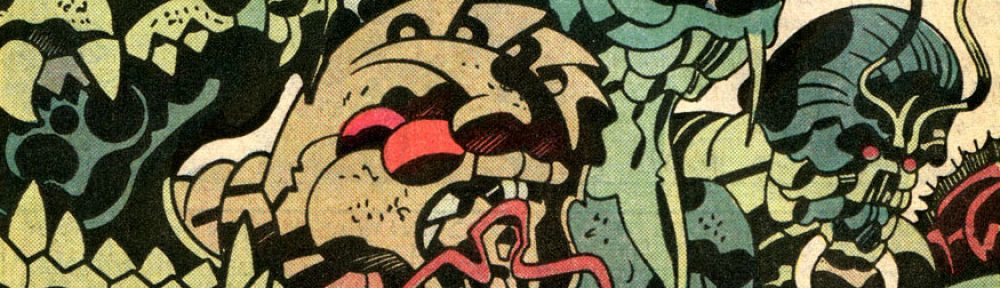
That’s what happens in Yuletide Horrors, Vol. 3, a recent anthology of holiday-themed hair-raisers. In a story called “Be My Friend, Pweese?” by Dustin Dreyling, Elmo (I mean, Wilmo) is reinvented as a frizzy green monster that looks like it came from a nightmare world at the bottom of the ocean.

As a Yuletide gift for a little girl, Elmo (I mean, Wilmo) is the ultimate Christmas present from Hell. Right out of the box, he attacks everybody in the Preston family. “Wilmo is going to eat your faces!” he screams in an unnerving cartoon voice. “Rrrraaagggghhh! Kill you now!”

During the assault, the little green fuzzball is surprisingly chatty and vulgar (“Wilmo will fuck your skull with his little hard pecker,” he says), but he still can’t ruin the Preston’s Christmas. “Watch your mouth,” cries the Preston matriarch as she takes a power drill to Wilmo’s face.   

A big chunk of Yuletide Horrors is dominated by a qualogy of stories by Christofer Nigro. Taking place during the holiday season of 1977, his series of interconnecting tales brings the classic Triad of Terror to a small midwestern town called Marksdale. 

In the first installment, Wilson Chambers is excited to join his relatives for a Christmas dinner. As a vampire he’s looking forward to a feast of blood and viscera  with a little sweet revenge for dessert. Embarrassingly, a slice of garlic bread gets the better of him. 

In the second story, a werewolf rips apart his extended family during a yearly reunion. Apparently everybody forgot that a full moon was lighting up the night sky. Writes Nigro: “It truly was the most wonderful time of the year.”

Next, Dr. Frankenstein’s latest reanimation project comes to town. Newly reborn, Brad Iverson was now a giant flesh golem looking for some long-simmering payback. “I wasn’t turned into a monster,” he tells his mouthy cousin, “I’m now a superior being—a superhuman. No longer do I have to suffer the bullshit of other people.”

The qualogy reaches its climax with a “Christmas Monster Mash, or Two Triads of Terror Come to Marksdale.” The multiple fights between the vampire, the werewolf and Frankenstein’s monster are the highlights of the third volume of Yuletide Horrors. It’s kind of like a sequel to House of Frankenstein. Like everything else I’ve ever read by Nigro, the story is an enjoyable jumble of influences drawn from pulp magazines, comic books and monster movies. 

[ Yuletide Horrors, Vol. 3 / By Christofer Nigro with Dustin Dreyling and Kevin Heim / First Printing: November 2023 / ISBN: 9798990366107 ]

Reindeer Games

Every year people travel to the small town of Point Pleasant, West Virginia, to celebrate the first appearance of Mothman back in 1966. They visit the Mothman Museum, buy trinkets and memorabilia, eat some pancakes and get a selfie with the Mothman statue. The festival’s website says it’s “fun for the kids.”

But when Rian, a TikTok content creator, comes face-to-face with the legendary insect man, he questions the festival’s family friendly reputation. Nothing about what he sees would make a good plush toy or Funko Pop figure. This is a thing that should be hidden in a basement, he thinks. “This isn’t the ideal mascot for pancakes at a festival in September. Everybody’s wrong. This thing is real and not totes adorbs.”

Fittingly, the giant mutant grabs Rian and impales him on the Mothman statue on Fourth Street. Pinned on the stone effigy like a Christmas ornament, the grisly death goes viral with the song “Rudolph the Red-Nosed Reindeer” playing in the background. 

All ensuing Mothman attacks are underscored by a creepy soundtrack of “Rudolph” and “Frosty the Snowman.” Combined, the two songs become an ominous leitmotif similar to the famous Godzilla theme by composer Akira Ifukube. 

Mothman’s ongoing connection to “Rudolph the Red-Nosed Reindeer” is an important plot point in Red Ice, the latest monster novel from Damien Casey. The holiday song was originally used to comfort the cryptid in 1952 when it was birthed in a government-funded laboratory. 

“Rudolph” was more than a sonic pacifier, however. The bug baby instinctively related to the red-nosed reindeer’s outcast status. Like poor Rudolph, the young man-made creature longed for companionship and friendship. The song’s enduring sadness would inform Mothman’s motives for the rest of its life.

Unlike Rudolph, Olive and all the other reindeer, Mothman couldn’t be reimagined as a cuddly stuffed toy. It was a horrible-looking thing specifically created to be a weapon against America’s adversaries—a blasphemous blend of man, moth and bat. It could easily pinpoint and hunt down a single fly in a wide-open space as big as 15 miles with the same efficiency as a great white shark smelling blood. “It was the perfect killer,” writes Casey. 

Over the years, Mothman became a twisted mess of contradictions and eventually succumbed to its prime directive. It couldn’t escape its DNA code that provoked the thrill of the hunt and the love of bloodshed. Genetic scientists had done their job well: Mothman was the world’s deadliest soldier. 

As good as it is, readers may feel slightly adrift during Red Ice. There’s no protagonist and no dominant point of view to anchor the narrative. Readers will also notice that author Casey has an “interesting” relationship with grammar. And finally, Red Ice never realizes its true potential—it’s a short piece of work that could easily expand to over 90,000 words. 

Fortunately, the novel is packed with plenty of quirky humor and moments of excellent craft. The prologue, for example, which chronicles Mothman’s infancy, is terrific and exists as an effective short story on its own. 

Near the end of the book, a nine-foot-tall Mothman hovers over its final prey. The creature hesitates for a few seconds, processing how it wants to kill its intended victim. How long should it take? How much pain should it inflict? For Mothman, It was all just a game—a reindeer game. 

[ Red Ice / By Damien Casey / First Printing: November 2023 / ISBN: 9798868357374 ]

The Master of Monsters

There are lots of ways people become monsters. They can be bitten, sucked, born, reborn, reanimated and exposed to toxic sludge—the list of possibilities goes on and on. 

Dicky Illes, a small town hillbilly, will never forget the moment he became a monster. It happened unexpectedly one night in the woods when a strange old man puked into his mouth. “The curse is yours now, boy,”  says the graybeard with relief. 

The phlegmy body fluid turns Dicky into an eight-foot-tall rotting bear. His eyes were white and dead and his bones jutted from his body in odd places. It was as if his new body represented the ghost of a bear rather than the living, breathing variety. 

After a few shapeshifting experiences, Dicky realizes that he’s now a werebear. But he isn’t just any werebear—he’s a monster with a superhero origin story. He instinctively understands that with great monster power comes great monster responsibility. 

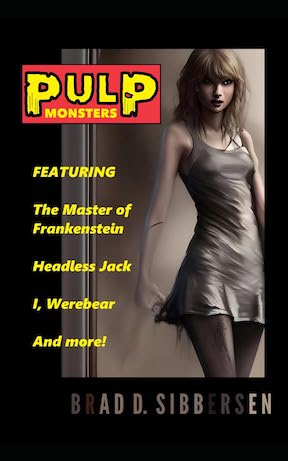
“Snare of the Werebear” is just one of a handful of terrific monster stories in Brad D. Sibbersen’s latest anthology Pulp: Monsters. As you can probably guess from the book’s title, Sibbersen infuses his stories with the spirit and adventure of vintage pulp magazines. 

Without a doubt, “Headless Jack, Part 1” is the most pulpy thing in the collection. The story features a flaming pumpkin head vigilante waging a one-man war against organized crime. Actually, that’s not exactly true. Headless Jack is working in tandem with a mysterious lady—“She was pretty, but harsh,” says one mobster. I’m definitely looking forward to reading more adventures about this dynamic duo. 

In true pulp tradition, most of these stories are serials, and I expect Sibbersen will revisit his characters at a later date. One excellent story that’s self-contained, however, is “The Great Dragon Burlesque Show of 1953.” 

American soldiers on a bender visit a mysterious Korean nightclub called Yong-ui (“Dragon’s House,” I think). Expecting bawdy humor and topless local girls, the servicemen are shocked to see a 20-foot dinosaur on stage. “It was really real, and not some sort of incongruously professional prop or illusion,” notes the narrator. People had paid lots of money to see a pretty young lady get eaten alive by a fire-breathing monster. 

Naturally, the U.S. soldiers cannot abide by such horror. They rush to the woman’s rescue and all hell breaks loose. The surrounding neighborhood goes up in flames, but the ending will surely put a smile on your face. 

In my opinion, Sibbersen’s best effort is “The Master of Frankenstein.” It’s another example of a great Bride of Frankenstein story. In this version, the patchwork girl is actually the reanimated corpse of Dr. Frankenstein’s wife. The twist is that Autumn Mary Frankenstein was murdered by her husband. And the mystery is: Why would Frankenstein kill his wife and then steal her body from the crypt?

Later, when she is told of her sad circumstances, Lady Frankenstein is struck with an all-consuming sadness. She knows that life is precious, but she wonders if there is happiness in a false life such as her own—a life that has been gifted by a devil. She answers her own question definitively after burning Frankenstein’s castle to the ground.

[ Pulp: Monsters / By Brad D. Sibbersen / First Printing: October 2023 / ISBN: 9798863056494 ]

Million Dollar Mummy

Cleopatra was the monster darling of Hollywood—a 4,000-year-old mummy gal who looked like a rockabilly version of Marilyn Monroe. Everyone agreed, she was stunning. “A vintage throwback horror dream of every man’s fantasy.”

Her career was in overdrive, but her personal life was a total wreck. Her father was a manipulative jerk and her fiancé was Frank N. Stein, the mad creation of Doctor Victor Frankenstein VII. 

Author Loretta Kendall described Frank in this way: “He looked like a typical greaser, complete with leather boots, a white T-shirt with the sleeves rolled up and matching rolled-up blue jeans. It was like looking at a Frankenstein version of 1950s Fonzie from Happy Days.” Cleo described him another way: “He was an asshole.”

Frank N. Stein and Papa Imhotep had plans to rule the world together. They were in possession of a powerful grimoire called The Necronomicon, but they also needed Cleo’s elemental power of regeneration in order achieve their dastardly goal.  

The one person uniquely capable of thwarting them was Victor Frankenstein himself. After all, he  was the guy who created Frank N. Stein and understood the art of reanimation intimately. Once a villain, he was now attempting to atone for his crimes against humanity. “I’m trying to fix the damages I’ve done,” he told Cleo. “I’m working hard to become a man of integrity.”

Victor and Cleo shared common goals, but they didn’t automatically click when they teamed up. He thought she was a bleach-blonde Botox bimbo with fake tits, and she thought he was a sex maniac and a colossal jackass. 

In truth, they weren’t totally wrong. Cleo was undeniably hooked on her glamorous Hollywood lifestyle and Victor was an unrepentant egomaniac who built his fortune by reanimating dead folks as sex slaves.  

Despite their differences, however, Cleo and Victor formed an alliance to smash the evil machinations of Frank N. Stein and Imhotep. Along the way, something surprising happened—the mummy and the mad scientist fell in love.  

Like Kendall’s previous novel in her Ghouls and Gals series (read my review here), Horror Earth is a place awash in midcentury monster miasma. Mummies, ghouls, werewolves, vampires and one-eyed, one-horned, flying purple people eaters mingle with humans in a hootenanny of rockabilly and bop. It’s a ginchy mix of monsters, romance and kinky sex with lots of laffs and clever word puns.

For me, Kendall’s latest effort really comes alive in Chapter 25 when she brings back a handful of popular characters from her first book, Gigi’s Monster Garage. To save the world, they all agreed to form a confederacy of monsters. 

At the very end, Fox Adams (the romantic object of lust from the first novel) asks: “Are we like a superhero team now? I feel like we’re superheroes.” A seven-foot Sasquatch named Barrett Jackson shakes his head no, “That’s not possible,” he says. “Monsters are real, but superheroes are fake.”

[ Cleo’s All Tied Up / By Loretta Kendall / First Printing: September 2023 / ISBN: 9798861406765 ]

Attack of the Crab Monsters

Wingaersheek Beach in Massachusetts was a place people went to wash away the weekly work struggles with the ebbing tide, crunching sand between toes, relaxing under the setting sun—these were the ways to forget about the troubles in the world.

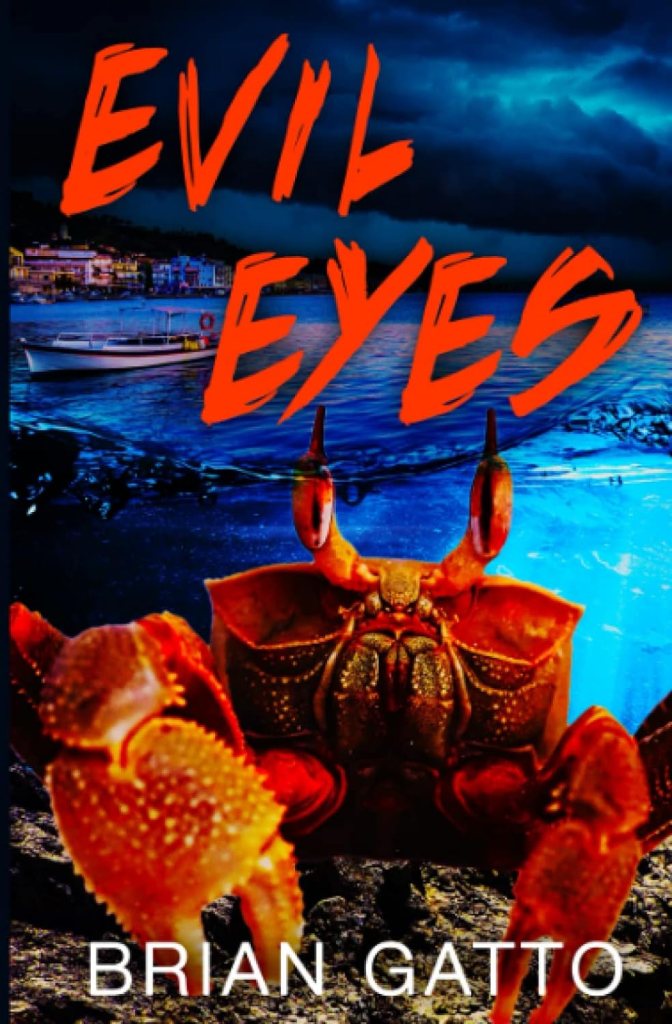
In Brian Gatto’s novel Evil Eyes, Winga Beach was also ground zero for a devastating giant crab invasion. “It was like something out of an apocalyptic scenario,” wrote Gatto. “The crabs came and conquered—today Gloucester, tomorrow the world.”

Before the crabs arrived, Massachusetts’ North Shore was a peaceful place home to generations of fishermen, young families, comic book nerds and headbangers. It was also the adopted hometown of 29-year-old Paula Lucile, a sexy adult model hoping to escape her manipulative manager and ex-boyfriend. 

One day, without warning or provocation, five enormous crabs emerged from the boggy beach. Besides being over 12 feet tall, they were not normal New England crabs. They had hate and bloodlust in their eyes and they enjoyed torturing their victims before gobbling them up. Hearing them eat, said the author, was like hearing someone slurping ramen noodles through a sippy cup—the kind with an attached straw. “We’re all going to die!” cried police deputy Vince Drayton. 

The crabs were tearing up downtown Gloucester, but somehow there was still time for a little romance. Paula had bumped into Nick Anderson at the local comic book shop and the pair quickly bonded over their love of Galacta Girl and Annihilator: Crime Zone. They made plans to celebrate Nick’s 18th birthday that night at a popular local restaurant called the Catch’n’Feast. 

Nick was totally shocked that someone like Paula was interested in him. He was scrawny and not very attractive and she was a glamorous pin-up gal with boobs the size of watermelons. The curvy model didn’t care that Nick looked like a homeless wet dog. After ditching her former salacious lifestyle in Los Angeles, Paula was looking for something a little more sober. Nick was everything she could have wanted. He had a beautiful soul, she thought. 

As you’d expect, the crabs had a nefarious origin story linked to a secret military experiment. The government wanted to create a squadron of crabs with human intelligence that could hypothetically control the waterways. If coastlines weren’t safe, then water traffic wouldn’t be safe. Supply chains would be disrupted, world economies would crumble and the U.S. would rule the Seven Seas like a modern-day Poseidon. 

Unfortunately things didn’t work out exactly as planned. The crabs grew large, escaped from captivity and pursued their own agenda. Massachusetts was the first stop on their ravenous world domination tour.  

Admittedly there were problems with Evil Eyes that could have easily been fixed by an attentive editor, but I enjoyed reading it nonetheless. There’s no way I could ever give a giant crab novel a bad review—that’s just the way I’m wired. 

I have two specific comments however. One: Nick was clearly a wish-fulfillment-type of character. That meant he was a little bit annoying. And two: Readers might be disappointed that Nick and Paula don’t have time to consummate their relationship. Male readers in particular may suffer from epididymal hypertension by the end of the novel. 

[ Evil Eyes / By Brian Gatto / First Printing: February 2023 / ISBN: 9798378460113 ]

Classic Monsters

I’ve said it before and I’ll say it again—I don’t think it’s possible to write a bad Bride of Frankenstein story. Mary Shelley only mentions the bride intermittently in her novel, but hundreds of writers have since been inspired by the idea of a female Frankenstein monster.

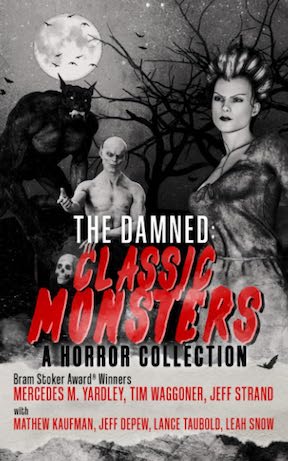
There’s a terrific Bride of Frankenstein story in a new anthology called The Damned: Classic Monsters. The bride (named Marieke by author Mercedes M. Yardley) was only 30 minutes old when she learned that she’d been created solely to be a monster’s mate. Trigger alert: She wasn’t given an opportunity to express her feelings one way or another because her lips were sewn shut. 

At first Marieke was confused by her contradictions. Dr. Pretorius professed that she was created to rival the gods and Dr. Frankenstein called her a work of art. But she knew, after being paired with her ghastly betrothed and fleeing a mob of angry villagers, that she was a monster herself. She was inextricably the “Sum of Her Parts.”

A couple of stories from Classic Monsters featured vampires from two decidedly different perspectives. “Renfield’s Journal,” for one, was a first-person account from Dracula’s infamous majordomo. What was it like eating rats and cockroaches in the castle dungeon while devoting your life to the king of vampires? Author Lance Taubold knew the shocking truth. 

“What Was Once Flesh” by Tim Waggoner was a story about an old vampire named Al who was mentoring a newly turned vampire. Dylan, the enthusiastic rookie, had questions about his new undead reality. “I’m an apex predator now, the very tip-top of the food chain,” he asked. “But am I more than that? Am I evil?”

The answer, of course, was yes. But Dylan’s idea of evil paled in comparison to the evil machinations of his wizened partner. Drinking blood from the animus (the soul) was like ambrosia to Al and he was using Dylan as a pipeline to his addiction. Even though he wasn’t technically alive, Al had found a way to live the good life.  

For personal reasons, my favorite story was “The Invisible Man” by Jeff DePew because I know firsthand how it feels to be invisible. It sucks. Being unseen can be an effective survival tool, I guess, but it’ll drive you crazy in the end. 

I can’t end this review without mentioning Jeff Strand’s zany contribution. Carl, a 25-year-old werewolf, reluctantly agrees to appear in an adult movie. It’ll be the ultimate porno flick, promised the director. “A bestially masterpiece beyond anything the world has ever seen.” 

“Werewolf Porno” was funny, but it wasn’t without considerable collateral damage. During filming Carl the psycho werewolf killed everybody on set. Not to worry, however; the movie’s director got exactly what he wanted. Blood Orgy Rampage of the Werewolf became the #1 bestselling underground DVD of the year. 

[ The Damned: Classic Monsters / Edited by Mathew Kaufman / First Printing: October 2023 / ISBN: 9781734131123 ]

Marvel Zombies

Back in the day, they were called Marvel Zombies—those comic book zealots who were hopelessly devoted to Marvel Comics. No Ralph Dibny for them. No Darkseid, no Swamp Thing and no Batman either. It was all Reed Richards, Thanos, Man-Thing and Moon Knight. There were no copies of Eightball in their long boxes, only Speedball

Initially it was a derisive term. If you called someone a Marvel Zombie you were questioning their taste level and dismissing their comic book cred. But in 2005 Marvel successfully flipped the script. That’s when the company published a titular series about superhero zombies. It was a big hit and spawned numerous sequels and reboots. As a result, nobody had to be embarrassed to be called a Marvel Zombie anymore. 

Now we have a prose novel called The Hunger by Marsheila Rockwell. Like the comic, the zombie virus came from a piece of space rock. While investigating the crater hole in Midtown Manhattan, Captain America caught the infection first and immediately passed it along to Ant-Man. One thing led to another and all of the Avengers quickly became flesh-eating monsters. It was Spider-Man who infected Doctor Strange. The Sorcerer Supreme quickly beat a path back to his Bleecker Street mansion for a tasty snack—i.e. his friend Wong. 

Within the first few pages of Rockwell’s novel, the world becomes overrun by superhero cannibals. Nobody could figure out what was going on because all the best minds had been exposed to the virus: Richards, Stark, Banner, Shuri, Nadia Pym, Lunella Lafayette—they were all “rotters.” 

A small group of unlikely heroes rose from the rubble. There was goth witch Nico Minoru from the Runaways, a monster hunter named Elsa Bloodstone and—because of a little time traveling hiccup—two versions of Wade Wilson. 

Most importantly, the group included Doctor Strange’s young librarian and apprentice, Zelma Stanton. She knew some of her mentor’s tricks, but most importantly she had access to the Chamber of Shadows, the Sanctum Sanctorum’s vast library of grimoires. 

With these books at their fingertips, she and Nico started looking at time spells, reality-altering spells, and realm shifting spells—anything they could use to move the zombies from the here and now to the elsewhere and elsewhen. 

Eventually, they concocted a plan to go back in time and nip the zombie apocalypse in the bud. They would tap into the time stream and create an infinite loop, open a portal to it, gather all the zombies together and toss them into the abyss.

It was an iffy plan. But what was the alternative? There was no Plan B. Even if it was possible, Zelma wasn’t convinced she could pull it off. To paraphrase a well-worn Spidey catchphrase: “With limited power came little ability to change things, but huge quantities of guilt.”

To be honest, The Hunger had some good moments, and a whole lot of bad moments. The good stuff was LOL funny I have to admit, but the bad stuff made me cringe. 

The good stuff included an endless series of guest appearances from the expansive Marvel Universe. It also featured an improbable battle involving Fin Fang Foom and Zombie Hulk onboard La Santa Gallega in 1492.

The most ridiculous thing (a.k.a. the best thing) was when the time-traveling heroes went all the way back to 1,000,000 BC. They didn’t bump into Raquel Welch, but they did meet Odin All-Father and his Stone Age Avengers. Crazy things like that kept me reading late into the night. 

But like I said, there was a lot of bad stuff in The Hunger as well. For one thing, the unending and repetitive navel-gazing wore me out. Plus, the author tried to make me care about the death of a character who wasn’t even in the story—that’s a writerly skill that most writers can’t pull off. 

And finally, there were two moments in the book that were underwhelming to say the least. The first was Elsa Bloodstone’s emotional confession at the half-way point of the story. The second underwhelming moment came at the end. There’s one thing that all readers demand from a time travel story: The author needs to stick the landing. Marsheila Rockwell didn’t.

[ The Hunger / By Marsheila Rockwell / First Printing: October 2023 / ISBN: 781839082453 ]

Uncharted Realms of the Human Experience

Monsters aren’t just wurms, woodwoses, wolf-men and spider whores. Like everyone else, they can be brothers, sisters, mothers, fathers, rappers and cowboys. According to More Than a Monster, a new anthology edited by Rachael Swanson, they can even be anti-Santa’s little helpers. 

It’s true, as Swanson writes in her brief introduction to this volume, that monsters occupy uncharted realms of the human experience, but they remain monsters nonetheless. Big or small, old or young, they all share the same history—at some point in their lives they’ve done monstrous shit. 

That’s what author Bert S.G. says in his nuanced story called “The Last Days of Monster Park.” Located somewhere in the radioactive hellscape of the Mojave Desert, Monster Park is a place where scary creatures and mutants are safely quarantined. Once captured by the authorities, they’re encouraged to work out their issues with therapy sessions, meditation, journaling and lots of weed. 

Unfortunately, it’s hard for such a disparate group of monsters to coexist. In Monster Park there are gill men, spider ladies, animated skeletons, werewolves, blobs and vampires mingling with each other. There’s always going to be some sort of conflict brewing—sometimes fatally. 

Monsters generally don’t get along with other monsters and they certainly don’t get along with their human neighbors either. Even shapeshifters have difficulty fitting in. That’s the case with stories by David Rider, Zachary Rosenberg and T.M. Morgan. Whether it’s a gang of preteen werewolves, a suburban jorögumo or a hungry monther, nobody can hide their monstrous nature forever. 

But who are we to judge? Larry Talbot didn’t ask to be bitten by a werewolf, King Kong didn’t want to leave Skull Island and the Bride of Frankenstein didn’t want to marry a monster. Like Howard the Duck, all monsters are trapped in world they didn’t make. 

For balance, the editor includes a couple of stories in her collection which feature monsters and humans finding common ground: “Take My Hand” by Christie Hansen and “Vesper’s Garden” by Ville Meriläinen. 

Hansen writes about an awkward meeting between a female troll and a distressed woman lost in the swamp. What follows is a series of misunderstandings (some comical and some not) between the two ladies. Everything works out for the best, thank goodness. The story’s charitable title turns out to be both figurative and literal. 

More profound is Meriläinen’s story about a tightly knit family of enchanted woodland creatures. The moondeer are generally shy, but when provoked they embrace a tribunal of ultra-violence. 

There is no wisdom in anger, however, and one fateful night teaches the moondeer to take responsibility in the face of unresponsive nature. By living harmoniously with their human neighbors, they learn that forgiveness is a gift they can give to themselves. 

[ More Than a Monster / Edited by Rachael Swanson / First Printing: September 2023 / ISBN: 9781960534057 ]

Monsters Unleashed, Part 3

It’s been several months since dinosaur eggs were found in a sea cave along the San Francisco coastline  (click here for more details). The time had finally come for a group of cave-diving commandos to embark on a  journey to the center of the earth. 

These potholers were comprised of various military and security personnel, doctors and scientists. The assignment was straightforward: Explore the cave system and destroy the eggs. They all knew their mission was a one-way ticket to Hell. 

The leaders of the expedition were Callie Breyer and Lara Newcomb, the heroines from the two previous novels in the series (including Rise of the Titanosaurus and Rage of the Titanosaurus). Both women felt a personal responsibility to protect their hometown of San Francisco from an insurrection of giant monsters. And, if necessary, they were willing to protect the rest of the world too. Their commitment was unwavering. 

In the past, Callie and Lara were the champions of their own separate narratives. This time, I was hoping to finally see them working together side by side. Unfortunately, rotating chapters and divergent catastrophes kept the alpha ladies (mostly) apart. That’s too bad. It was like they were on two separate adventures. 

As expected, the cavern contained a sundry of prehistoric dangers, but the biggest threat was the spelunking itself. Twisty passages, vertical shafts, unstable bridges, claustrophobia and hallucinations plagued the search party the entire time. It didn’t help matters that the roar of a baby Titanosaurus was like a sonic boom. Each roar caused a seemingly insurmountable mini-disaster of its own. 

The underground labyrinth was completely baffling to Callie, Lara and everyone else. From the git-go they became disorientated and didn’t know up from down. The tunnels, caverns and cliffs weren’t random, however. It was obvious they were created with a purpose. 

The passageways all pointed toward a vast common area that looked like a Garden of Eden for dinosaurs. It was, wrote John Grover, a primordial ecosystem that had somehow blossomed beneath the world of man. “An emerald green carpet blanketed the cave floor in the form of moss, algae, liverwort and ferns. A thin river ran right through the cavern. The air was moist and the area was lush—a place untouched by human existence.”

Paleontologist Theo Stanfield wasn’t too surprised to discover the underground oasis. Dinosaurs were a lot more intelligent than anyone realized, he said. “Some were even smarter than dolphins. They were social creatures and they had the capability to work together.”

Despite the discovery of the idyllic prehistoric paradise (and all the invaluable biological information it contained), the spelunking squadron still had a mission to complete. To save San Francisco from any future dinosaur attacks, they brought the cavern down with enough explosives to obliterate a micro-neighborhood. Only four members of the original troop survived the ordeal, but the dinosaurs and their eggs were destroyed. I guess you could call that a success. 

[ Den of the Titanosaurus / By John Grover / First Printing: September 2023 / ISBN:9798860661530 ]

The Night Time Is the Right Time

David Agranoff’s outstanding new novel begins on April 30, 1945, the night Adolf Hitler kills himself in an underground bunker below the streets of Berlin. 

With the Führer dead, the end of WWII is imminent. Germany’s surrender is just days away, but there’s still a couple of loose ends to tie up. A radical OSS agent named Noah Samvovich is determined to chase down and execute 150 high-level Nazi Party members on their way to Manchuria via the Berchtesgaden Alps. 

This group includes members of Hitler’s inner circle, plus an assortment of military officers. The most infamous of these goons is Heinrich Himmler, the Reichsführer of the Schutzstaffel. “No one short of Hitler is more responsible for the crimes of the Final Solution than Himmler,” says Samvovich who’s seen firsthand the horrors of the concentration camps. Like Batman and other emotionally damaged vigilantes, he wears his rage like armor and carries it like a weapon. 

The clock is ticking for the avenging OSS agent and his suicide squad. Once Germany surrenders and the Nuremberg trials begin, they won’t be able to get close to their Nazi prey. They have one chance to get it right. It is, as the novel’s title makes clear, the last night to kill Nazis. 

Samvovich knows that Himmler and his retinue are resting warmly and comfortably inside Hitler’s reclusive alpine chalet. All he needs to do is drop his secret hellspawn weapon into the middle of the Eagle’s Nest. He figures it’ll take a monster to kill a bunch of monsters. He’s right. 

Count Reiter is a 400-year-old vampire with a personal grudge against Germany. Because his ancestral home sits on the highest peak in Romania, the Nazis consider it a key to protecting or taking the most valuable regions of Europe. Reiter isn’t happy about the Wehrmacht knocking down his doors. In truth, he’s pissed off about it. He enters the war the moment he hears German boots echoing inside his castle atop the Carpathian Mountains. 

Reiter is a monster imbued with powers from Hell. He understands that he’s evil, but he has a little bit of self-control. He’s not a heartless creature after all. Here in the twilight of WWII, Reiter is more than willing to help the Allies permanently squash the Third Reich. “I assure you, I hate the Nazis too,” he says. “I consume to survive, but the things they do, the way they wield misery, is an insult to monstrosity.”

As promised, Count Reiter is an excellent Nazi smasher. He’s also a great tool for exposition. Because vampires absorb the memories of their prey, the author uses Reiter to illuminate the sins of his victims. “The souls of those he consumes, and their memories, joys and fears are like a universe to which he is God,” writes Agranoff. No one escapes judgment day.  

[ The Last Night to Kill Nazis / By David Agranoff / First Printing: September 2023 / ISBN: 9781955904728 ]