Raising Cain

On the back cover of The Locust Bride, author Ellis Goodson describes his latest novel as a “Kaiju Western.” But if you’re looking for a typical Brobdingnagian bang-up, you’ll need to wait patiently until the final act. 

This is not to say there isn’t a gaggle of monsters prowling the prairie in 1875. Before the behemoth Beleem arrives, the small town of Locust needs to survive flesh eating Hell-bugs, malevolent conjoined twins, albino revenants (white zombies!) and a demonic American Indian wielding a fiery tomahawk.

The monster uptick is due to a large sinkhole that suddenly appears in the middle of Main Street. It’s a big gaping hole—big enough to suck the entire town of Locust into its maw. “It was a large round pond of void that smelled like mildew and rot,” said the author. “Deep down in the pit, an eerie sound of combative, competitive movement continued to get louder and louder. It was like putting your ear to the chest of a rotting corpse and hearing worms fight for dead flesh.”

Without a doubt something unspeakably vile is living at the bottom of the rupture. Something big and cosmic. Something Lovecraftian—something biblical. 

To help lure the monster to the surface, a traveling medicine show rolls into town. In tow with Basil Mackovie and his brother Micah (the evil conjoined twins) and Red (the Amerind archfiend) is a pretty young actress named Grace Dane. Poor Gracie doesn’t know she is the bait, the monster’s intended bride. 

Thank goodness Cain Mann is nearby. He’s a man with his own set of problems, but as the novel’s hero, he’s prepared to rescue Grace, save the citizens of Locust and destroy all monsters. And with a name like Cain, you know he’s willing to raise a little hell to get the job done.  

Finally, after a long 155-page set-up, Beleem, the kaiju king, crawls out of the void and reveals itself. This is how the author describes the raging behemoth: It was two-stories high with the bulk of five elephants. A sperm whale-shaped head featured large eyeless sockets and a nasty mouth with pointed teeth set in circular rows. The creature’s orifice would shrink to a hat-size sphincter and then expand into a two-yard-wide opening. “The ugly mouth made a continuous steam-driven locomotive sound—catching its breath from the hard work of being reborn.”

As expected, Cain defeats Beleem and its devilish grubs. By doing so, he saves Grace from a monster wedding. In return, Grace (who’s obviously read the Hebrew Bible) gives Cain permission to live with happiness and contentment. To paraphrase the Good Book: “His joy was greater than he could bear.”

[ The Locust Bride / By Ellis Goodson / First Printing: February 2024 / ISBN: 9798879769746 ]

Dino Fury

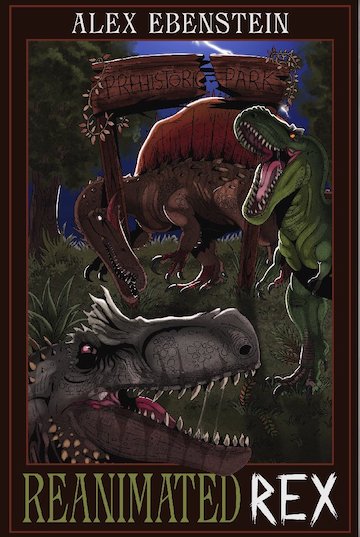
Not exactly an homage to H.P. Lovecraft nor Mary Shelley, Reanimated Rex is a book that nonetheless walks the same crooked path as Herbert West-Reanimator and Frankenstein.

It all starts when a high school kid sneaks into an abandoned amusement park one stormy night. After being shuttered for nearly 20 years, the dilapidated dinosaur theme park is now a dense thicket of overgrown flora and derelict structures. 

Still standing—and scattered throughout the park—are life-size statues of various dinosaurs such as the T-Rex, the Stegosaurus, the Allosaurus, a couple of Utahraptors, and the big daddy of them all, the Spinosaurus. They are amazingly realistic and dominate the landscape with their stoney silence. 

In the dark and in the rain, the former dinosaur park is certainly a scary place to be. In fact, it’s the perfect place for an innocent high school caper to go terribly wrong—sadly, the young trespasser is never heard from again. 

After three weeks, the local police give up on the case. Teenagers go missing all the time, they conclude. Maybe he enlisted in the army and didn’t tell anyone? Or maybe he joined the circus? Who knows? 

Laura Harding, the kid’s big sister, doesn’t see it that way. She does a little sleuthing around town and discovers that her brother was spotted near the dinosaur park the night of his disappearance.  

Skipping ahead to the next dark and stormy night, Laura is at the dinosaur park looking for clues. In a Blue Velvet-like moment, she finds one of her brother’s sneakers in the weeds—with his foot still in it. 

Unbeknownst to Laura, she is not alone. Alan Tippett, the park’s original owner and dino geek, has secretly been living in the tunnels under the property for the past 20 years. He’s a big weirdo with a big secret. He knows that his dinosaur statues come alive during thunderstorms. 

Well, they aren’t really alive, he tells Laura when the two finally meet. They change from stationary dinosaur replicas into lifelike creatures only when it storms—“something about the electricity,” he shrugs. 

It’s here when Reanimated Rex takes a sharp moral turn. Just as Victor Frankenstein did in 1818, Tippett was using lightning and thunder to successfully transcend natural limits to create life, and just like Herbert West in 1922, he found a way to animate his creations.  

Also like Frankenstein and West, Tippett’s monsters ultimately destroy him. “I always knew it would end this way,” he says with his final breath, “live, create and die from the creation.”

Coda: Tippett dies in a very satisfying way. If you’re wondering what ultimately happens to Laura, however, you’ll have to hold on until the very last sentence. But believe me it’s worth the wait. Honestly, it’s probably the best final sentence of any novel I’ve ever read. 

[ Reanimated Rex / By Alex Ebenstein / First Printing: May 2024 / ISBN: 9781960470034 ]

Bottoms Up

When 23-year-old Vladimir Radu posted a video on social media outing himself as a gay vampire he didn’t know what to expect. 

Initially, he just wanted to tell his story and leave it at that. The video was simply a quick hello to the planet, he explained. “I didn’t do it to expose other vampires. I did it to expose myself. All I wanted was to be me, and I couldn’t do that living in the shadows.”

But you can’t go around saying you’re a vampire—a gay vampire!—and not expect some kind of unwanted attention. For example, days after his video went viral, Vlad became a celebrity to a clutch of vampire cosplayers who followed him around in their capes, frilly shirts and ugly polyester corsets. 

More dire, however, Vlad found himself in the crosshairs of Master Sven, the most notorious occultist in human history. Even to vampires, Sven was a nasty dude. He was in league with a host of hoary demons and was the champion of resurrecting long-forgotten forms of magic. He even created the modern-day porn industry, so you know he was a bad mammy jammy.

Sven’s nefarious plan (I think) was to assimilate vampires into mainstream society and create a master race of monsters. But Vlad, with his confessional video, ruined all of that.

Vlad openly rejected his family’s undead legacy. He represented a new generation of non-binary vampires who didn’t want to drink human blood. With his new-found infamy, he had unwittingly become an avatar for change. 

Like Coming Out of the Closet, the previous novel by author D.A. Holmes (read my review here), Bottoms and Bloodsuckers was a breezy LGBTQIA+ coming-of-age story that fiddled around with horror tropes for laughs. 

Without a doubt Holmes’s book was funny, but he didn’t shy away from shocking the reader when the opportunity presented itself. The late-night fight at Denny’s pitting Vlad and his friends against a gang of occultists was ghastly. And visits to stately Radu manor were also quite spine-tingling. The image of Maria Radu sensually feasting on a corpse haunts me still. 

All of the carnage at Denny’s was mainly due to Vlad’s new servant and companion (i.e. familiar). Charlie Rockwell was a shaggy-haired, stoner popinjay who was tasked with protecting Vlad from harm. He was a lovable sidekick with an overly enthusiastic Jack the Ripper streak. Vlad wanted no part in vampire traditions, but he quickly realized that a familiar like Charlie could be useful in certain situations. 

Other significant characters are introduced in Bottoms and Bloodsuckers—in particular Daniel Mai and Jenny, a waitress working the nightshift at Denny’s. And, of course, everybody’s favorite goth girl Alison Grady returns to help her friend “Count Popular” navigate the tangled line between monster and man cub.  

[ Bottoms and Bloodsuckers / By D.A. Holmes / First Printing: May 2024 / ISBN: 9798322523369 ]

Midnight Monster Madness

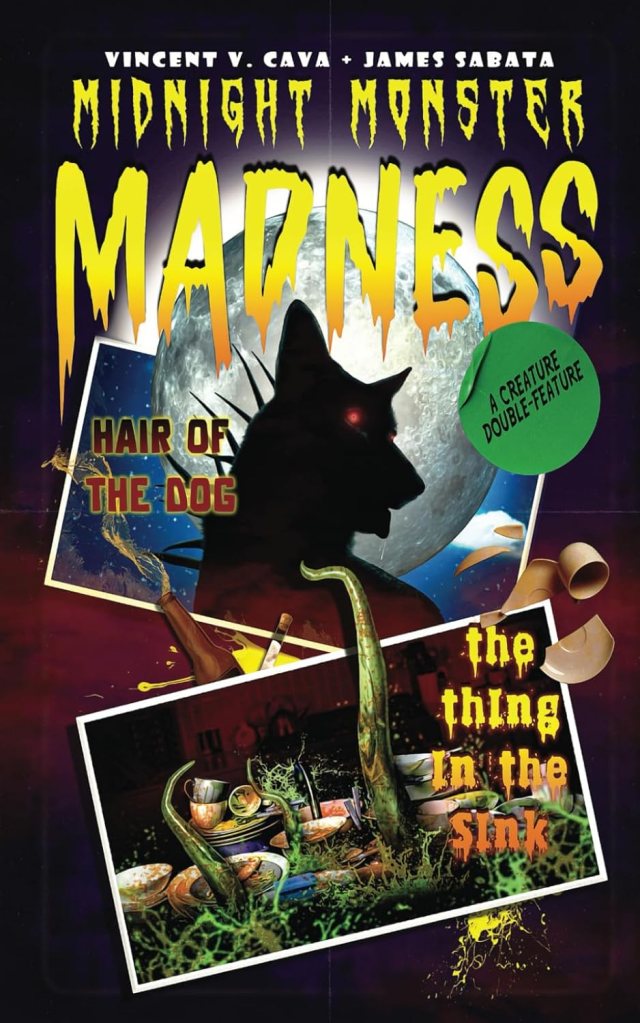
As advertised, there are two creature feature short stories included in this slim edition. It is, I believe, the first volume in a continuing series of retro pulp monster pocketbooks from authors James Sabata and Vincent V. Cava. 

Mostly, I feel Sabata and Cava are on the right track with their new project. Both of their efforts are suitably monsterific and raunchy, and I look forward to future volumes to come. 

But to be totally honest, I’ve got to say that the first story in Midnight Monster Madness stumbles out of the gate. “Hair of the Dog” is a facile tale of drug use and relapsed addiction with a familiar monkey/dog metaphor. It’s a little bit funny and weird, but it’s a throwaway effort nonetheless. Note to the author, next time try to remember Kurt Vonnegut’s number one rule for writers: don’t waste the time of strangers. 

Much better is “The Thing in the Sink.” It’s a story that begins with a sink full of dirty dishes—“A miniature city made of mucky dinnerware,” explains the author. “A bustling filthtopia.”

At some point, Neal (our hero?) notices something is living in the drainpipe of his kitchen sink. Beneath the cereal bowls and encrusted dinner plates he discovers a hungry eldritch monster born from rotten food, humidity and “whatever-the-hell-else.”

It was a hideous blob of orange goop with green fur and yellow spots. Its body pulsated rhythmically, rising and falling in a hypnotic fashion. The thing’s mouth was a round suction cup with multiple rows of jagged teeth. Inside the creature’s mouth was a pink protrusion shaped like a shiv. It would use this deadly body part to puncture your skull and squeeze the life juices out of your body like a tube of toothpaste. 

After a few moments of indecision, Neal decides what to do with the “sentient mound of sink scum.” He will provide food (like turkey sandwiches and other meaty items) for the monster to consume. And, later, he will contact whatever department of the FBI handles man-eating mold monsters. 

Neal’s plan sorta works. He successfully cleans up his kitchen mess and gets rid of his thoughtless roommates, but he pays a deadly price for his Little Shop of Horrors escapade. The last sentence of the story makes it clear that the sink monster is not going away anytime soon. 

[ Midnight Monster Madness, Book One: “Hair of the Dog” and “The Thing in the Sink” / By James Sabata and Vincent V. Cava / First Printing: April 2024 / ISBN: 9798884560352 ]

Godzilla Crickets

Like all great giant monster stories, the latest novel by Edward J. McFadden III begins with a big bang and ends with a big question mark. It’s a terrific book in many ways.  

But between the book’s prologue and coda, the author sidesteps numerous opportunities to escalate his post-apocalyptic narrative to an insane Mad Max level. That’s too bad.  

Here’s how it all starts: An explosion at a bio lab turns Staten Island into a war zone pitting local citizens against colossal mutant crickets. Over night, the “Crics” morph into Godzilla-size insects with ravenous appetites. Needless to say, it’s a dire situation with little-or-no chance for survival. 

Within hours, Long Island falls into total disarray with emergency services stretched to the breaking point. Everyone is afraid the Crics will spread to other New York City boroughs and they want the government to drop a Black Flag insecticide bomb on the area. Instead, officials quickly lock down the island—no one allowed in or out. 

McFadden’s story follows newlyweds Scott and Jenni Ward as they struggle to survive and escape the dangerous quarantined zone. During their journey, the pair encounter a riot of monsters and crazy survivalists. 

At this point, I wanted Crics to succumb to its doomsday genre—a genre that I love dearly. Did I get what I wanted? Yes, but not exactly. 

Scott’s first encounter in the cricket wasteland is with a neighborhood vigilante carrying an AR-15 and dressed in a motorcycle jacket, gloves, crash helmet and hip waders. The lone “bug soldier” doesn’t stick around very long because the Crics descend on him like ants on a fallen lollipop. 

Next, Bill the Bugman appears in his super tight apocalypse van. I was hoping that Bill would be a Road Warrior-like marauder—like the nutjob with the red mohawk in Mad Max 2. But in a twist, the Bugman turns out to be a decent guy trying his best to save his family and his neighborhood. 

Before the final showdown with the Godzilla-Cric queen (which is awesome btw), Scott, Jenni and the Bugman’s crew tangle with a New Barbarians-like motorcycle gang and a desperate horde of suburban outlaws. Naturally, casualties pile up quickly. 

Throughout the novel, McFadden dutifully touches upon issues of morality, civility, privilege and groupthink. Good on him. But honestly I would have preferred a gonzo version of Lord of the Flies with monsters, grotesque anti-heroes and a dollop of bizarro fiction absurdity. 

Like I said earlier, Crics ends with a big question mark: do the giant crickets make it off Staten Island? If they do, I’m hoping the sequel will feature a freaky phalanx of Mad Max road warriors trying their best to make sense of their new post-apocalyptic world.

[ Crics / By Edward J. McFadden III / First Printing: April 2024 / ISBN: 9781923165127 ]

The Crimson Executioner

Rome was an extraordinary place back in 1960. Economic prosperity culminating in the Dolce Vita era, Italian haute couture up and down the runway, the summer Olympics, the dawn of giallo cinema, Gina Lollobrigida, Sophia Loren, Claudia Cardinale and all the other iconic actresses. And more than anything else, there were dinosaurs from outer space. 

The Saurians arrived en masse five years earlier and quasi-colonized the planet. Explained author James W. Evans: “There were approximately 12 million Saurians on the planet now, along with a mothership the size of Sicily in high orbit, and a fleet of smaller saucers busy across the solar system.”

Saurian Empire technology changed the world completely. It introduced clean and limitless energy, flying cars and high-speed transit. Together, the dinos and humans successfully colonized the moon and began terraforming Mars.  

Most of the Saurian’s looked like anchisaurs, small and obscure dinosaurs from the early Jurassic period. But there were other dinosaurs in the mix as well—the allosaurus, for example. 

These allosaurs were second-class citizens used mainly for soldiers, scouts and slave labor. As a group, they were compliant and disposable. 

One allosaur named Rover was different, however. Because of chemicals or radiation (or just evolution), Rover had somehow become a sentient being. His work during WWII (including twisting Adolf Hitler’s head from his body) had earned him a lot of goodwill with the U.S. Government. 

During the day, Rover was a private investigator working cases involving marital infidelity and domestic abuse. But at night he strapped on a katana and a backpack filled with Batman-like gadgets and transformed himself into an ultra-violent vigilante named the Crimson Executioner. 

Inspired by the Dark Knight in New York and the Shadow from Los Angeles, the Crimson Executioner protected the working-class people of Rome from bandits, bagmen and bullies. By writing his nom de plume on walls using the blood from his victims, Rover’s nightly adventures blurred the line between giallo cinema and superhero comic books. I liked it very much. 

Beyond the solo adventures of the Crimson Executioner, Rover and his human sidekick Robert Levin were recruited by the Rome Police Department to help solve a gaggle of murder mysteries featuring beautiful (and bored) ambassador wives along with various coed libertines. 

Everything quickly becomes a jumble of clues and Rover and Levin don’t know what to think. The killer is either a maniac, a mobster, the member of a post-war Fascist motorcycle gang, a Russian hitman or the entire U.S. Government. 

At some point, the author has to step in and clean up the mess. The Crimson Executioner was pleased with the resolution and anxious to get started on his next adventure. Said the author in conclusion: “The allosaur smiled a terrifying smile that promised nothing but hell.”

[ Giallosaurus / By James W Evans / First Printing: March 2024 / ISBN: 9798321510810 ]

The Fear That Flies By Night

In 1924, British captains of industry partnered with political opportunists to begin construction of a shipping port on the Indonesian island of Java. Once completed, they hoped the port would facilitate a major trade route between England and the Orient. 

But even 100 years ago environmentalists were concerned about greedy profiteers raping indigenous flora and fauna for their own agenda. To make sure the construction on Java didn’t negatively impact the ecosystem of the island and its people, a naturalist by the name of Ernest Bartels was dispatched to oversee the situation. The poor academic had no idea what kind of mess he was getting himself into. 

Today Java is a popular destination site for tourists hoping to enjoy the island’s culture, scenery and beaches. (Personally, I’d like to see the magnificent Borobudur temple in person one day.) But 100 years ago it was a remote native paradise with inclement weather. In fact, author Gary R. Brand Jr. constantly reminds readers just how hot and humid it is on the tropical island day and night. 

It was also the home to the Ahool, a legendary regional monster that didn’t like the ongoing construction encroaching on its habitat. At night, the Ahool was sabotaging the project and viciously killing anyone in the vicinity. 

When Professor Bartels first learned about the Ahool, he wanted to hop on the next ship back to England. “I was only sent here to observe the wildlife,” he cried, “not fight monsters!”

Over the years, rumors of the Ahool were shrouded in mystery and hearsay. Was it a giant owl, like some people claimed? Or a giant bat? Maybe it was a surviving pterosaur? To confuse matters further, all countries had their own singular version of the colossal winged cryptid—the Kongamato, the Fangalabolo and the Guiafairo for example. 

The mystery was finally solved when Bartels and his beautiful Indonesian female guide confronted the Ahool in the Java jungle. “The creature’s face was unmistakable, with features of a chimpanzee and a bat. Its skin was dark and red. Long claws protruded from its arms and gray fur covered its entire body. Taller than most adult humans, its wingspan was wider across than three men.”

Everything culminates in a big explosive showdown between the monstrous bat-thing and the construction team militia. Although the Ahool puts up a tremendous fight, the shipping port is ultimately completed—“a testament to British advancement,” said the author. 

[ Cry of the Ahool / By Gary R. Brand Jr. / First Printing: March 2024 / ISBN: 9798851583681 ]

The Big Sleep

Back in 1859, Frankenstein’s monster had a brilliant plan to solve America’s slavery problem. By creating a race of zombie creatures absent of freewill—and therefore constitutionally compliant—he could successfully nip the U.S. Civil War in the bud (click here for more information). 

When you think about it, zombies would be helpful in a variety of jobs. For example, they’d be great data entry workers, assembly line operators, post office employees and animation inbetweeners.

As seen in a new anthology titled Dead Detective Society, zombies would also be great private investigators. They’re relentless and they’ve got a never-say-die attitude. “As a zombie detective,” said Dan Chambeaux, the hero of Kevin J. Anderson’s story “Mystery Meat,” “I am good at aimlessly shambling.”

Admittedly, not all of the detectives in this collection were zombies, but everybody was certifiably unliving. They were all “supernatural investigators operating on the fringes of society, lurking in the shadows, working strange cases with little reward. They were hardboiled zombies and ghosts, mythological creatures and ass-kicking vampires … whose normal was the bizarre and weird.” 

All of the characters shared the same origin story as well. More than a dozen years ago, a cosmic event shifted the world and rewrote the natural laws of science, magic and superstition. As a result, an assortment of undead P.I.s were solving mysteries wrapped inside mysteries. None more so than the protagonist in “The World Is a Secret” by Lisa Morton. 

“I was a patchwork person,” observed an individual with no memory to explain their odd appearance. Naturally, he/she had a lot of questions about their countenance and bigender condition. “Who was I really,” they wanted to know. And: “Was I more or less than the sum of my parts?” Those were hard questions to answer and the mystery-within-a-mystery led directly to an awkward (and sad) climax.

Sometimes the mysteries remained mysteries. That was certainly the case in David Avallone’s story “Nick Carter: Recalled to Life.” Carter was the world’s preeminent detective during the late 19th century. Killed by his archenemy in 1944, he somehow resumed his career twenty years later. 

As a reader, you’ll probably want to know how he got from Gilded Age to Space Age. Nick Carter, on the other hand, wasn’t curious at all. “He was afraid to find out what unholy combo platter of Dr. Frankenstein, Dr. Moreau, Baron Samedi and/or Anubis had been involved,” explained the author.  

As much as I enjoyed this anthology, I have to admit that some of the stories were more half-baked than hardboiled. The aforementioned Nick Carter story, in particular, seemed like a prelude rather than a full-bodied effort. 

But overall, I’d say the debut volume of Dead Detective Society was a winning knockout. There were plenty of mysteries that needed to be solved and plenty of devils and goblins in need of aid. Zombie detectives wanted to be helpful. Just because they were monsters didn’t mean they had to act like it. 

[ Dead Detective Society / Edited by James Aquilone / First Printing: March 2024 / ISBN: 9781946346216 ]

Nietzsche Anathema

Monsters don’t care if you believe in them or not, said a local rummy. “You gotta put your faith in something, even if you can’t see it. Believe me, the Nietzsche Anathema is fucking real.”

Nietzsche Anathema was a fancy name for a monster supposedly living in the local man-made lake. According to a dusty old book about Maine folklore, the creature was tall like Bigfoot. Plus: it’s hands were webbed and its eyes were as black and cold as a shark.

Frankly, it all sounded like a bizarre horror-science fiction mashup. No one literally believed in the far-fetched tales of monsters and deformed fish with missing eyes and a taste for the flesh of children. 

The scariest thing in the forest was actually Francis Owens, a Vietnam War veteran with post-traumatic stress disorder. He was the caretaker for Owens Lake and he roamed the area with ill-intent. Francis was a madman—not the creature from the Augusta lagoon—but he knowingly manipulated the Nietzsche Anathema legend for his own benefit. 

Author Glenn Rolfe begins his novelette with the murder of Francis Owens’ brother. The death eventually attracts the attention of a detective named Bruce Maddox and includes a confluence of characters including Quincy, a truant who enjoyed hanging out in the woods, and a runaway orphan from New Hampshire named Leilani. 

After all these years in seclusion, the Nietzsche Anathema finally comes out of hiding. It couldn’t resist all the sudden commotion in the forrest. Here’s how the author describes first contact with the monster: “Even hunched over, it looked to be at least seven feet tall. Its slender torso was slightly twisted and covered in thick, black scales. The long legs ended in flippers. Its hands were webbed and its head was dark with wet clumps of hair hanging like seaweed braids from its scalp. The face featured a half-formed human nose that gave way to an awful teardrop-shaped orifice.”

It was the “teardrop-shaped orifice” that made the creature uniquely creepy and deadly. It would latch onto your mouth and fill your body with lake sludge and unknown toxins. One victim “felt as though someone were violently attempting to crack the front of his skull open with Thor’s mighty hammer.”

It Came From the Lake ends like all great creature feature stories, id est the author makes sure to leave the door open for a sequel. To quote the monster’s namesake Friedrich Nietzsche: “Whoever fights monsters should see to it that in the process he does not become a monster.”

[ It Came From the Lake / By Glenn Rolfe / First Printing: January 2024 / ISBN: 9798876518064 ]

Enigmatic Encounters

Editor Jim Beard wants readers to know something about his new short story collection titled Knocks and Howls. “This book isn’t about Bigfoot,” he writes in the introduction. “It’s about the idea of Bigfoot.”

Oh sure, you’ll find one or two rampaging apemen in this volume, but Beard is true to his word: his anthology takes Bigfoot to the nth degree. Each writer tackles the legend of Bigfoot as it intersects with the real world. 

The first story expresses this theme with a bit of poetry. “Regions of Fancy” by Josh Reynolds features a conversation between Daniel Boone and John Audubon back in 1810. The two folk heroes chat amicably until Boone makes a startling admission. He tells Audubon that he had a fatal confrontation with Bigfoot in the woods of Kentucky. And more startling, he still carried the beast’s skull in his rucksack. 

Taking a look at the skull, Audubon notices right away that it did not lack for ferocity. “It was a thing of utter strangeness that set the world off its axis,” he later wrote in his journal. “I could feel the weight of an inhuman tread in my mind. What thing was this, that the Creator had set loose upon the land?”

Similarly, two stoner kids take a trip through the woods to find God in Christopher Ryan’s story “Legacy.” What they find instead is Bigfoot tripping on mushrooms and experiencing his own intimate religious enlightenment. 

“Legacy” is unabashedly a stoner buddy adventure similar to Cheech and Chong’s Up in Smoke and Harold and Kumar Go to White Castle. It’s funny, I admit, but it’s not the wackiest thing in this collection. That honor goes to “Suicide Squatch” by Eric M. Esquivel. 

Esquivel’s story is about a suicidal sad sack named Richard Franzblau. His intention is to kill himself amid the majestic splendor of Washington’s Gifford Pinchot National Forest. 

Richard’s plans go pear-shaped, however, when he comes face-to-face with a hostile nine-foot-tall Bigfoot. He’s not afraid to die, but he doesn’t want to be torn limb from limb by a cryptid monster. Immediately, his survival instincts kick in. 

Richard somehow survives his tussle with Bigfoot but he’s thrown in jail for unauthorized first-contact with a non-human intelligence. Because of his unique experience, he’s then recruited by an organization called C.L.I.C.K. (short for Cryptid Location, Intervention, Capturing and Killing) and immediately dispatched to Colorado, to negotiate peace talks between warring Sasquatch tribes. 

Another comedic tale is “Like and Subscribe” by Mary Fan. Three video podcasters travel to the Pine Barrens of New Jersey to confirm the existence of Bigfoot. After a series of stunts and petty bickering, the rivals reach an amicable truce. Fan’s characters are sweet and adorable and I encourage her to revisit her story and expand it into a novel-length adventure. 

The final story in Knocks and Howls is by editor Beard himself. It is literally “The Last Bigfoot Story.” Acting as good neighbors, an alien race comes to Earth to solve all of mankind’s ills—cancer, dementia, Covid-19 and all the rest.

Unfortunately, these aliens are excessively logical and cannot abide by anything enigmatic. There’s no place for religions, myths and folktales … and that spells doom for the legend of Bigfoot. 

[ Knocks and Howls / Edited by Jim Beard / First Printing: February 2024 / ISBN: 9798878739085 ]