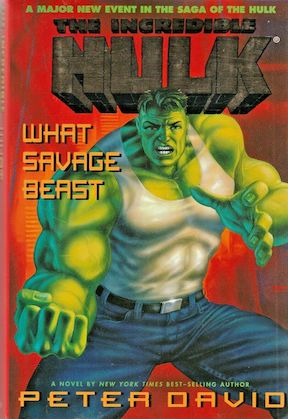
In this 1995 novel, author Peter David describes the Hulk as “a nuclear warhead on legs” and “an unstoppable engine of destruction.” The Hulk’s muscles, we are told, defy all known rules of human anatomy. And when he’s on a rampage, “there was no plan to his pounding, no art, no strategy.”
But David’s version of the Hulk isn’t the same as the iconic inarticulate brute I grew up with. He may still be “seven feet tall and green as grass,” but he now sports the personality of puny Bruce Banner. He even wears nerdy black-rimmed glasses and smokes a pipe while contemplating advanced mathematical equations. He is 1,000 pounds of ripping muscles with the brain of a genius. No longer does he speak in monosyllables and confuse personal pronouns. He’s so refined he probably eats petite cucumber sandwiches while drinking a cup of P.J. Tips. Pinkie out, of course.
But one thing remains the same. The U.S. Army still hates his guts. Gen. Thunderbolt Ross may be long gone, but the Hulk continues to be hounded by the military wherever he goes. “Our country has been at war with him from the moment he smashed his first tank,” explains Major William Talbot.
With no place left to go, the Hulk retreats to another dimension with help from the Eye of Agamotto. And wouldn’t you know it, even in this negative-like zone, the Hulk can’t find any peace. He’s hunted by his future self (now called the Maestro) and an army of Hulkbusters. He even has to wrestle his 20-year-old son Brett (the name being a portmanteau of Bruce and Betty, FYI).
The entire novel is a never-ending string of crazy situations and connections. The Hulk gets a computer chip implanted into his brain, his wife gets pregnant and gives birth to conjoined twins, Doc Samson and Dr. Strange make guest appearances, and an army of Hulks show up armed with a collection of superhero accoutrements (like the Sub-Mariner’s trident, Captain America’s shield, Wolverine’s adamantium claws, and Thor’s hammer). Unquestionably, the book is a huge page-turner with lots of action and laughs (intentional and/or otherwise). And there’s even a little bit of Hulk sex too.
Overall, What Savage Beast is totally insane and awesome at the same time. Mostly because it’s unapologetically a comic book superhero novel and doesn’t court any sort of literary merit. The only way this book could have been any better is if the Hulk rode a surfboard or an invisible jet. Kudos to Peter David for his ability to maintain his hyper propulsive comic book storytelling skills in prose format. I had a great big smile on my face when the Hulk and his son started debating the merits of Friedrich Nietzsche. At that point, I knew I was reading something truly incredible.
[The Incredible Hulk: What Savage Beast / By Peter David / First Printing: July 1995 / ISBN: 9780756759674]




 Monster Book Club