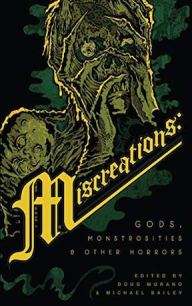
 I agree with author Alma Katsu. In her chatty foreword to this book, she says that Mary Shelley created the greatest and most iconic monster of all time. Forget about giant gorillas and colossal kaiju, Frankenstein’s Prometheus remains king of the monsters.
Everybody knows the story of Shelley’s iconic creature. Made by man and rejected by mankind, he begged for his creator’s love and humanity’s pity. Born in 1818, Frankenstein’s monster was a sympathetic and lonely figure doomed to an eternity of unhappiness. “What heart, on hearing such a story, could still scorn a monster like that?” asks Katsu rhetorically.
Monstrosity is a complicated topic, that’s for sure. But we can learn a couple of things from Frankenstein. It is a cautionary tale that can teach us what not to do and how not to behave. But it can also teach us how to be heroic. After all, a monster to one person is a savior to another. Amirite?
With Miscreations: Gods, Monstrosities & Other Horrors, editors Doug Murano and Michael Bailey have tasked their contributors to submit prose and verse inspired by the Frankenstein mythos. Some of the stories are linked solidly to Shelley’s original effort (“Butcher Blend” and “Imperfect Clay”), and some have only a tangential connection to the source material (“Ode to Joad the Toad” and “Sounds Caught in Cobwebs”). Despite my predilections, all the efforts are excellent. There’s not a stinking corpse in the whole bunch.
The anthology begins with a dollop of metafiction called “A Heart Arrhythmia Creeping Into a Dark Room.” I enjoy deconstructive monster tales as much as the next guy, but Michael Wehunt’s story (as good as it is) lands the collection on less-than-solid ground.
To better establish the theme of the book, the editors might have considered slotting “Frankenstein’s Daughter” at the top of the ToC. Author Theodora Goss explores the dynamic between the monster and his descendant. And in this way she’s able to give a new perspective on the influential and ongoing legacy of Frankenstein.
One thing is consistent throughout these 23 stories and poems: Man and monster are inescapably twined together. Like it or not, monsters can’t exist without man to will them into existence. Frankenstein walks among us. Get used to it.
[Miscreations: Gods, Monstrosities & Other Horrors / Edited by Doug Murano and Michael Bailey / First Printing: February 2020 / ISBN: 9781732724471]
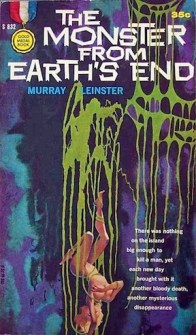 Gow Island was a pile of drab rocks in the middle of the ocean—3,000 miles from New Zealand, 2,000 miles from Chile, 600 miles from the Antarctic ice cap and a million miles from home.
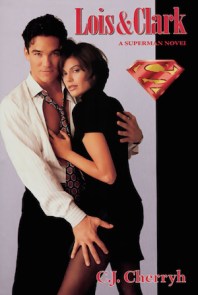 Lois & Clark: The New Adventures of Superman was a TV series from the 90s that emphasized the flirty relationship between Lois Lane and Clark Kent. During its four-season history, the show was a fun and good-natured romantic comedy.
 In Gayne C. Young’s previous novel (
 The Titan Prophesies is dedicated to “all those who helped craft amazing tales of giant monsters that thrilled us with wonder, filled us with awe and swept us away to realities where giants walk among us.”
 Shindo Yamaguchi from Japan’s Ministry of Defense knew trouble was brewing. It wasn’t because COVID-19 was spreading or because the 2020 Olympics had been postponed or because manga piracy was on the rise. Yamaguchi knew there was a new kaiju threat on the horizon.
 Readers don’t have to wait long for the killer kangaroo to show up in Alan Baxter’s latest novelette. The Australian buck begins its blitzkrieg hop right away on page two: “The roo’s mouth closed over its victim’s neck,” writes Baxter. “The flesh peeled up and away with a wet tear.”
 There’s no question about it. Wolverine is a tough nut to crack. In this book alone, for example, he’s pumped full of lead, burned alive, fed to sharks, attacked by ninja and blown to pieces. Later, he jumps out of an airplane without a parachute. Twice. “It will only slow me down,” he says.
 There are many things I hate (Starburst candy for one, cow’s milk for another). But specific to this site, I especially hate authors who write monster novels and don’t fully commit to the genre.
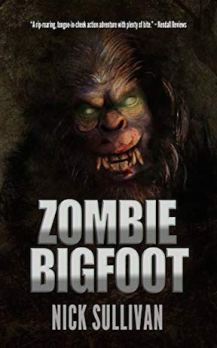 Russ Cloud was a wildlife expert and the star of a reality program called Survivor Guy. But over the years a lot of copycats had chipped away at his show’s popularity—shows like Man vs. Nature, The Naked Survivalist and The Mormon Family Robinson.
 Monster Book Club