The Joker

When 34-year-old Bark Mouglas hit rock bottom he knew things had to change. He went to rehab, got himself clean, moved to a new city, found a new job and started his life all over again. There was even a whiff of romance in the air.  

“I had this whole fresh new world in front of me,” said Bark; “new city, new job, new apartment and it was really empowering.” Unfortunately, all that empowerment stuff went up in smoke when the L.A. Mummy came to town. 

The creature had an enormous green afro the size of an exercise ball. It wore dirty purple samurai-style pants and was wrapped in linen. The thing—maybe it was male?—appeared unexpectedly one day and let loose with an ear-piercing shriek. Said Bark: “I can only describe it as a high-pitched death metal scream performed with some sort of sucking technique.”

BTW: Bark called the monster L.A. Mummy because that’s the only thing it ever said. It was like listening to a hell-baked version of “L.A. Woman” by Jim Morrison. “I will never listen to that Doors song again,” said Bark. “And if I happen to see Jim Morrison in the afterlife, I’m gonna give him a swift kick in the nuts.” 

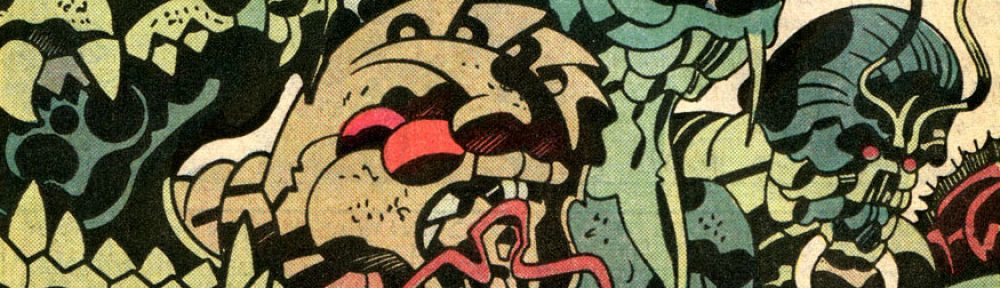
Even though L.A. Mummy looked like a frightening cross between Eddie the Head and the Joker, it wasn’t doing anything harmful. It licked some windows, danced like Joaquin Phoenix and screamed like Bruce Dickinson. Mostly it just followed Bark around town ominously. “It was a total buzzkill,” he told the police. 

That all changes during the book’s grisly third act. L.A. Mummy springs to life like someone flipped its circus freak switch. It starts attacking people and drinking their blood with teeth that look like a staple remover. “What the fuck kind of mummy even drinks blood anyway??” asked Bark. 

After being struck with bullets, arrows and a butter knife (?), the blood-soaked L.A. Mummy drops down on all fours and makes a dash for freedom—taking Bark Mouglas’s newfound happiness with it. 

“You sonofabitch,” yelled Bark as the L.A. Mummy disappeared into the woods. “You’re ruining everything for me, do you realize that?! I came here to get a fresh start, a new beginning! Shed my old skin! And you won’t let me! I’ve practically been to the goddamn grave and back, and I just wanna finally have a normal life for once? So leave me the fuck alone!”

[ L.A. Mummy / By Lance Loot / First Printing: August 2024 / ISBN: 9781964053059 ]

Welcome to the Purg

It always felt like the night before Halloween and the day after an earthquake in Walpurgis County. Everything had to be taken at face value—monsters existed, the dead sometimes kept their day jobs and sinister cults made plans to rule the world.

Walpurgis County (a.k.a the Purg) was the star (or maybe the costar) of Kyle Toucher’s latest anthology of connected monster tales. Like Tess of the d’Urbervilles, The Wizard of Oz, The Martian Chronicles and, my favorite, The Monster From Earth’s End, The Medusa Psalms: Welcome to Walpurgis County elevates the stories prime location into a major character. It was the catalyst that animated the narrative. 

Walpurgis never appeared in the same place twice on a map because of “the Shimmer”—a slipstream of non-linear time. “Everything here was a ghost trapped in an immense time prison,” said Beeley Ballantine, a character featured in both the first and last stories of this mosaic-like novel. The Shimmer was real and it was an expressway to the Great Elsewhere. 

Time warp tomfoolery wasn’t the only thing local citizens had to worry about, however. There was also Walpurgis Peak, a sentient summit that resembled the Devil’s fang and was 100x more evil than the land surrounding it. “If you died in the shadow of the mountain,” warned Toucher, “your soul remained in the Shimmer, where decades were stepping stones, and the centuries a crooked path that always led you back to where you were.”

Even more scary, the mountain had a secret agenda that, if fulfilled, spelled doom for the entire world. Below the earth’s surface, a loathsome devilry murmured; “An idiot darkness scheming since the primal days of the world.” 

But what exactly was going on? Toucher pens an epistolary origin story early in the book, but readers don’t get a clear picture until much later. To his credit, the author is totally forthright when the time comes to expose Walpurgis Peak, the Winter Howl, the Great Machine, the Shadowless Ones, the Medusa Cult, the Architect of Zero—and all of the unspeakable secrets of secrets. 

The Medusa Psalms wraps up nicely like a Christmas gift from Krampus. “Billy Beauchamp and the Monster Cartel,” takes all the information previously revealed and throws it together in a thrash metal smashup.  

The story follows Billy Beauchamp (the Evictor!) as he travels through the Shimmer to perform an exorcism on a rampaging monster. You read that right—Billy’s hired by the Medusa Cult to expel a monster from a monster. A tricky assignment indeed. 

What starts as a quirky adventure quickly turns into a time-traveling shitstorm. To collect his Bitcoin booty, Billy has to tangle with a drug-addled monster and a family of anatomically incorrect spider-people.

When the Shimmer spits Billy back to the present, he knew that his job wasn’t complete—he needed to stay in Walpurgis County. “I’ve been too tolerant, lacking vigilance, almost tolerating evil,” he said upon reflection. “And that attitude has kept everyone in the Purg complacent. We’ve all become blasé.”

He added: “If you’re born knowing there are fallen angels and monsters in your backyard, you learn to accept them. We should never be all right with that.”

[ The Medusa Psalms: Welcome to Walpurgis County / By Kyle Toucher / First Printing: September 2024 / ISBN: TK ]

Shitter Critter

Hey, did you hear what college student Callie Callaway did during her summer vacation? The crazy girl went to Florida and jumped into the jaws of a giant mutant shark. I know what you’re thinking—madder than a wet hen, she is!

But why would she do such a thing? That’s the question hanging over Sewer Sharks, the latest creature feature from author Christopher Robertson.

Studying marine biology at school, Callie was an unabashed shark nerd. She signed up to be a summer intern with Florida’s Aquatic Conservation Project to help research one of the rarest species of sharks on earth—the Mustelus Vidua, a.k.a. the Widow Shark. 

Because it was a Florida coastal town, there was a 24/7 drug and party scene awaiting Callie in Skidd’s Bay. But there was also a whirlwind of ongoing and untold events waiting for her too. Almost immediately, she came face to face with serial criminals, deranged swamp cultists, horny swingers and bloodthirsty rogue sharks. 

It was the sharks that caused the most grief. Because of mad science (and parasites in their pituitary glands), the Widow Sharks could grow large or small depending on the stimulus. Once they found their way into the city’s septic system, nobody in Skidd’s Bay who used a toilet was safe. 

They would explode out of toilet bowls like a torpedo to dismember and eviscerate their victims in the most humiliating way possible. The initial attack in Sewer Sharks was especially gruesome. Sensitive readers might want to skip the novel’s first chapter altogether. 

Throughout the book, the author provides inspired descriptions of every single attack. And he does so with a flurry of creative similes such as: “A shark exploded out of some guy’s ass like a cereal prize inside a water balloon filled with shit,” and “The shark flipped over with the heel of a red shoe jutting from its head like a Jimmy Choo brand narwhal.” 

Robertson’s novel also contained a substantial subplot involving a creepy swamp cult dedicated to Gator Jesus. Said one parishioner: “It’s a well-known fact that the Lord’s Second Coming will be in the form of an animal, and he hath chosen the divine form of a blessed alligator.” And if you’re curious, yes, there was a big battle brewing between the Widow Sharks and Gator Jesus—a classic clash of titans featuring Selachimorpha and Alligator Mississippiensis!

The book’s climax occurs when a 100-foot-tall shark rises from a nearby waterpark. It’s at this moment when our hero decides to jump into the giant mutant’s maw. Was it a stupid thing for Callie to do? Yup. But it was the only way to stop this insane Mary Shelley and Peter Benchley-like nightmare. 

[ Sewer Sharks / By Christopher Robertson / First Printing: May 2024 / ISBN: 9798323498376 ]

Swampus Among Us

Tucker was an insignificant townlet located in the middle of a swamp filled with alligators, snakes, Florida panthers, black bears, bobcats and sharks. One longtime citizen called it “the armpit of Louisiana.”

With only 300 full-time residents, Tucker was a sleepy little burg. The surrounding wetlands, however, were known for excellent fishing, birdwatching, frog gigging and gator hunting. 

Among cryptozoologists, the area was somewhat famous for being the home of an eight-foot-tall swamp ape and his alligator sidekick. Together, Swampus and Snapper ruled the bog with unbothered impunity for nearly 40 years. 

Stories of bipedal creatures in the swamps of Louisiana harkened back to the time of the Spanish and the French, said author Jeffrey B. Miley, and all of the stories inevitably contained a hint of voodoo and Cajun witchcraft. 

Was Swampus real? And, if so, was he the result of some kind of deviltry? That’s what Kevin Vince wanted to know. Vince was the executive producer for a popular reality TV show called Misled: Myths, Monsters and Mass Hysteria. It was his job to uncover the truth behind mythical creatures. 

Initially he had doubts about the veracity of the local legend, but that all changed when he caught a glimpse of the monster for himself. Green and spiky, Swampus was an ape-like beast with unexpected reptilian characteristics. There was no way evolution could have produced such an insane creature, he thought. 

Not only did Vince find a monster living in the Tucker swamp, he also found love. The owner of the town’s sole bed and breakfast, Cassie Anderson was a “breathtakingly beautiful southern belle.” Vince was smitten the moment he saw her. 

That’s not to say Ms. Anderson was charmed by the Hollywood producer right away. At first, she kept her distance. She was wary of a West Coast city slicker like Vince. As the two slowly got to know each other, their love story gave Swampus an emotional element often missing in similar monster novels. That’s a good thing in my opinion.

Another relationship worth mentioning was the one between Swampus and his herptile companion Snapper. These two swamp things shared a psychic bond that resembled something akin to friendship. It would have been adorable had the two creatures not ripped apart anything that set foot in their stillwater domain. 

In the end, the legend of Swampus turned out to be true. And yet nobody in Louisiana knew exactly what he was or where he came from. Was he a sasquatch from outer space? Or an overgrown green monkey? Maybe he was the offspring of a bear and an alligator? The author lets the cat out of the bag in the novel’s epilogue. His explanation is perfectly reasonable; but really, any explanation could’ve been possible. 

[ Swampus / By Jeffrey B. Miley / First Printing: June 2024 / ISBN: 9798324405144 ]

Twenty-Nine Tales of Mayhem

When author Mark Onspaugh says he loves monsters, he’s not kidding. Being a child of the ‘50s and ‘60s, he experienced firsthand the “evilution” of monster mania. From drive-in creature features to explicit slasher movies on Shudder, his love of monsters knows no bounds. 

There’s one particular story in this wicked collection that cements Onspaugh’s life-long monster cred. Featuring a riot of godless creatures, “Gray Skies and Stilled Clocks” is about a mother’s journey to see her dead child during Allhallowtide. 

The amount of unhuman cameos in this story is amazing. It’s filled with ghouls, redteeth (vampires), man-spiders, black dogs, werewolves, burnt men, weeping women, crab monsters, snake women, elementals, sprites and boogeymen. In a word: Whew! “All the things that haunt the dreams of children and adults,” says Onspaugh. “All the wretched terrible things we pray are only nightmares, but suspect are not.”

Some of the best stories in A Mayhem of Monsters successfully mimic the unexpected twists of mid-century EC Comics—“Still one of the benchmarks for grisly creatures and the most horrific forms of poetic justice.” 

If you’re unfamiliar with classic EC horror titles like Haunt of Fear and Crypt of Terror, the comics often ended with a gasp—a kicker featuring a last-panel reveal or surprise. Over the years, it’s become a beloved storytelling trick in horror, crime and suspense genre fiction. 

Onspaugh’s stories provide plenty of ghastly twists to titillate readers. “The Broken Hand Mirror of Venus,” for example, is a love story (?) in a post-War of the Worlds cacotopia, “Grim and Grimmer” turns a well-known fairytale into The Naked Prey and “Let That Be a Lesson to You” proves that demonic binding spells can work both ways. 

Possibly my favorite of these EC-like stories is called “A Lullaby for Caliban.” Two wannabe teenage hoodlums (and an innocent sidekick) attempt to steal a pickled punk from a traveling carnival. 

If you aren’t a carny, you might not know that “pickled punk” is slang for a deformed fetus kept in a jar filled with formaldehyde. Incredibly, such things were once popular as grind show attractions. 

The heist quickly goes sideways. Lucien, the Devil’s Baby, is ultimately rescued but the teenagerates are never heard from again. That doesn’t mean, however, that the story ends without a twist and a satisfying comeuppance. 

[ A Mayhem of Monsters / By Mark Onspaugh / First Printing: March 2024 / ISBN: 9798873646845 ]

War and Peace

War of the Sea Monsters is the fourth book in author Neil Riebe’s entertaining giant monster series. It features the return of some favorite characters such as secret agent Shindo Yamaguchi along with a mercenary named Satin and her all-female gang of cutthroats. It also features a klatch of quarrelsome monsters old and new.  

These characters (and more) provide the catalyst for lots of subterfuge, gunplay, political machinations and, of course, thunderous kaiju action. But seemingly contrariwise, the novel’s ultimate message seems to be “love your enemy.” 

Take, for example, the secret agent and the soldier of fortune. Shindo and Satin have been adversaries for a long time, and they’ve developed affection for each other over the years. But like Batman and Catwoman, they were star-crossed lovers with no future together.

Said the author: Shindo joined the secret service for the thrill of adventure just as much out of a sense of duty, but he could never go the distance with Satin. He wanted to remain within the boundary of the law.

Satin’s flirty behavior kept Shindo on a string, however. No matter what terrorist organization she aligned herself with, or who her boyfriend currently was, the Queen of Hearts always made it clear that she was interested in a relationship with the Japanese secret service agent. The novel shines bright when this pair cross paths during conflicting assignments.  

Similarly, the monsters in all of Riebe’s books were a headstrong bunch with various agendas and alliances. War of the Sea Monsters brings back two A-list kaiju from previous outings, but the spotlight this time definitely belongs to Marrellagon and Lario and their battle with a psycho kaiju stingray named Tryga. 

Marrellagon was a 250-foot Cambrian crustacean who was queen of the ocean deep, and Lario was a huge mutant sea creature with razor sharp fins and four eyes. The two were bitter rivals who tangled every time they had a chance. 

Initially raised in a laboratory, Tryga was a new breed of stingray that behaved as though the entire ocean belonged to her. “The sea is one place,” she reasoned. “Therefore only one can claim it—and I am the one!”

Both Marrellagon and Lario can’t stand Tryga’s excessive arrogance. Despite being bitter rivals, they decide to team up and battle the demon stingray. By doing so, the two monsters break the chains of hate that bind them.  

After an epic confrontation on land and sea, the former foes retreat to the bottom of the Marianas Trench to lick their wounds. The journey represents a new detente for them. What would the future hold for the crustacean and the archosaur? There was only one way to find out. “They took the plunge,” said the author. 

[ War of the Sea Monsters / By Neil Riebe / First Printing: May 2024 / ISBN: 9798324294342 ]

Raising Cain

On the back cover of The Locust Bride, author Ellis Goodson describes his latest novel as a “Kaiju Western.” But if you’re looking for a typical Brobdingnagian bang-up, you’ll need to wait patiently until the final act. 

This is not to say there isn’t a gaggle of monsters prowling the prairie in 1875. Before the behemoth Beleem arrives, the small town of Locust needs to survive flesh eating Hell-bugs, malevolent conjoined twins, albino revenants (white zombies!) and a demonic American Indian wielding a fiery tomahawk.

The monster uptick is due to a large sinkhole that suddenly appears in the middle of Main Street. It’s a big gaping hole—big enough to suck the entire town of Locust into its maw. “It was a large round pond of void that smelled like mildew and rot,” said the author. “Deep down in the pit, an eerie sound of combative, competitive movement continued to get louder and louder. It was like putting your ear to the chest of a rotting corpse and hearing worms fight for dead flesh.”

Without a doubt something unspeakably vile is living at the bottom of the rupture. Something big and cosmic. Something Lovecraftian—something biblical. 

To help lure the monster to the surface, a traveling medicine show rolls into town. In tow with Basil Mackovie and his brother Micah (the evil conjoined twins) and Red (the Amerind archfiend) is a pretty young actress named Grace Dane. Poor Gracie doesn’t know she is the bait, the monster’s intended bride. 

Thank goodness Cain Mann is nearby. He’s a man with his own set of problems, but as the novel’s hero, he’s prepared to rescue Grace, save the citizens of Locust and destroy all monsters. And with a name like Cain, you know he’s willing to raise a little hell to get the job done.  

Finally, after a long 155-page set-up, Beleem, the kaiju king, crawls out of the void and reveals itself. This is how the author describes the raging behemoth: It was two-stories high with the bulk of five elephants. A sperm whale-shaped head featured large eyeless sockets and a nasty mouth with pointed teeth set in circular rows. The creature’s orifice would shrink to a hat-size sphincter and then expand into a two-yard-wide opening. “The ugly mouth made a continuous steam-driven locomotive sound—catching its breath from the hard work of being reborn.”

As expected, Cain defeats Beleem and its devilish grubs. By doing so, he saves Grace from a monster wedding. In return, Grace (who’s obviously read the Hebrew Bible) gives Cain permission to live with happiness and contentment. To paraphrase the Good Book: “His joy was greater than he could bear.”

[ The Locust Bride / By Ellis Goodson / First Printing: February 2024 / ISBN: 9798879769746 ]

Dino Fury

Not exactly an homage to H.P. Lovecraft nor Mary Shelley, Reanimated Rex is a book that nonetheless walks the same crooked path as Herbert West-Reanimator and Frankenstein.

It all starts when a high school kid sneaks into an abandoned amusement park one stormy night. After being shuttered for nearly 20 years, the dilapidated dinosaur theme park is now a dense thicket of overgrown flora and derelict structures. 

Still standing—and scattered throughout the park—are life-size statues of various dinosaurs such as the T-Rex, the Stegosaurus, the Allosaurus, a couple of Utahraptors, and the big daddy of them all, the Spinosaurus. They are amazingly realistic and dominate the landscape with their stoney silence. 

In the dark and in the rain, the former dinosaur park is certainly a scary place to be. In fact, it’s the perfect place for an innocent high school caper to go terribly wrong—sadly, the young trespasser is never heard from again. 

After three weeks, the local police give up on the case. Teenagers go missing all the time, they conclude. Maybe he enlisted in the army and didn’t tell anyone? Or maybe he joined the circus? Who knows? 

Laura Harding, the kid’s big sister, doesn’t see it that way. She does a little sleuthing around town and discovers that her brother was spotted near the dinosaur park the night of his disappearance.  

Skipping ahead to the next dark and stormy night, Laura is at the dinosaur park looking for clues. In a Blue Velvet-like moment, she finds one of her brother’s sneakers in the weeds—with his foot still in it. 

Unbeknownst to Laura, she is not alone. Alan Tippett, the park’s original owner and dino geek, has secretly been living in the tunnels under the property for the past 20 years. He’s a big weirdo with a big secret. He knows that his dinosaur statues come alive during thunderstorms. 

Well, they aren’t really alive, he tells Laura when the two finally meet. They change from stationary dinosaur replicas into lifelike creatures only when it storms—“something about the electricity,” he shrugs. 

It’s here when Reanimated Rex takes a sharp moral turn. Just as Victor Frankenstein did in 1818, Tippett was using lightning and thunder to successfully transcend natural limits to create life, and just like Herbert West in 1922, he found a way to animate his creations.  

Also like Frankenstein and West, Tippett’s monsters ultimately destroy him. “I always knew it would end this way,” he says with his final breath, “live, create and die from the creation.”

Coda: Tippett dies in a very satisfying way. If you’re wondering what ultimately happens to Laura, however, you’ll have to hold on until the very last sentence. But believe me it’s worth the wait. Honestly, it’s probably the best final sentence of any novel I’ve ever read. 

[ Reanimated Rex / By Alex Ebenstein / First Printing: May 2024 / ISBN: 9781960470034 ]

Bottoms Up

When 23-year-old Vladimir Radu posted a video on social media outing himself as a gay vampire he didn’t know what to expect. 

Initially, he just wanted to tell his story and leave it at that. The video was simply a quick hello to the planet, he explained. “I didn’t do it to expose other vampires. I did it to expose myself. All I wanted was to be me, and I couldn’t do that living in the shadows.”

But you can’t go around saying you’re a vampire—a gay vampire!—and not expect some kind of unwanted attention. For example, days after his video went viral, Vlad became a celebrity to a clutch of vampire cosplayers who followed him around in their capes, frilly shirts and ugly polyester corsets. 

More dire, however, Vlad found himself in the crosshairs of Master Sven, the most notorious occultist in human history. Even to vampires, Sven was a nasty dude. He was in league with a host of hoary demons and was the champion of resurrecting long-forgotten forms of magic. He even created the modern-day porn industry, so you know he was a bad mammy jammy.

Sven’s nefarious plan (I think) was to assimilate vampires into mainstream society and create a master race of monsters. But Vlad, with his confessional video, ruined all of that.

Vlad openly rejected his family’s undead legacy. He represented a new generation of non-binary vampires who didn’t want to drink human blood. With his new-found infamy, he had unwittingly become an avatar for change. 

Like Coming Out of the Closet, the previous novel by author D.A. Holmes (read my review here), Bottoms and Bloodsuckers was a breezy LGBTQIA+ coming-of-age story that fiddled around with horror tropes for laughs. 

Without a doubt Holmes’s book was funny, but he didn’t shy away from shocking the reader when the opportunity presented itself. The late-night fight at Denny’s pitting Vlad and his friends against a gang of occultists was ghastly. And visits to stately Radu manor were also quite spine-tingling. The image of Maria Radu sensually feasting on a corpse haunts me still. 

All of the carnage at Denny’s was mainly due to Vlad’s new servant and companion (i.e. familiar). Charlie Rockwell was a shaggy-haired, stoner popinjay who was tasked with protecting Vlad from harm. He was a lovable sidekick with an overly enthusiastic Jack the Ripper streak. Vlad wanted no part in vampire traditions, but he quickly realized that a familiar like Charlie could be useful in certain situations. 

Other significant characters are introduced in Bottoms and Bloodsuckers—in particular Daniel Mai and Jenny, a waitress working the nightshift at Denny’s. And, of course, everybody’s favorite goth girl Alison Grady returns to help her friend “Count Popular” navigate the tangled line between monster and man cub.  

[ Bottoms and Bloodsuckers / By D.A. Holmes / First Printing: May 2024 / ISBN: 9798322523369 ]

Midnight Monster Madness

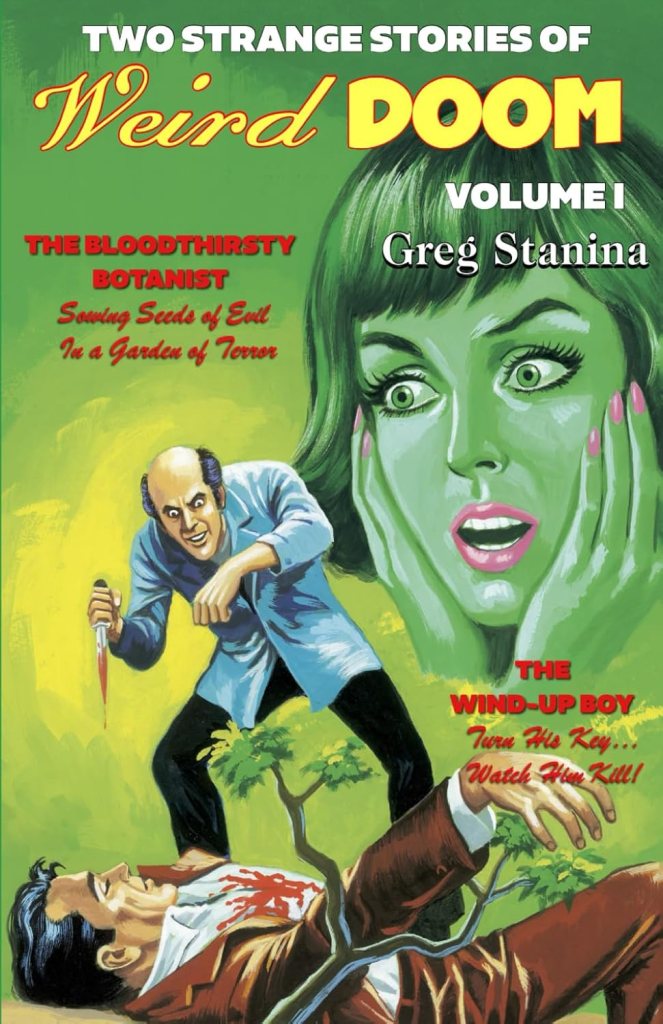
As advertised, there are two creature feature short stories included in this slim edition. It is, I believe, the first volume in a continuing series of retro pulp monster pocketbooks from authors James Sabata and Vincent V. Cava. 

Mostly, I feel Sabata and Cava are on the right track with their new project. Both of their efforts are suitably monsterific and raunchy, and I look forward to future volumes to come. 

But to be totally honest, I’ve got to say that the first story in Midnight Monster Madness stumbles out of the gate. “Hair of the Dog” is a facile tale of drug use and relapsed addiction with a familiar monkey/dog metaphor. It’s a little bit funny and weird, but it’s a throwaway effort nonetheless. Note to the author, next time try to remember Kurt Vonnegut’s number one rule for writers: don’t waste the time of strangers. 

Much better is “The Thing in the Sink.” It’s a story that begins with a sink full of dirty dishes—“A miniature city made of mucky dinnerware,” explains the author. “A bustling filthtopia.”

At some point, Neal (our hero?) notices something is living in the drainpipe of his kitchen sink. Beneath the cereal bowls and encrusted dinner plates he discovers a hungry eldritch monster born from rotten food, humidity and “whatever-the-hell-else.”

It was a hideous blob of orange goop with green fur and yellow spots. Its body pulsated rhythmically, rising and falling in a hypnotic fashion. The thing’s mouth was a round suction cup with multiple rows of jagged teeth. Inside the creature’s mouth was a pink protrusion shaped like a shiv. It would use this deadly body part to puncture your skull and squeeze the life juices out of your body like a tube of toothpaste. 

After a few moments of indecision, Neal decides what to do with the “sentient mound of sink scum.” He will provide food (like turkey sandwiches and other meaty items) for the monster to consume. And, later, he will contact whatever department of the FBI handles man-eating mold monsters. 

Neal’s plan sorta works. He successfully cleans up his kitchen mess and gets rid of his thoughtless roommates, but he pays a deadly price for his Little Shop of Horrors escapade. The last sentence of the story makes it clear that the sink monster is not going away anytime soon. 

[ Midnight Monster Madness, Book One: “Hair of the Dog” and “The Thing in the Sink” / By James Sabata and Vincent V. Cava / First Printing: April 2024 / ISBN: 9798884560352 ]