In our solar system, Mercury, Venus, Mars, Jupiter, Saturn, Uranus and Neptune are considered dead planets. They’re all geographically inactive and unable to support life as we know it. Not counting Earth, only Europa and Enceladus—two moons circling Jupiter and Saturn—are considered potentially “living” astronomical objects.
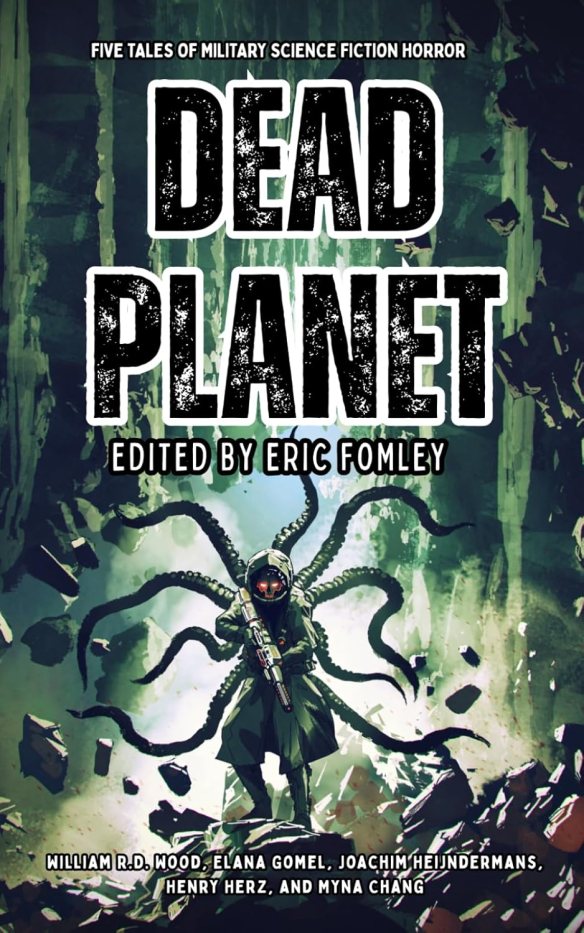
But the Milky Way is a vast, rotating collection of stars, rocks, gas and dark matter. Who knows what’s out there? Potentially, there could be billions of dead exoplanets yet to be explored. With this in mind, editor Eric Fomley has assembled a handful of stories emphasizing the alien desolation of dead planets and the hostile environments they create.
The collection kicks off on Christmas Day with a story called “Of Faith and Fallow.” Gray and white figures are scattered across the landscape like heaps of garbage. They weren’t people any longer, writes author William R.D. Wood; they were now husks resembling wispy, smoldering layers of burnt paper.
Overnight, Earth had become a barren space rock. The only thing that remained was a shadow darker than any starless night hanging over California’s San Joaquin Valley. Black tendrils writhed around an undulating mass, like ink spilled in the water of a cloudless blue sky. Globs the size of mountains pulsed against the convulsing emptiness. Despite the surprising (not surprising) ending, the motivation of the Lovecraftian beast is too unfathomable to grasp in the span of a short 14-page story.
The next story, “City of Gold” by Elana Gomel, is about humanity’s failed galactic expansion to a planet with an Earth-incompatible biosphere. The scouting party discovers that Veles is a resource-poor planet that forces locals to survive by committing acts of auto-genocide. The inevitable conflict between the astronauts and the indigenous community is messy, to say the least.
In his story “Ice in the Dark,” Joachim Heijndermans uses an epistolary format to describe a failed rescue mission to an icy and uninhabitable world. How efficiently the planet’s bitter cold atmosphere defeats the rescue team serves as a harbinger for the rest of the universe. It’s a harrowing story and probably my favorite piece in the volume.
“Betrayal Comes at a Pryce” by Henry Herz is a straightforward SFnal retelling of William Shakespeare’s play “The Tempest.” Like the source material, Herz uses the phrase “He that dies pays all debts” as the great equalizer.
And finally, “Metalloid Blues” by Myna Chang is a funny—and prescient?—story that takes place 100 years after mankind abandons Earth. “It looks like all the pollution and junk we left behind is trying to get even with us,” groans a police detective who is fighting for her life against the attack of Terran biomechanical monsters.
[ Dead Planet / Edited by Eric Fomley / First Printing: April 2026 / ISBN: 9798255501731 ]
 Monster Book Club