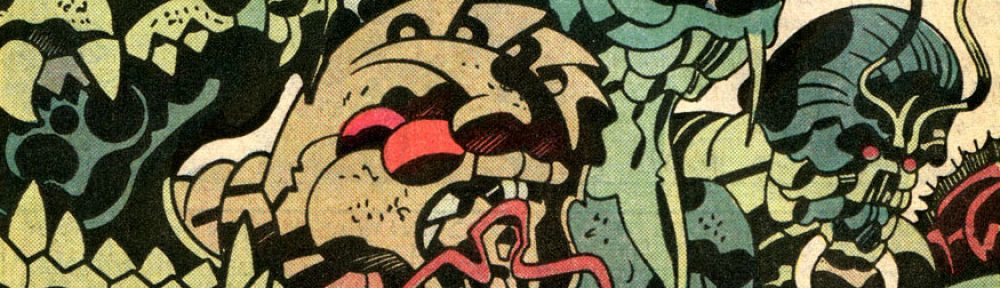

Here’s a personal request for all writers walking the thin line between pulp fiction and comic books: At the very beginning of the process, when rendering the main characters of the story, please give some consideration to creating a villain who is simply a disembodied brain floating in a jar of formalin.
Talking brains are the best, amirite? Still to this day, I remember watching the movie Donovan’s Brain and being shocked by the image of a “talking” cerebrum suspended in a laboratory container. Various episodes of The Simpsons and Futurama have also used this iconic image to great effect.
There’s a fun story in Monster Aristocracy, a new compilation from editors Dan Brereton, Allison Pang and James A. Moore (RIP), that unabashedly uses the disembodied brain trope with gusto—and I’m all for it.
Author Thomas E. Sniegoski revisits his character Grim Death (with the help of Jeannine S. Acheson) in a story called “Earthbounders’ Lament.” If you picked up Grim Death’s first adventure back in 2017 (Grim Death and Bill the Electrocuted Criminal), you already know the origin story of how a recluse named Bentley Hawthorne donned a skull mask and became an agent of supernatural retribution.
In this new adventure, Hawthorne is trying to provide eternal rest for the dead. “I was visited by the life energies of those trapped between the worlds of the living and the dead,” he explains. These Earthbounders (as they were called), were recently exhumed by grave robbers and used to create reanimated monsters.
The mad villain behind the caper was Dr. Fredrick Clive, the talking brain—a.k.a. the Floating Muscle of Thought. He was a renowned expert on radical surgical transplant techniques and automata. His goal was to drag humanity into the future by building an army of Frankenstein-like patchwork soldiers. And, if he had time afterward, he wanted to find a suitable skull for his brain to reside.
Beyond Dr. Clive’s big brain, Monster Aristocracy is filled with all sorts of horrible (good) monsters, including vampires, mummies, werewolves, evil magicians, murderous mythical creatures, wild flora and abominable snow queens. My favorite monster of the bunch can be found in a story called “A Procession of Brides.”
Here’s the truth, writes Carina Bissett: Dr. Frankenstein didn’t create a wife for his original monster. He wanted a bride for himself. “She was nothing more than a vessel,” says Bissett, “an empty receptacle for him to fill.”
Ultimately rejecting her creator, Frankenstein’s bride walked the earth becoming a willing repository for all the girls and women abused and abandoned in back alleys and under bridges, chained to stones and strung from wires. “You know the ones,” she says. “The drowned girls. The burning girls. Brown girls, black girls, the disappearing girls and the runaways.” She became a multitude of souls swirling through one core union.
Bissett ends her story like this: “We are no longer following the script Frankenstein wrote. We are the women raped on the altar. The forced brides. The final girls. And we are coming for you. We are the New Eve. Everlasting. Eternal.”
[ Monster Aristocracy / Edited by Dan Brereton, Allison Pang & James A. Moore / First Printing: July 2026 / ISBN: 9798184340388 ]

