 We all know what’s coming. And it’s not going to be pretty. At some point in the future, earthquakes will rock our world. The planet’s axis will shift and the magnetism of the North and South Poles will spin out of control. Oceans will flow in new directions and land mass will change dramatically. Don’t be surprised to wake up one morning and discover entire continents under water.
But that’s not all, folks. Expect a natural disaster of this magnitude to trigger a nuclear winter. Global positioning systems will malfunction and send atomic warheads skyward—mostly toward friendly soil. The ensuing fallout will poison the atmosphere and take hundreds of years to dissipate.
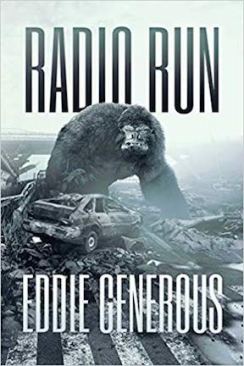
That’s the situation in Radio Run, a post-apocalyptic novel with giant monsters and a Hunger Games-like twist. The year is approximately 2109, nearly forty years after earthquakes and nukes change the world forever. South America is now underwater and Arizona is an uninhabitable polar ice cap. Canada is “balmy,” and the People’s Republic of Alaska is a paradise wistfully known as New Eden.
Getting to Alaska is a problem, however. The terrain between Niagara Falls and Anchorage is a wasteland filled with giant birds, mutant insects and roving tribes of fifty-feet tall sasquatch. And don’t even think about jumping on a boat. The water is teeming with predatory fish and whales that would make Jonah flinch. Even beyond the scary cryptids, the path to New Eden winds through a fog that is thick with face-melting radiation.
Over the years, the mad scramble to get to Alaska has morphed into a top-rated game show. Each season, a handful of people are selected to participate in the hopeless adventure. Drones follow them as they stumble through the wasteland while smarmy celebrity hosts keep viewers (and gamblers) entertained in the studio. Part Battle Royale and part Naked and Afraid, Radio Run was the biggest and best game show on TV.
The parade of monsters is what you’d expect in a world awash in nuclear radiation: three-foot tall ants, eight-inch long houseflies, eagles with a wingspan of 20-feet, whales the size of islands, etc. The animals survived because something in their genes used the poison like steroids to create monster magic. They all embodied the genetic rewriting of life.
Without a doubt the most dangerous creature roaming the wasteland was the sasquatch. Fifty feet tall, its fur was coarse and thick like a bear’s quill-like pelt, but its shape and rippled muscles resembled something more like a gorilla. Most disturbing of all, says the author, its face had a recognizable human-like quality. Think about that for a moment or two.
The contestants get picked off one by one. The first guy dies when a bird opens his skull like a can opener, a parasitic plant gets the next unlucky slob and the third guy gets thrown overboard as chum. The carnage continues until two survivors eventually reach Alaska. That’s a first. Nobody has ever crossed the finish line in the history of the Radio Run TV show.
But alas, there’s bad news in Anchorage. Like Thelma and Louise, the two finalists embrace the futility of their existence in the most dramatic way possible. “This isn’t worth it,” says one of the dispirited winners. “The government poisons the planet and we have to pay? Those a-a-abominations, they chase us. Them and the birds and the wasps and we just run and run and run. That isn’t living.”
[Radio Run / By Eddie Generous / First Printing: September 2018 / ISBN: 9781925840230]
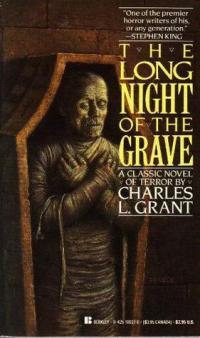 Mummies are creepy and dusty and probably smell like rotten flesh, but they aren’t very scary. Think about it, whom would you rather meet in a dark alley? Nosferatu or Imhotep?
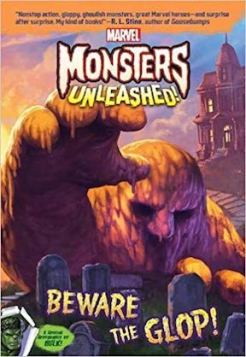 Ben Lee and his sister Cindy believed in monsters. They’d never seen one of course, but that didn’t matter. If there were talking raccoons and seven-foot-tall ambulatory trees in outer space, then why couldn’t there be monsters on Earth?
 When it comes to horror comics, nobody does it better than Junji Ito. His efforts—including Uzumaki, Tomie and Frankenstein—are famous for being absurd, obscene and grotesque. If you’re new to the creator’s oeuvre, I recommend starting with Uzumaki. I guarantee you won’t be able to resist its insanely hypnotic spiral iconography.
 Who’s the most popular witch in the wayward sisterhood? Is it Morgan le Fay? Circe? Baba Yaga? How about Hermione Granger, Willow Rosenberg, Wanda Maximoff or Sabrina Spellman? Laugh if you want, but my favorite witch will always be Wendy, the good little sprite.
 In Maori legend, there are stories of monsters living in rivers and swamps throughout New Zealand. Every child knows about the taniwha—vengeful creatures that slaughter warriors, kidnap maidens and eat babies in one gulp.
 When Professor John Lowson stumbles upon an alien creature sleeping in the swamp, he immediately begins thinking about his lofty reputation. He is, after all, the self-proclaimed “greatest archaeologist in Britain.” Never mind the danger, he says. He wants to bring the beast back to civilization and reap his reward. “Do you think I’m going to let the most profound scientific discovery of all time slip through my fingers?” he asks his colleagues.
 While watching the movie Godzilla: King of the Monsters, one question kept popping into my head: Where was Kong? Surely, he must have heard the rumble of Monster Zero or the bio-sonar signal from Fenway Park. Every time Ghidorah flapped his wings and every time Godzilla retreated to the bottom of the ocean, the giant ape from Skull Island was conspicuous in his absence.
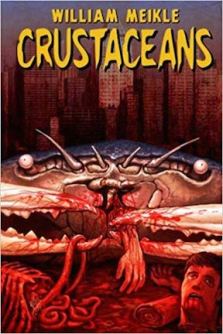 The first sentence of any novel is important. Not only does it grab the reader’s attention, but it also affords the author an opportunity to craft something eloquent and memorable.
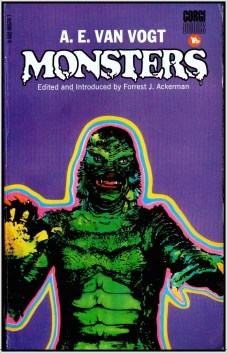 Within the very first pages of this anthology, author A.E. van Vogt describes the story’s monster like this: “The creature was tiny, but it was a monstrous, many-legged, long-bodied, long-snouted, hideous miniature, a very caricature of abnormal life, a mad creation of an insane imagination.”
 Monster Book Club