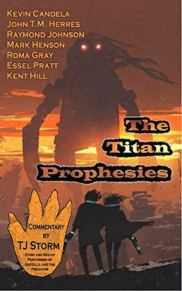
 The Titan Prophesies is dedicated to “all those who helped craft amazing tales of giant monsters that thrilled us with wonder, filled us with awe and swept us away to realities where giants walk among us.”
Thus inspired, editor Kevin Candela has given readers a collection of short stories featuring a 200-foot-long “robot virus,” a couple of hungry Cyclopes, an MMO filled with thunderous daikaiju battles, cyborg titan paladins, kujira sanjuutou, a prehistoric tree monster and a gigantic, mutant man-shark.
Overall, it’s a legit assemblage of daikaiju fiction with only a single misfire. For better or worse, the two best stories are slotted near the back of the book. Editor Candela makes his readers wait, but he eventually delivers a satisfying payoff at the end.
“Walking Among the Trees” is about a friendship between an 11-year-old boy and a tree from the dawn of time. “It was a tree of beauty,” says author Essel Pratt; “royal in stature and brooding in strength.”
Working together, the boy and the tree stop a logging company from ravaging the surrounding forest. “Speaking ancient words that were never meant to be heard, the giant woodland beast rose from the ground.” Even though no one understands the low rumbles emanating from its jagged mouth, the tree’s message is clear: man is not welcome in its domain.
Like every movie from Hayao Miyazaki, Pratt’s story celebrates nature and vilifies technology. In this case, mononoke manifests itself in the symbiotic relationship between a young boy and an ancient tree. The results are something Miyazaki would definitely approve of: The majestic protector Tapio, King of the Forest!
Humanity’s relationship with nature can also be found in Roma Gray’s story “Locusts of the Sea.” This time, however, the beasts of nature are 100 times more aggressive and exploitive.
In 1492, sailing the ocean blue, Christopher Columbus’s fleet is attacked by 30 enormous sea creatures. Making an ominous tick-tick-tick sound (like the crocodile from Peter Pan), the whale-sized monsters attack the Niña, the Pinta and the Santa Maria like sharks on a feeding frenzy.
The evil minions from Hell quickly discover they enjoy the taste of man flesh and chase Columbus back to Europe. “What had started out as an expedition to find an easier route to the Orient had created a far bigger problem than the one they had attempted to resolve,” writes the author. The entire civilized world was now in danger.
Jumping to the year 1984, the monsters are no longer confined to water. Evolution has given them legs and their appetite compels them across the continent. The clock was ticking down to an unimaginable apocalypse.
[The Titan Prophesies / Edited by Kevin Candela / First Printing: May 2019 / ISBN: 9781097578207]
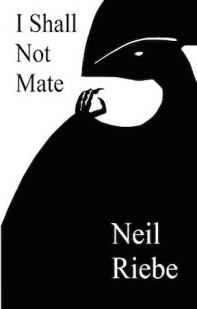 Shindo Yamaguchi from Japan’s Ministry of Defense knew trouble was brewing. It wasn’t because COVID-19 was spreading or because the 2020 Olympics had been postponed or because manga piracy was on the rise. Yamaguchi knew there was a new kaiju threat on the horizon.
 Readers don’t have to wait long for the killer kangaroo to show up in Alan Baxter’s latest novelette. The Australian buck begins its blitzkrieg hop right away on page two: “The roo’s mouth closed over its victim’s neck,” writes Baxter. “The flesh peeled up and away with a wet tear.”
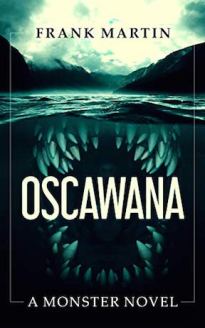 There are many things I hate (Starburst candy for one, cow’s milk for another). But specific to this site, I especially hate authors who write monster novels and don’t fully commit to the genre.
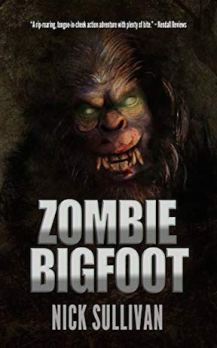 Russ Cloud was a wildlife expert and the star of a reality program called Survivor Guy. But over the years a lot of copycats had chipped away at his show’s popularity—shows like Man vs. Nature, The Naked Survivalist and The Mormon Family Robinson.
 According to editor Christofer Nigro’s introduction, the inspiration for this 2019 short story collection goes all the way back to 1965. That was the year Creepy #7 appeared on newsstands.
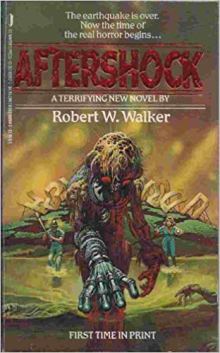 Aftershock starts on the day Los Angeles is smacked by the biggest earthquake in recorded history. The initial tremor began “like a deeply released, contented sigh from a lover in warm slumber,” and quickly escalates to a 9.4 on the Richter magnitude scale.
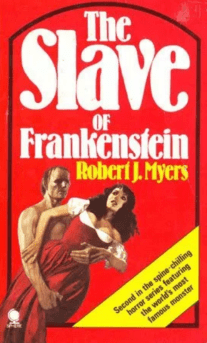 The Slave of Frankenstein takes place two years before the start of the U.S. Civil War. It’s 1859 and the focus of the entire nation is concentrated on Harpers Ferry and the forthcoming hanging of abolitionist John Brown. “Our universe is suspended somewhere between Heaven and Hell,” says a concerned patriot.
 Back in 1961, President John F. Kennedy pulled the plug on a proposal to invade Cuba with a cast of giant crabs. It was Eisenhower’s crazy idea and JFK hated it. The newly elected president didn’t want anything to do with his predecessor’s cockamamie science fiction plan.
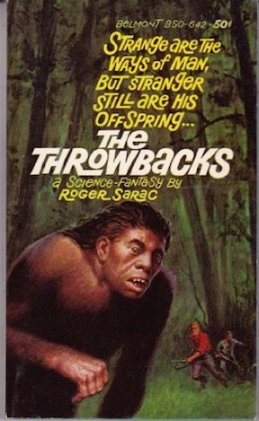 Roger Sarac never explicitly gives a name to the shaggy humanoid beast at the heart of his novel. “It’s like a bear, and yet it ain’t,” he writes. “It’s sort of manlike, yet it ain’t. It’s just a thing without a proper name.”
