The Heroic Trio

Bramley was a college dropout working the graveyard shift at an all-night gas station. Because of his shitty job, he could barely pay rent. He lived in the urban slum of Leedham, the armpit of Massachusetts, and had no friends and a two-timing girlfriend. On top of everything else, he couldn’t leave his apartment during the day because there was a zombie pandemic raging in his neighborhood. 

The zombie outbreak turned out to be a kick in the butt for Bram. Here was his opportunity to reinvent himself, leave his dead-end job, dump his cheating girlfriend, kill some zombies and go back to school to get a business degree. There were monsters in the streets but the future looked bright, he told himself. 

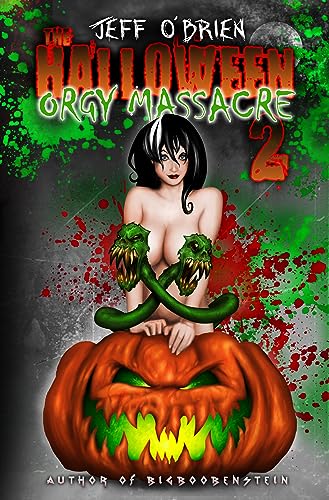
Jeff O’Brien’s latest novel, The Halloween Orgy Massacre, Part 2, was a loopy horror comedy and a randy harem romance rolled into one. Love and danger were in the air and Bram had no problems surrounding himself with a battalion of pretty girls to keep him warm during the apocalypse. 

There’s Bianca, an olive-skinned dominatrix who didn’t go anywhere without her whip and cat-o-nine tails. She wasn’t afraid of any man, dead or alive. “Isn’t this exciting?” she said enthusiastically. “I can’t wait to slay some zombies!” 

Then there was Tess, the buxom spitfire who favored pink wigs, skimpy outfits and Meiji Matsumoto anime. When she wasn’t watching Galaxy Express 999 and Captain Harlock videos, she was dancing at the Bursting Cherry strip club on the edge of town. She and Bramley hit it off immediately. “Let’s fuck like the world’s ending,” she said, “and then I’ll make some pancakes for us.”

And finally there’s Lilly, a perky goth girl with a big boner for Bram (if you’re curious, Lilly’s the one on the book’s front cover). She knew how lonely the zombie apocalypse was for a young man, so she sent him a selfie of herself masturbating. “What’s a little nudity between friends?” she asked innocently. 

It was Lilly—the smart one—who figured everything out. She wasn’t a conspiracy theorist or someone who jumped to illogical conclusions, but it was easy for her to connect the dots between the state’s governor, the military and the zombie virus. She knew the zombies were part of a nefarious plot to flatten the slums of Leedham in order to erect high-rent apartments and lavish restaurants. Everyone agreed it was a dirty rotten plan. 

Along with a good-natured pimp named Stone Stallone Trombone (who dressed not unlike the Joker), Bram and his sexy heroic trio unite to save the world. Their madcap adventure includes lots of bra-busting action but no sex (all the hardcore stuff happens off the page btw). 

In the end, the author wants you to know that his novel isn’t just about male titillation. It’s about grrl power too. The zombie invasion was squashed by three gutsy ladies. “Women,” he said, “were in the right place at the right time and rose to the occasion when America needed some true heroes.” Let’s all say it together: “God bless America!”

[ The Halloween Orgy Massacre, Part 2 / By Jeff O’Brien / First Printing: July 2023 / ISBN: 9798854468527 ]

New Gods, Part 2

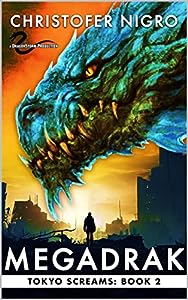
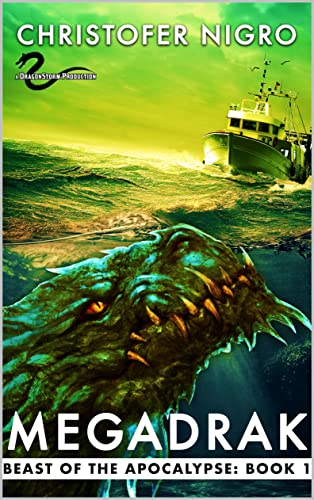
This second Megadrak novel from Christofer Nigro picks up immediately following the events of the first book (read my review here). It was 1954 and a gigantic  reptilian monster with ill intent was racing toward Japan’s largest island Honshu.

Spawned by the atom bomb, but deadlier than the bomb itself, Megadrak wanted to topple humanity from its exalted place at the top of the planetary food chain. The 55-meter-tall behemoth perceived Honshu’s largest city Tokyo as an affront to its primal cognitive directive. Megadrak was, according to one eyewitness, “the beast of the apocalypse—Leviathan manifested.”

Megadrak was the first daikaiju the world had ever seen, so it made sense for people to compare it to age-old religious and folkloric monsters such as  Jörmungandr, Tiamat and Yamata no Orochi. Said the author: “It was a beast that looked as if it could be challenged by nothing less than one of the gods themselves.” 

Unfortunately, there were no benevolent Shinto or Christian gods available for duty. It was up to Japan’s ground and air forces (along with some help from nearby U.S. troops) to counter the oncoming titan. Spoiler alert: the military couldn’t stop mighty Megadrak from tearing up Tokyo. That was bad news for Tokyoites, but good news for the rest of us. 

Megadrak’s attack on the city’s metro railway system was particularly memorable, and featured (perhaps) the best descriptive writing in the volume. Take my advice, when a giant monster comes to your prefecture, stay away from trains and the subway. You’ll never get out of the city alive.

The destruction of Haneda Airport and the National Diet Building were also pretty awesome. Somehow Megadrak instinctively knew that destroying these two locations would break the spirit of Japan. Here and elsewhere, the author does a good job of describing what it would be like to be inside a building being torn apart by a super-monster. Before the dust even settled “the kaiju announced his multiple triumphs with a roaring hiss that seemed to evoke a sense of sadistic glee.”

Nigro drops a bomb during a brief moment at the Yasukuni Shrine. I’m not 100 percent what happens here, but it definitely opens the door for numerous sequels to come. There are other moments throughout the book that provide a bit of foreshadowing—the epilogue, in particular, is filled with a mad jumble of clues for future volumes. 

The novel ends with an intense double-fisted climax featuring an unlikely crucifixion and a heroic kamikaze gambit. Does Megadrak survive? Do other mutant monsters reveal themselves? And what’s up with the Kaiju Kombat Force? Monster fans (like me) want to know. 

[ Megadrak: Tokyo Screams, Book 2 / By Christofer Nigro / First Raven Tale Edition: June 2023 / ISBN: 9798396849945 ]

New Gods, Part 1

It all started in 1954 on a small man-made island located in Tokyo Bay. That’s when humanity came face-to-face with the wrath of nature’s vengeance in a manner few besides Biblical literalists could ever have imagined. 

I’m talking about the appearance of Megadrak of course, the first daikaiju the world had ever seen. Fifty-five meters tall, covered in bluish-gray bony armor and adorned with tiger-like stripes, the Brobdingnagian über-beast rose from the Philippine Sea and quickly asserted its alpha status over mankind.  

In chapter two, author Christopher Nigro spends five chunky paragraphs describing the fearsome reptilian monster. All you really need to know, however, is that Megadrak is a proxy for Godzilla. 

The author freely admits that this novel (and its sequel) represent a dark retelling of the early mid-century Gojira films. It’s all part of his inclusive DragonStorm Universe of giant monsters and tokusatsu superheroes. After reading Megadrak: Beast of the Apocalypse, Book 1, I look forward to future volumes in an ever-expanding DSU.

Before Megadrak makes his big screen debut though, a clew of giant mutant bloodworms invade the island of Odaiba. The hideous annelid were 12-meters long with proboscides filed with copper-metallic fangs. In many ways, the worm onslaught reminded me of a creepy Jinji Ito manga.  

It became clear right away that Japanese response teams and U.S. naval support weren’t ready for Megadrak. They were dealing with a beast considerably larger and more deadly than anything outside of the darkest and most frightening passages of world mythology—larger than Tiamat, Jörmungandr or Fin Fang Foom.

The story is told through the eyes of a marine biologist, an amateur naturalist and a local fisherman. All three knew firsthand how destructive and unrivaled Megadrak was. They also understood how the leviathan could be a serious threat to dethrone mankind from its position at the top of Earth’s food chain. 

I must confess that I never fell into a comfortable rhythm with Nigro’s (somewhat) awkward writing style. Even though it’s not a translated manuscript, to me his text read like a literal translation in need of a rewrite. For example, he calls a fisherman a “procurer of aquatic food.” But I know literal translations have become popular these days because of manga pirate sites—sometimes more popular than officially approved translations. So who knows? Maybe Nigro is doing it on purpose. Maybe I’m the one who’s not in sync with current reading preferences. 

On the other hand, all G-fans will undoubtedly enjoy the occasional nods to the original Gojira source material. It’s a lot of fun and personally I’m always open to new interpretations of the classic Toho films. 

There’s also a funny callback to the original King Kong movie from 1933. In one memorable scene, a pretty police secretary named Kei is grabbed by the towering colossal reptile. Like Kong, Megadrak is curious about attractive human females and wants to get a closer look. Unlike Kong and Ann Darrow, Megadrak doesn’t remove Kei’s clothing in a fumbling, naive manner. The monster simply gives her the stink eye and stuffs the struggling woman into its cavernous mouth.

[ Megadrak: Beast of the Apocalypse, Book 1 / By Christofer Nigro / First Raven Tale Edition: June 2023 / ISBN: 9798396850156 ]

Monster Island

Moku Kino Make, known in some circles as Dead Body Island, was located 500 miles off the Florida coast. It was a convenient place to dump murder victims and toxic waste. It was also a great place for a Herbert West-Reanimator-like mutation event. 

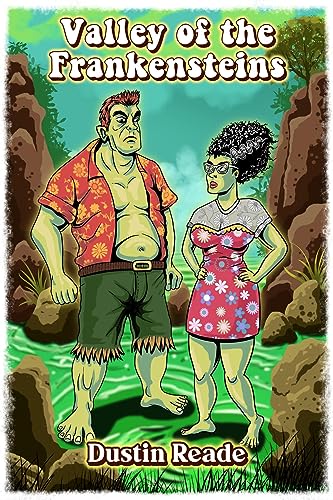
Here’s the moment when all the dead bodies and toxic sludge came together to create the titular Valley of the Frankensteins: “The rotten remains of two dozen corpses bobbed like potatoes in a stew of lime green Jello,” wrote author Dustin Reade. “Where limbs accidentally bumped against one another, they fused, shocked through with something very close to life. A chemical reaction. The fusing of RNA and DNA and melted plastics and medical byproducts.”

Reade continued: “Severed heads fluttered their eyes open, seeing milky white ribbons of liquid latex and petroleum go by as the desiccated remains of a human torso floated by in search of a new way of thinking. An arm here. A leg there. Not in any normal order. Not in any way that made sense, but it was something new. It was twenty-four monsters being born in an ocean of filth.”

A quick note here: Don’t judge a book by its cover, especially in this case. The Frankenstein monsters in Reade’s latest effort don’t look anything like goofy caricatures of Boris Karloff and Elsa Lanchester in resort wear. One day (I’m sure) someone will write a novel about Frankenstein and his bride taking a Carnival Cruise to Club Med, but that day has yet to come. 

Instead, Reade uses the phrase “Frankenstein monsters” to connote a secondary meaning. They were creatures of unnatural origins. Said the author: “They were poorly put-together people, a madhouse of wrecked humanity—their flesh a bubbling, pestilent cauldron of pollution and rot.”

They had multiple eyes, vertical maws, tails made of human fingers, faces like starfish and numerous heads stacked on top of shoulders like a totem pole. They were swamp things, iguana people and Kiseijuu-like parasitic beasts. Each new iteration was horrible and terrific at the same time. 

Into the valley of the Frankensteins rode a disparate group of mobsters, flunkies, FBI agents and hazardous waste personnel. After surviving a sundry of bizarro challenges on their own, they eventually came together in a climax involving a thirty-foot colossal beast made of human bric-a-brac featuring one hundred legs, one thousand eyes and endless rows of teeth. All the Frankenstein monsters were great, but for me the appearance of the toxic kaiju was the topper to this funny and oddball version of Monster Fantasy Island.

[ Valley of the Frankensteins / By Dustin Reade / First Printing: August 2023 / ISBN: 9781915546397 ]

Young Vampire Blues

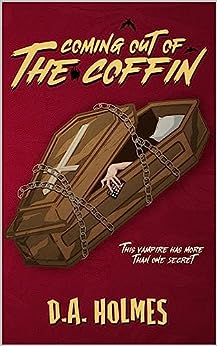
Coming Out of the Coffin is about Vladimir Radu, a 23-year-old gay vampire from New Jersey. The novel’s title is a cute pun that promises readers a funny LGBTQ+ coming-of-age story with a horror twist. And that’s exactly what author D.A. Holmes delivers.

It’s a terrific book, but I have one little quibble with the book’s premise. Vlad’s sexual angst was basically a non-issue. Vampire queerness has already been integrated into mainstream media. Was Carmilla gay? Yes. Was Dracula gay? Probably. Was every vampire in an Anne Rice novel gay? The truth was, all vampires were symbols of non-binary sexuality—they were transgender creatures of the night.

Vlad was gay, but honestly he had more pressing problems to worry about. For one thing, drinking human blood was now off his diet. No more killing, no more lurking about in the shadows. The whole vampire thing had become totally repulsive to him. 

Could a young, urban vampire like Vlad survive simply by eating popcorn and drinking soda every day? No, of course not. For a vampire or anyone else, that wasn’t a great diet. “It’s not healthy,” warned his mother. “You’ll become weaker and lose your senses. Your hunger will take over and you’ll transform into a creature of sheer carnage.” She was talking about “vampire psychosis” of course—a feral state of bloodlust that would turn Vlad into a raging superpowered monster. That’s exactly the thing he was trying to avoid. 

Vlad was also trying to avoid a gruff, hyper-masculine  vampire hunter named Lance Crosby. This guy was a hardcore nutjob. He enjoyed capturing “suckers” and letting them sizzle like bacon in the sun. Instead of smelling like a nice piece of pig meat, he noted, they generally smelled like pig shit. 

In a weird way, this was all new and exciting to Vlad. He grew up in a world of creaking mansions and old shriveled servants. His childhood was like a staid old Victorian-era novel. There had to be more to life than that, he thought. “I want to explore the world,” he told his unsupportive parents. “I want to live life as a human. Get out there. Date guys and fall in love.”

Moving out of his parents manor, getting a job, making friends and hooking up with a cute gym rat was all part of being a young independent vampire. So what if Vlad was being stalked by vampire hunters and 19th century occultists? So what if his parents didn’t approve of his new lifestyle? He wanted to experience the true misery of human life in all of its glory. Mission accomplished. 

[ Coming Out of the Coffin / By D.A. Holmes / First Printing: July 2023 / ISBN: 9798395301598 ]

Splatter Raptor

As an ex-reporter and editor, I was a little concerned that author Harrison Phillips wasn’t going to provide 5W1H information in Psychoraptor, his latest novel about a hangry velociraptor run amok onboard a luxury cruise ship. 

The FW1H writing method (or Kipling Method) stands for “Who, What, When, Where, Why and How.” It was a great way to assemble data and present it in a straightforward manner. It’s an acronym that’s familiar to all journalists, ethicists, researchers and detectives. In my opinion, it’s also an important guideline for any author working on a novel. 

I wasn’t the only one initially worried about the lack of 5W1H in Phillips’s splatter raptor novel. Characters in the book had questions too. “Where had the velociraptor come from?” Laura Michaels wondered. “How was it even possible that such a creature was still alive?” 

All of it sounded like the plot of some shitty sci-fi movie to Laura, but the dinosaur had to have come from somewhere. How had it gotten on the ship? And more importantly, did someone bring it onboard intentionally?

Phillips answers some (but not all) of these 5W1H questions, but he waits until the very last chapter to do so. Laura and the rest of the ship’s passengers must contend with the inexplicable prehistoric predator with no context beyond basic survival. 

The Royal Sapphire was an elite cruise ship with 16 decks, 4 swimming pools, 12 restaurants and over 5,000 guests and 800 crew members. The author has a lot of fun imagining what kind of chaos a velociraptor could cause in such a situation. Maintenance workers, security guards, a gaggle of children and Sammy the Shark, the ship’s goofball mascot, all have memorable and fatal encounters with the dinosaur.

All this mayhem provides ample opportunity for Phillips to flex his writing skillz. His use of simile in particular is outstanding. Like this: “His insides slithering out of him, sinking down to the bottom of the pool like a cluster of necrotic eels nesting in a cloud of blood.”

The most memorable (and horrible) scene in Psychoraptor happens during a sexual encounter between a horny steward and stewardess. The two sweethearts experience an abrupt coitus interruptus when the dinosaur bursts into their cabin. 

“Sarah held her breath as the animal cocked its head to one side,” wrote Phillips. “It was looking at her, trying to figure her out. It blinked once, pounced on top of her and bit down on her face. Its teeth puncturing her cheeks, scraping against bone. When it pulled its head away, a mask of flesh was torn from her skull.” Splayed and naked upon her bed, Sarah screamed while watching the velociraptor eat her face. 

[ Psychoraptor / By Harrison Phillips / First Printing: July 2023 / ISBN: 9798852258762 ]

The Heroes Three

Forever Lost at Sea: Ryujin Rising is a novel about three unlikely shipmates chasing a sea dragon across the Northwest Passage. Is it a good yarn? Yes, I think it is very good. 

But I have a question for authors Anghus Houvouras and Sara Hutchins: Who is the hero of your story? I’m curious. Is it Charles Wickham, a small town reporter looking for a big front-page byline? Is it Hideo, the Japanese monster hunter who kinda looks like a monster himself? Or maybe it’s Bess Riley, the young proto-feminist sailor? 

According to mythologist Joseph Campbell, a hero in literature is a character who experiences a challenging adventure that ends with a victorious homecoming. Heroes usually act at the behest of fate and divine forces, but ultimately their journey is all about self-discovery and self-development. Using this simple definition, I’d argue that all three mariners are the heroes of the story.

Wickham, for one, is introduced as a wealthy English dandy who has no experience IRL. For most of the novel, he is simply an ineffectual naif. Little did he know that his journey across the Canadian Arctic Archipelago would give him hero status. 

And Bess Riley is a young woman raised along the California coast. At the beginning of the story, she’s just a local fisherwoman with no prospects for the future. Joining the hunt for Eisendrachen the Destroyer gives her options. She dreams of getting her own ship and being the first female whaling captain. (Note: whale hunting was legal in the U.S. at the time of this novel.)

As a character with a unique origin story and a well-defined quest, Hideo is the presumptive and natural hero. Unlike Charles and Bess, he clearly understands his destiny. Hideo is a hunter who must kill the ryujin—he doesn’t have a choice, he is the chosen warrior.  

The creature itself is the size of multiple whales with teeth like daggers (or maybe arrows). “It looked like a dragon, or some other monster straight out of the pages of a book of myths and fables.” 

As fearsome as it is, however, the sea monster’s behavior is a bit puzzling. Even though it kills with abandon and without mercy, it allows the heroes three to escape its clutches multiple times. 

Hideo thinks he knows why. Like himself, the creature adheres to an ineffable universal hunter’s code. “We are the same,” he explains. “Hunters locked in combat, both existing only to vanquish the other.”

[ Forever Lost at Sea: Ryujin Rising / By Anghus Houvouras & Sarah Hutchins / First Printing: July 2023 / ISBN: 9781922861771 ]

Cinéma Goblin

Gothic cinema is hard to define. Certainly there’s an existing iconographic tradition that encourages castles, ghosts and bad weather, but there aren’t any hoary plot points to direct storytellers. In fact, the plot isn’t even important according to Renee Balcombe, the producer of the indie gothic horror flick at the heart of Jonathan Raab’s latest novel. “Atmosphere is all that matters, tone and color. Vibe over verisimilitude,” she says.

Gothic horror is an expression of anxiety-ridden id, continues Balcombe. “What we’re trying to do,” she explains, “is produce an extended mood piece punctuated by thrilling, decadent explosions of color, fog, practical effects and blood. Plot is for brain-dead YouTube film critics pointing out logical inconsistencies in works that operate beyond logic.”

Most importantly for Balcombe and her crew, Hierarchies of Blood is a movie that’s attempting to capture the physical world and the spiritual world on 35mm film stock. It’s been done before, of course, films made in concert with occult and supernatural forces. They call it Cinéma Goblin.

That’s why the film crew (consisting of a small group of theater kids and art weirdoes) sets up camp deep in the woods of New York’s Fingers Lake region. The area reportedly has a connection to otherworldly forces and is arguably the most gothic place in the U.S. “Proximity to certain elements can alter things,” says Balcombe. “Reality itself becomes more pliable. Magic—real magic—is easier to perform.” In other words, it’s the perfect place to receive transmissions from the goblin world

And that’s exactly what happens. The filmmakers rouse an ancient vampire and his monster minions, and find themselves fighting a nightly battle in multiple realities. Their weapons of choice include wooden stakes, holy water, movie cameras, tape recorders and Tungsten flood lights. 

Interspersed throughout the monster mayhem is a lot of jibber-jabber about the power and influence of cinema. None of it is unwelcome because Raab’s enthusiasm for his subject is articulate and never-waning. Filmmakers are masters of manipulating light, sound and shadow, he says. Imagine what kind of movie they could make if they went beyond the simple tools they’ve been using for a hundred years. Cinéma Fantastique is that idea. An evolution of the art by harnessing forces that predate Auguste and Louis Lumière, that predate modernity. 

For added insight into their situation, the production crew occasionally hunker down to smoke cosmic cannabis and watch Cinéma Goblin in the basement of an abandoned castle. Raab’s account of these movies is first-rate. “This is how the spell is cast,” he says. “This is how we remake the world.”

[ Project Vampire Killer / By Jonathan Raab / First Printing: June 2023 / ISBN: 9798987968802 ]

The Duchess and Duke of Death

Darla Drake, a.k.a. the Duchess of Death, was both majestic and frightening. Her innate beauty would not make her look out of place sitting atop a gilded throne; her innate monstrosity would not make her look out of place sitting atop a pile of bones. 

Also known as the Duchess of Dismemberment, Darla had been terrorizing the counselors of Camp Clear Creek for 20 years and was a living legend. Up until recently she loved being a monster and being feared by humans. Stories had been written about her (mostly fan fiction) and there was even a Netflix movie. “Everybody in the world knew who Darla Drake was,” said Gretl the Gobbler, “But did she know who she was?”

That was the big existential question Darla was struggling with. Doing unspeakable things to unsavory people no longer fulfilled her. She was in a funk. “I just want something else,” said the mopey monster, “I want something more.” Like Peggy Lee, she wondered “is that all there is?”

Darla wasn’t getting any sympathy from her family and friends. “You want something else?” asked her mother incredulously. “We’re monsters, for goodness sakes. We scare. We stalk. We hunt.” Her best friend Gretl agreed. “Keep doing what you’re meant to do—make crusty teenagers pee themselves before tearing off their limbs.”

After two decades of jump scares, life had become routine for the Duchess of Death. Maybe she needed a distraction? Or maybe a new challenge? She got both when Jarko Murkvale (great name btw) came to her hometown.  

Jarko was some sort of octopus-human creature looking for a new place to call home. Monsters were generally territorial, and Darla wasn’t happy when she saw the interloper terrorizing kids at a nearby sleepaway camp. Worst of all, she was kind of blinded by the octopus guy’s charisma. Said author Jason Pinter: “Darla hated herself for even thinking it, but Jarko was … kind of hot?”

As it turned out, Jarko thought Darla was kind of hot too. Instead of getting into a big monster fight, the rivals fell into a big-hearted monster romance. Their unlikely love affair was funny too. Really funny. I didn’t generate an Excel spreadsheet to keep track of all the laughs, but I think there was at least one joke on every page.

The pair’s relationship was a little rocky at first—they were two different monsters with two different ways of frightening people. Said Darla to her new boyfriend: “I have my methods and you have yours. My methods are like a knife’s edge, delicate and refined. Yours are like a bunch of tentacles flailing around like an octopus caught in a blender.”

Despite their differences, however, the two lovebirds eventually found a way to coexist. Jarko helped Darla resolve her lingering identity crisis, and as a couple they became infamous as the Duchess and Duke of Death. It was a monster match made in Hell. 

[ Dating & Dismemberment / By Jason Pinter writing as A.L. Brody / First Printing: June 2023 / ISBN: 9798988386902 ]

The Ozark Howler

A few years ago, Carter Renfrow shot a man in Memphis just to watch him die. But instead of being arrested and sent to Folsom Prison, he successfully evaded the police. He became a drifter and lived his life in the margins of society. 

Covid-19 was a big help for him. Wearing a gaiter mask was useful to a criminal who wanted to stay anonymous. And since everyone else was basically stuck at home during the pandemic watching TV all day, it was easy for Carter to move silently from town to town without raising any suspicions. 

That all changed dramatically one night when he was ensnarled in a multi-car pileup while driving through the Boston Mountains of Arkansas. With no way off the mountain and EMS vehicles arriving shortly, Carter knew his life as a free man was about to end.  

The author spends a big chunk of time describing the details of the car crash. In doing so, he brings together four of his five main characters: Carter, along with a young women named Aniyah, a little girl named Stacey and a creep named Jed who thought he was Kraven the Hunter. 

The fifth member of the cast came along shortly after the crash—a 15-foot-tall cryptid known colloquially as the Ozark Howler. It was a bear-cat-dog bipedal beast that moved with the “fluidity of water separating from the shadows of the forest like a building storm.” It was an apex killing machine not of this time or world, explained Jed. “It was magnificent.”

The highway crackup occurred along the Borderland Pass, a desolate section of the Ozarks featuring nothing but trees, rolling mountains and the animals who dared call the place home. According to Native legends, the area was prime Howler territory. Ancient Caddo and Quapaw tribes had unsuccessfully tangled with the wendigo-like monster—as did Mayans, Spanish conquistadors and white settlers. In time, the Borderland Pass was simply abandoned and became a no man’s land. 

But now it was time for the Howler to come out of hiding. The crash site provided a delicious all-you-can-eat buffet for a beast that was probably tired of munching on muskrats all day. The sounds of bone gnashing and gurgled laughing filled the air. 

Carter, Jed, Aniyah and Stacey flee into the nearby woods hotly pursued by the hungry Howler. This is when Tragic (the latest effort from author Edward J. McFadden III) turns into a 72-hour slow motion tragedy. Spoiler alert: there’s more than one monster roaming the Ozark Mountains. 

Indeed, McFadden’s novel is a slow ride that takes time to build up speed. The reader spends an awfully long time amidst the highway rubble. Maybe too long, I don’t know. But trust me, the Howler is a nasty creature—you’ll be glad you stuck around for the crazy ending.

And speaking of endings, this one has a prescient one. After the happy (unhappy) finale, a family of Howlers huddles together by the side of the Borderland Pass. They sit in silence, birds flitting around them, the hum of the highway carrying through the forest. “They waited,” wrote McFadden with a hint of foreboding. 

[ Tragic / By Edward J. McFadden III / First Printing: June 2023 / ISBN: 9781922861731 ]